
Difenidol
- CAS NO.:972-02-1
- Empirical Formula: C21H27NO
- Molecular Weight: 309.45
- MDL number: MFCD00057378
- EINECS: 213-540-9
- SAFETY DATA SHEET (SDS)
- Update Date: 2026-05-28 04:11:01
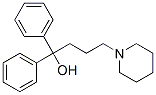
What is Difenidol?
Absorption
Well absorbed from gastrointestinal tract following oral administration.
Toxicity
Symptoms of overdose include drowsiness (severe); shortness of breath or troubled breathing; unusual tiredness or weakness (severe).
Originator
Vontrol,SKF,US,1967
The Uses of Difenidol
Anti-emetic.
Background
Diphenidol is an antiemetic agent used in the treatment of vomiting and vertigo. Diphenidol overdose may result in serious toxicity in children.
Indications
For use in the prevention and symptomatic treatment of peripheral (labyrinthine) vertigo and associated nausea and vomiting that occur in such conditions as Meniere's disease and surgery of the middle and inner ear. Also for the control of nausea and vomiting associated with postoperative states, malignant neoplasms, labyrinthine disturbances, antineoplastic agent therapy, radiation sickness, and infectious diseases.
Definition
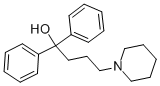
ChEBI: A tertiary alcohol that is butan-1-ol substituted by two phenyl groups at position 1 and a piperidin-1-yl group at position 4.
Manufacturing Process
2.6 grams magnesium, activated by means of iodine, is introduced into 20 cc
of absolute ether and is caused to react with 0.6 cc of ethyl
omide. While
warming gently, 16.2 grams (0.1 mol) of N-[1-chloropropyl-(3)]-piperidine in
40 cc of absolute ether are added and, after adding a further 0.5 cc of ethyl
omide, 14.5 grams (0.08 mol) of benzophenone in 50 cc of anhydrous ether
are added in portions. The magnesium is used up fairly quickly and, after 10
hours, only traces are left. In working up, both with hydrochloric acid and with
ammonium chloride, the hydrochloride of diphenyl-3-piperidinopropyl carbinol
is precipitated as a dense precipitate. It is purified by recrystallization from
chloroform-ethyl acetate. MP 212-214°C.
Therapeutic Function
Antinauseant
Trade name
Vontrol (Smith Kline & French), Cephadol (Nippon Shinyaku).
Pharmacokinetics
Diphenidol is used for control of nausea and vomiting. It has an antivertigo effect on the vestibular apparatus, inhibiting the chemoreceptor trigger zone to control nausea and vomiting, thus preventing motion sickness.
Metabolism
Not Available
Properties of Difenidol
| Melting point: | 104-105° |
| Boiling point: | 449.71°C (rough estimate) |
| Density | 1.0350 (rough estimate) |
| refractive index | 1.5614 (estimate) |
| NIST Chemistry Reference | Diphenidol(972-02-1) |
Safety information for Difenidol
Computed Descriptors for Difenidol
New Products
Cyclobutanone (R)-(-)-2-Amino-1-propanol Fmoc-OSu 5-bromo-4-fluoro-2-nitrobenzaldehyde 2-Amino-2-(4-methylphenyl)acetic acid 1-(2-Chloroethyl)pyrrolidine Hydrochloride 2,4-Dihydroxybenzaldehyde Obidoxime hydrochloride API Pyrrolo[1,2-a]pyrimidine-6-carboxylic acid, 4,6,7,8-tetrahydro-4-oxo-, sodium salt (1:1), (6S) Dipropyl disulfide N-Vinylformamide 4 pentyn 1 ol Methacrylate-PEG-Methacrylate, Mn:35000 2,4-Dihydroxyacetophenone 2-Chloro 5-Fluoro Pyridine Vasicinone 2-Chloroisonicotinic Acid Tween 80 or Polysorbate 80 2-Butyn-1-oL N-(4-fluoro-2-methoxy-5-nitrophenyl)-4-(1-methyl-1H-indol-3-yl)pyrimidin-2-amine Pirtobrutinib intd. 2-Pentyn-1-oL 4-Nitrobenzotrifluoride N-(4-Cyano-3-(trifluoromethyl)phenyl)-2-methyloxirane-2-carboxamideRelated products of tetrahydrofuran
You may like
-
 7250-67-1 1-(2-Chloroethyl)pyrrolidine Hydrochloride 98+View Details
7250-67-1 -
13227-01-5 98+View Details
13227-01-5 -
7250-67-1 1-(2-Chloroethyl)pyrrolidine Hydrochloride 98+View Details
7250-67-1 -
13227-01-5 98+View Details
13227-01-5 -
545445-44-1 3-Morpholino-1-(4-(2-oxopiperidin-1-yl) phenyl)-5,6-dihyropyridin-2-(1H)-one 98%View Details
545445-44-1 -
6629-04-5 98%View Details
6629-04-5 -
4-(4-Αminophenyl)-3-Morpholinone 98%View Details
438056-69-0 -
1-(4-Aminophenyl)-3-morpholino-5,6-dihydropyridin-2(1H)-one 1267610-26-3 98%View Details
1267610-26-3