
1,6-Bis(cyclohexyloximinocarbonylamino)hexane
Synonym(s):1,6- bis(Cyclohexyloximinocarbonylamino)hexane;1,6-bis(Cyclohexyloximinocarbonylamino)hexane;RHC-80267 - CAS 83654-05-1 - Calbiochem;U 57908
- CAS NO.:83654-05-1
- Empirical Formula: C20H34N4O4
- Molecular Weight: 394.52
- MDL number: MFCD00210844
- SAFETY DATA SHEET (SDS)
- Update Date: 2026-09-12 18:56:33
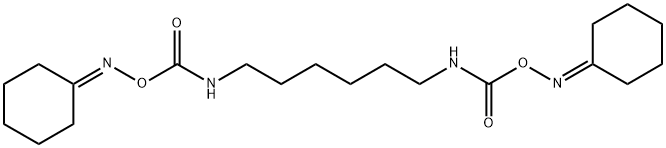
What is 1,6-Bis(cyclohexyloximinocarbonylamino)hexane?
Description
RHC-80267 (83654-05-1) inhibits DAG Lipase activity in a variety of cell types and tissues, including canine platelets, bovine adrenal chromaffin cells, human adrenal glomerulosa cells, rat thyroid lobes and pancreatic minilobules. IC50 in canine platelets is 4 μM.1
The Uses of 1,6-Bis(cyclohexyloximinocarbonylamino)hexane
RHC-80267 is a selective inhibitor of DAG lipase, which plays an important role in the production of arachidonic acid.
What are the applications of Application
RHC-80267 is a selective inhibitor of DAG lipase and PKC activator
Definition
ChEBI: N-[6-[[(cyclohexylideneamino)oxy-oxomethyl]amino]hexyl]carbamic acid (cyclohexylideneamino) ester is a carbamate ester and an organonitrogen compound.
General Description
Selective inhibitor of DAG lipase activity in canine platelets (IC50 = 4 nM) and in a variety of mammalian cells. Also inhibits glucose- and carbachol-induced insulin release from intact islets. An inhibitor of Angiotensin II (Cat. No. 05-23-0101) and ATP-induced synthesis of 6-keto-prostaglandin F1α.
Biological Activity
Inhibitor of diacylglycerol lipase (IC 50 values are 1.1 and 4 μ M in rat cardiac myocytes and canine platelets respectively). Weakly inhibits phospholipases C and A 2 . Potentiates acetylcholine evoked relaxation in mesenteric arteries by the inhibition of cholinesterase activity (IC 50 = 4 μ M).
Biochem/physiol Actions
Product does not compete with ATP.
Storage
Store at +4°C
References
1) Southerland and Amin (1982), Anthranilic acid amides: a novel class of antiangiogenic VEGF receptor kinase inhibitors; J. Biol. Chem., 257 14006 2) Rindlisbacher et al. (1990), Advances in the structural biology, design and clinical development of VEGF-R kinase inhibitors for the treatment of angiogenesis; J. Neurochem., 54 1247 3) Chandra Sekar et al. (1987), Anthranilic acid amides: a novel class of antiangiogenic VEGF receptor kinase inhibitors; Arch. Biochem. Biophys., 256 509 4) Levasseur et al. (1984), Advances in the structural biology, design and clinical development of VEGF-R kinase inhibitors for the treatment of angiogenesis; Prostaglandins, 27 673 5) Natarajan et al. (1988), Anthranilic acid amides: a novel class of antiangiogenic VEGF receptor kinase inhibitors; Biochem. Biophys. Res. Commun., 156 717
Properties of 1,6-Bis(cyclohexyloximinocarbonylamino)hexane
| Melting point: | 118-121℃ |
| Density | 1.21±0.1 g/cm3(Predicted) |
| RTECS | GW1485000 |
| storage temp. | Sealed in dry,Room Temperature |
| solubility | DMSO: 9 mg/mL |
| form | solid |
| pka | 13.81±0.46(Predicted) |
| color | white |
| Stability: | Stable for 2 years from date of purchase as supplied. Solutions in DMSO or ethanol may be stored at -20°C for up to 3 months |
Safety information for 1,6-Bis(cyclohexyloximinocarbonylamino)hexane
| Signal word | Warning |
| Pictogram(s) |
 Exclamation Mark Irritant GHS07 |
| GHS Hazard Statements |
H302:Acute toxicity,oral H315:Skin corrosion/irritation H319:Serious eye damage/eye irritation H335:Specific target organ toxicity, single exposure;Respiratory tract irritation |
| Precautionary Statement Codes |
P261:Avoid breathing dust/fume/gas/mist/vapours/spray. P305+P351+P338:IF IN EYES: Rinse cautiously with water for several minutes. Remove contact lenses, if present and easy to do. Continuerinsing. |
Computed Descriptors for 1,6-Bis(cyclohexyloximinocarbonylamino)hexane
New Products
5-bromo-4-fluoro-2-nitrobenzaldehyde (R)-(-)-2-Amino-1-propanol Cyclobutanone Fmoc-OSu 1-(2-Chloroethyl)pyrrolidine Hydrochloride 2-Amino-2-(4-methylphenyl)acetic acid β-Bromostyrene Ethyl 3-phenylpropanoate Phenethyl cinnamate Dipropyl disulfide 4 pentyn 1 ol N-Vinylformamide Methacrylate-PEG-Methacrylate, Mn:35000 2,4-Dihydroxyacetophenone 2-Chloro 5-Fluoro Pyridine Vasicinone 2-Chloroisonicotinic Acid Tween 80 or Polysorbate 80 2-Butyn-1-oL 2-Pentyn-1-oL 4-Nitrobenzotrifluoride N-(4-fluoro-2-methoxy-5-nitrophenyl)-4-(1-methyl-1H-indol-3-yl)pyrimidin-2-amine Pirtobrutinib intd. N-(4-Cyano-3-(trifluoromethyl)phenyl)-2-methyloxirane-2-carboxamideRelated products of tetrahydrofuran
![(E)-3-[[[3-[2-(7-CHLORO-2-QUINOLINYL)ETHENYL]PHENYL]-[[(3-DIMETHYLAMINO)-3-OXOPROPYL]THIO]METHYL]THIO]-PROPANOIC ACID, SODIUM SALT](https://img.chemicalbook.in/CAS/GIF/115104-28-4.gif)

You may like
-
 RHC 80267 CAS 83654-05-1View Details
83654-05-1 -
RHC-80267 CAS 83654-05-1View Details
83654-05-1 -
7250-67-1 1-(2-Chloroethyl)pyrrolidine Hydrochloride 98+View Details
7250-67-1 -
13227-01-5 98+View Details
13227-01-5 -
7250-67-1 1-(2-Chloroethyl)pyrrolidine Hydrochloride 98+View Details
7250-67-1 -
13227-01-5 98+View Details
13227-01-5 -
7250-67-1 1-(2-Chloroethyl)pyrrolidine Hydrochloride 98+View Details
7250-67-1 -
13227-01-5 98+View Details
13227-01-5