
TRYPSINOGEN
- CAS NO.:9002-08-8
- Empirical Formula: C39H55N9O17
- Molecular Weight: 921.9
- MDL number: MFCD00466939
- EINECS: 232-651-3
- SAFETY DATA SHEET (SDS)
- Update Date: 2026-05-28 06:07:20
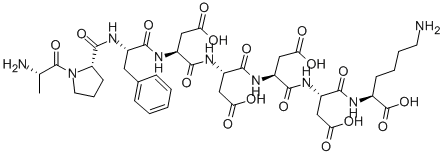
What is TRYPSINOGEN?
The Uses of TRYPSINOGEN
Trypsinogen from bovine pancreas is suitable for use in:
- the secondary structure analysis of proteins in H2O solution using single-pass attenuated total reflection Fourier transform infrared (ATR-FT-IR) microscopy
- tuning and calibration of electrospray ionization quadrupole time-of-flight (ESI-Q-TOF) mass spectrometer
- the secondary structure analysis of proteins by infrared (IR) spectroscopy
- SDS-PAGE as a molecular weight standard (24kDa)
General Description
Trypsinogen is a proenzyme (zymogen) that is activated to form trypsin. It is synthesized in the pancreas and activated by enterokinase once it reaches the lumen of the small intestine. Bovine trypsinogen is a single polypeptide chain of 229 amino acids that is cross linked by six disulfide bridges. Enterokinase cleaves a hexapeptide to from the NH2 terminus of trypsinogen at the Lys6 - Ile7 peptide bond and activates it. Trypsin, thus formed, autocatalytically activates more trypsinogen to trypsin. This native form of trypsin is called β-trypsin, which undergoes autolysis at Lys131 - Ser132 resulting in α-trypsin that is held together by disulfide bridges. Trypsin is a serine protease with His46 and Ser183 at the active site. The pH optimum of trypsin is 7 - 9.
Biochem/physiol Actions
Hereditary pancreatitis was shown to be caused by a Arg-His substitution at residue 117 of trypsinogen causing auto-activation of trypsinogen to trypsin.
Properties of TRYPSINOGEN
| storage temp. | 2-8°C |
| form | essentially salt-free, lyophilized powder |
Safety information for TRYPSINOGEN
| Signal word | Danger |
| Pictogram(s) |
 Health Hazard GHS08 |
| GHS Hazard Statements |
H315:Skin corrosion/irritation H319:Serious eye damage/eye irritation H334:Sensitisation, respiratory |
| Precautionary Statement Codes |
P302+P352:IF ON SKIN: wash with plenty of soap and water. P305+P351+P338:IF IN EYES: Rinse cautiously with water for several minutes. Remove contact lenses, if present and easy to do. Continuerinsing. |
Computed Descriptors for TRYPSINOGEN
New Products
N-Carbethoxy-4-piperidone 1-Aminocyclopentane carbonitrile Tetrabutylammonium perchlorate N,O-Dimethylhydroxylamine hydrochloride (RS)-beta-Amino-beta-(4-bromophenyl)propionic acid 2-Amino-5-bromo-4-(trifluoromethyl)pyridine N-Vinylformamide 4 pentyn 1 ol Phenethyl cinnamate Dipropyl disulfide Ethyl 3-phenylpropanoate β-Bromostyrene Methacrylate-PEG-Methacrylate, Mn:35000 2,4-Dihydroxyacetophenone 2-Chloro 5-Fluoro Pyridine Vasicinone 2-Chloroisonicotinic Acid Tween 80 or Polysorbate 80 5-Bromo-1-Pentyne 1-(2-Methyl-5-nitrophenyl)guanidine Nitrate Methyl trans-4-Aminocyclohexanecarboxylate Hydrochloride N-(4-Cyano-3-(trifluoromethyl)phenyl)-2-methyloxirane-2-carboxamide 2-Pentyn-1-oL 4-NitrobenzotrifluorideRelated products of tetrahydrofuran

You may like
-
 Trypsinogen from bovine pancreas CAS 9002-08-8View Details
9002-08-8 -
Trypsinogen, PMSF treated from bovine pancreas CAS 9002-08-8View Details
9002-08-8 -
144-83-2 Sulfapyridine 98+View Details
144-83-2 -
29976-53-2 98+View Details
29976-53-2 -
6638-79-5 N,O-Dimethylhydroxylamine hydrochloride 98+View Details
6638-79-5 -
674783-97-2 98+View Details
674783-97-2 -
1-Aminocyclopentane carbonitrile 98+View Details
49830-37-7 -
Tetrabutylammonium perchlorate 1923-70-2 98+View Details
1923-70-2