
thonzylamine hydrochloride
- CAS NO.:63-56-9
- Empirical Formula: C16H22N4O.ClH
- Molecular Weight: 322.84
- MDL number: MFCD00058195
- EINECS: 2005613
- SAFETY DATA SHEET (SDS)
- Update Date: 2026-06-24 18:39:39
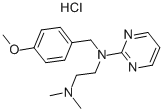
What is thonzylamine hydrochloride?
Chemical properties
White, crystalline powder; faint odor. Very soluble in water; freely soluble in alcohol and chloroform; practically insoluble in ether and benzene; pH 5.0–6.0 (2% solution).
Originator
Neohetramine,Warner Lambert,US,1948
The Uses of thonzylamine hydrochloride
Medicine (antihistamine).
Definition
ChEBI: Thonzylamine hydrochloride is a member of methoxybenzenes.
Manufacturing Process
54 g of 2-(p-methoxybenzyl)aminopyrimidine and 12.0 g of sodamide were suspended in 250 cc of toluene and were refluxed for 31 hours. To the thus prepared sodium salt of 2-(p-methoxybenzyl)aminopyrimidine, 28.1 g of dimethylaminoethyl chloride were added and refluxed under continuous stirring for 26 hours. After cooling, the reaction mixture was extracted with dilute hydrochloric acid at about pH 5.0, removing the product thus formed containing only very little of the unreacted 2-(p_x0002_methoxybenzyl)aminopyrimidine. This solution was then made alkaline to liberate the free base of the product, which was extracted with ether. The ether solution was evaporated and the residue vacuum distilled. The product, 2-(p-methoxybenzyl-dimethylaminoethyl)aminopyrimidine forms an oily liquid, boiling point 185°C to 187°C at 2.2 mm.
Therapeutic Function
Antihistaminic
General Description
White crystalline powder with a faint odor . pH: 5.1-5.7 (2 % aqueous solution).
General Description
Thonzylamine hydrochloride,2-[[2-(dimethylamino)-ethyl](p-methoxybenzyl)amino]pyrimidine hydrochloride, is a white crystallinepowder soluble in water (1:1), in alcohol (1:6), and in chloroform(1:4). A 2% aqueous solution has a pH of 5.5. It is similar in activity to tripelennamine but is claimed to be lesstoxic. The usual dose is 50 mg taken up to 4 times daily. Itis available in certain combination products.
Air & Water Reactions
Water soluble.
Reactivity Profile
thonzylamine hydrochloride behaves as a weak organic acid. Materials in this group are generally soluble in water. The resulting solutions contain moderate concentrations of hydrogen ions and have pH's of less than 7.0. They react as acids to neutralize bases. These neutralizations generate heat, but less or far less than is generated by neutralization of inorganic acids, inorganic oxoacids, and carboxylic acid. They usually do not react as either oxidizing agents or reducing agents but such behavior is not impossible.
Health Hazard
SYMPTOMS: Symptoms of exposure to thonzylamine hydrochloride may include drowsiness, lethargy, fatigue, hypnosis, coma, vertigo, ataxia, tinnitus, blurred vision, tremors, anxiety, insomnia, excitement, hallucinations, delirium, convulsions, dry mouth, anorexia, nausea, vomiting, abdominal distress, constipation, diarrhea, central nervous system depression, gastrointestinal reactions, respiratory arrest and circulatory collapse.
Fire Hazard
Flash point data for thonzylamine hydrochloride are not available. thonzylamine hydrochloride is probably combustible.
Properties of thonzylamine hydrochloride
| Melting point: | 173-176° |
| Boiling point: | bp2.2 185-187° |
| Density | 1.2562 (rough estimate) |
| refractive index | 1.5800 (estimate) |
| Stability: | Stable. Incompatible with strong oxidizing agents. |
| EPA Substance Registry System | Thonzylamine hydrochloride (63-56-9) |
Safety information for thonzylamine hydrochloride
Computed Descriptors for thonzylamine hydrochloride
New Products
N-Carbethoxy-4-piperidone 1-Aminocyclopentane carbonitrile Tetrabutylammonium perchlorate N,O-Dimethylhydroxylamine hydrochloride (RS)-beta-Amino-beta-(4-bromophenyl)propionic acid 2-Amino-5-bromo-4-(trifluoromethyl)pyridine N-Vinylformamide 4 pentyn 1 ol Phenethyl cinnamate Dipropyl disulfide Ethyl 3-phenylpropanoate β-Bromostyrene Methacrylate-PEG-Methacrylate, Mn:35000 2,4-Dihydroxyacetophenone 2-Chloro 5-Fluoro Pyridine Vasicinone 2-Chloroisonicotinic Acid Tween 80 or Polysorbate 80 5-Bromo-1-Pentyne 1-(2-Methyl-5-nitrophenyl)guanidine Nitrate Methyl trans-4-Aminocyclohexanecarboxylate Hydrochloride N-(4-Cyano-3-(trifluoromethyl)phenyl)-2-methyloxirane-2-carboxamide 2-Pentyn-1-oL 4-NitrobenzotrifluorideRelated products of tetrahydrofuran
![N-[(4-methoxyphenyl)methyl]pyrimidin-2-amine](https://img.chemicalbook.in/CAS/GIF/6957-21-7.gif)

![[[(2-aminoethyl)amino]methyl]phenol](https://img.chemicalbook.in/CAS/GIF/53894-28-3.gif)
You may like
-
 144-83-2 Sulfapyridine 98+View Details
144-83-2 -
29976-53-2 98+View Details
29976-53-2 -
2-Amino-5-bromo-4-(trifluoromethyl)pyridine 98+View Details
944401-56-3 -
(RS)-beta-Amino-beta-(4-bromophenyl)propionic acid 39773-47-2 98+View Details
39773-47-2 -
6638-79-5 N,O-Dimethylhydroxylamine hydrochloride 98+View Details
6638-79-5 -
674783-97-2 98+View Details
674783-97-2 -
1-Aminocyclopentane carbonitrile 98+View Details
49830-37-7 -
Tetrabutylammonium perchlorate 1923-70-2 98+View Details
1923-70-2