
Thiopental Sodium
- CAS NO.:71-73-8
- Empirical Formula: C11H17N2NaO2S
- Molecular Weight: 264.32
- MDL number: MFCD00072013
- EINECS: 200-763-1
- SAFETY DATA SHEET (SDS)
- Update Date: 2026-06-08 13:56:01
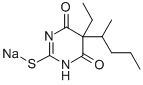
What is Thiopental Sodium?
Description
Sodium thiopental, trade name Sodium Pentothal (among others), is a general anesthetic that acts quickly but only for a short time. The preparation of this member of the barbiturate family of anesthetics was first described in 1939 in a US patent to Abbott Laboratories.
One advantage of sodium thiopental is that it can be used in surgery for pregnant mothers with no effect on the fetus. It has been a useful tool in psychiatry as a "truth serum", which has also given it notoriety in fiction and film.
In addition to its beneficial use in medical anesthesia, sodium thiopental was formerly used as the first drug in a three-drug lethal injection series. This use was discontinued de facto when Hospira, the only US manufacturer, stopped making it, and the European Union banned exporting it for death penalty purposes.
The discontinuation of sodium pentothal for lethal injections followed the same path as that of pentobarbital and midazolam, previous Molecules of the Week. All three drugs were originally developed as anesthetics; however, after they became ingredients of lethal injection "cocktails", governments and manufacturers denied their use for this purpose. In 2015, J. E. Stern wrote an excellent account in The Atlantic of how the absence of these drugs led to botched executions in the United States.
Description
Thiopental sodium , the sodium salt of 5-ethyl-5-(1-methylbutyl)thiobarbituric acid, a yellowish-white, crystalline, slightly bitter powder, is very soluble in water and soluble in alcohol. The compound is hygroscopic and has a weak unpleasant odor. The free acid forms colorless crystals, mp 158 – 159 ?C.A10%solution of the sodium salt has a pH of 10.6.
Chemical properties
Yellowish-white, hygroscopic powder.
The Uses of Thiopental Sodium
Pentothal (Abbott).
Definition
A rapidly acting barbiturate administered intravenously for general anesthesia and hypnosis. Commonly known as “truth serum.”
brand name
Thiopental is BAN.
Hazard
May cause respiratory failure; use onlywith physician in attendance.
Pharmacokinetics
Thiopental is highly bound to albumin, and free drug availability is increased in hypoproteinaemia. Protein binding is decreased by alkalaemia, hyperventilation and some drugs that occupy the same albumin binding sites, thereby increasing unbound thiopental concentrations. Metabolism occurs predominantly in the liver, and the metabolites are excreted by the kidneys. Only a small proportion is excreted unchanged in the urine. The terminal elimination half-life is approximately 11.5h (longer in the elderly). Elimination after an infusion is a zero-order process with 10%–15% of the remaining drug metabolised each hour. Up to 30% of the original dose may remain in the body at 24h, and a hangover effect is common. Accumulation may result if further doses of thiopental are administered within 1–2 days.
Clinical Use
Thiopental sodium is a short-acting intravenous anesthetic used for brief surgical procedures and induction of anesthesia. It is a potent,rapidly effective hypnotic. Sleep ensues within 30 – 60 s. A disadvantage is the lengthy hangover. In the United States and Great Britain it is the most widely used injection anesthetic. Abuse can lead to addiction.
Safety Profile
Poison by ingestion, intraperitoneal, rectal, subcutaneous, and intravenous routes. Human systemic effects by intraarterial route: acute arterial occlusion; by rectal route: respiratory depression, body temperature decrease, general anesthetic. An experimental teratogen. Experimental reproductive effects. An intravenous anesthetic. When heated to decomposition it emits toxic fumes of NO, and Na2O. See also PENTOTHAL and BARBITURATES
Veterinary Drugs and Treatments
Because of its rapid action and short duration, in young, healthy animals, thiopental is excellent induction agent (rapid IV bolus) for general anesthesia with other anesthetics or as the sole anesthetic agent for very short procedures. In sick or debilitated animals, thiopental may be used in a more cautious manner (IV, slowly to effect).
Properties of Thiopental Sodium
| solubility | H2O: >10 mg/mL |
| color | Yellowish hygroscopic powder |
| EPA Substance Registry System | Thiopental sodium (71-73-8) |
Safety information for Thiopental Sodium
Computed Descriptors for Thiopental Sodium
Thiopental Sodium manufacturer
New Products
2-(2-Chlorophenyl)glycine Propiolic Acid 1-(3-Hydroxy-4-methoxyphenyl)-2-nitroethene (±)-amino(2-fluorophenyl)acetic acid trans-3-Benzyloxy-4-methoxy-beta-nitrostyrene 1-Pentadecanol 2,4-Dihydroxybenzaldehyde Dipropyl disulfide Pyrrolo[1,2-a]pyrimidine-6-carboxylic acid, 4,6,7,8-tetrahydro-4-oxo-, sodium salt (1:1), (6S) Obidoxime hydrochloride API 4 pentyn 1 ol N-Vinylformamide Methacrylate-PEG-Methacrylate, Mn:35000 2,4-Dihydroxyacetophenone 2-Chloro 5-Fluoro Pyridine Vasicinone 2-Chloroisonicotinic Acid Tween 80 or Polysorbate 80 2-Butyn-1-oL N-(4-Cyano-3-(trifluoromethyl)phenyl)-2-methyloxirane-2-carboxamide N-(4-fluoro-2-methoxy-5-nitrophenyl)-4-(1-methyl-1H-indol-3-yl)pyrimidin-2-amine Pirtobrutinib intd. 2-Pentyn-1-oL 4-NitrobenzotrifluorideRelated products of tetrahydrofuran
You may like
-
 71-73-8 Thiopental sodium 98%View Details
71-73-8 -
 471-25-0 Propiolic Acid 98+View Details
471-25-0 -
84145-28-8 98+View Details
84145-28-8 -
trans-3-Benzyloxy-4-methoxy-beta-nitrostyrene 98+View Details
63909-29-5 -
2-(2-Chlorophenyl)glycine 88744-36-9 98+View Details
88744-36-9 -
40216-83-9 trans-4-Hydroxy-L-proline methyl ester hydrochloride 98+View Details
40216-83-9 -
629-76-5 98+View Details
629-76-5 -
1-(3-Hydroxy-4-methoxyphenyl)-2-nitroethene 98+View Details
39816-35-8