
Quinocetone
- CAS NO.:81810-66-4
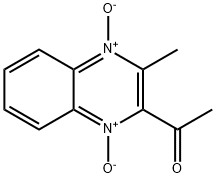
- Empirical Formula: C18H14N2O3
- Molecular Weight: 306.32
- MDL number: MFCD09753267
- EINECS: 1312995-182-4
- SAFETY DATA SHEET (SDS)
- Update Date: 2026-05-28 03:48:59
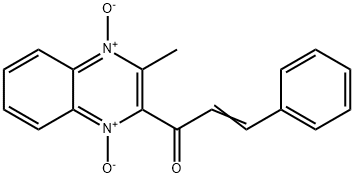
What is Quinocetone?
Description
Quinocetone is a novel veterinary chemicals that is also bacteriocide and potential anti-tumor agent.
The Uses of Quinocetone
Quinocetone can be used as analyte in analytical study for multi-residue determination of 210 drugs in pork by ultra-high-performance liquid chromatography-tandem mass spectrometry. Bacteriocide and potential anti-tumor agent.
Definition
Quinocetone is a quinoxaline-N,N-dioxide antimicrobial agent used in veterinary medicine as a feed additive for livestock, birds and fish. It is an antidiarrheal growth promotion drug developed in Lanzhou, China. Quinocetone has also been seen to induce a decline in aldosterone production from the swine adrenal glands in vivo and in vitro, and thus cause hypovolemia, hyponatremia and hyperkalemia. The compound is under investigation for potential benefits against aldosterone dysmetabolism disease via the reduction of aldosterone production in adrenal and/or the cardiovascular tissues. This may provide a new option in the therapy for aldosterone dysmetabolism disease, especially in the cardiovascular system.
Biological Activity
Quinocetone is a potent synthetic antimicrobial agent that is used for improving the feed efficiency and controlling dysentery in food-producing animals.
Properties of Quinocetone
| Melting point: | 183-188 °C |
| Boiling point: | 576.9±60.0 °C(Predicted) |
| Density | 1.22 |
| storage temp. | 2-8°C |
| solubility | Chloroform (Slightly), DMSO (Slightly), Methanol (Slightly, Heated) |
| form | Solid |
| pka | 1.62±0.30(Predicted) |
| color | Yellow |
Safety information for Quinocetone
| Signal word | Warning |
| Pictogram(s) |
 Exclamation Mark Irritant GHS07  Health Hazard GHS08 |
| GHS Hazard Statements |
H315:Skin corrosion/irritation H319:Serious eye damage/eye irritation H335:Specific target organ toxicity, single exposure;Respiratory tract irritation H341:Germ cell mutagenicity |
| Precautionary Statement Codes |
P280:Wear protective gloves/protective clothing/eye protection/face protection. P321:Specific treatment (see … on this label). P305+P351+P338:IF IN EYES: Rinse cautiously with water for several minutes. Remove contact lenses, if present and easy to do. Continuerinsing. P405:Store locked up. P501:Dispose of contents/container to..… |
Computed Descriptors for Quinocetone
Quinocetone manufacturer
New Products
2-(2-Chlorophenyl)glycine Propiolic Acid 1-(3-Hydroxy-4-methoxyphenyl)-2-nitroethene (±)-amino(2-fluorophenyl)acetic acid trans-3-Benzyloxy-4-methoxy-beta-nitrostyrene 1-Pentadecanol 4-(4-Αminophenyl)-3-Morpholinone 3-Morpholino-1-(4-(2-oxopiperidin-1-yl) phenyl)-5,6-dihyropyridin-2-(1H)-one 1-(4-Aminophenyl)-3-morpholino-5,6-dihydropyridin-2(1H)-one N-cyanoacetylurethane 1H-IndazoleRelated products of tetrahydrofuran
You may like
-
 Quinocetone 98% (HPLC) CAS 81810-66-4View Details
81810-66-4 -
 Quinocetone CAS 81810-66-4View Details
81810-66-4 -
471-25-0 Propiolic Acid 98+View Details
471-25-0 -
84145-28-8 98+View Details
84145-28-8 -
trans-3-Benzyloxy-4-methoxy-beta-nitrostyrene 98+View Details
63909-29-5 -
2-(2-Chlorophenyl)glycine 88744-36-9 98+View Details
88744-36-9 -
40216-83-9 trans-4-Hydroxy-L-proline methyl ester hydrochloride 98+View Details
40216-83-9 -
1-(3-Hydroxy-4-methoxyphenyl)-2-nitroethene 98+View Details
39816-35-8