
Quinoxaline
Synonym(s):1,4-Benzodiazine;Benzo[a]pyrazine;Benzopyrazine
- CAS NO.:91-19-0
- Empirical Formula: C8H6N2
- Molecular Weight: 130.15
- MDL number: MFCD00006719
- EINECS: 202-047-4
- SAFETY DATA SHEET (SDS)
- Update Date: 2026-05-27 22:50:50
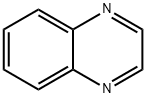
What is Quinoxaline?
Chemical properties
light yellow to brown crystalline
The Uses of Quinoxaline
Quinoxaline is a reagent used in the synthesis of quinoxaline diimides as small molecule non-fullerene acceptors for organic solar cells.
The Uses of Quinoxaline
Organic synthesis.
Definition
ChEBI: A naphthyridine in which the nitrogens are at positions 1 and 4.
Synthesis Reference(s)
Journal of the American Chemical Society, 69, p. 795, 1947 DOI: 10.1021/ja01196a015
The Journal of Organic Chemistry, 55, p. 1744, 1990 DOI: 10.1021/jo00293a014
Organic Syntheses, Coll. Vol. 4, p. 824, 1963
General Description
Transition metal-free acylation of quinoxaline derivatives, by cross dehydrogenative coupling (CDC) reaction, were studied.
Purification Methods
Crystallise quinoxaline from pet ether. It crystallises as the monohydrate on addition of water to a pet ether solution. It has UV: at 242 and 331nm (Ho –2); 234 and 316nm (pH 7.1). The picrate has m 161-162o.[Albert & Phillips J Chem Soc 1294 1956, Beilstein 23 H 176, 23 II 177, 23 III/IV 1226, 23/7 V 135.]
Properties of Quinoxaline
| Melting point: | 29-32 °C (lit.) |
| Boiling point: | 220-223 °C (lit.) |
| Density | 1.124 g/mL at 25 °C (lit.) |
| refractive index | nD48 1.6231 |
| Flash point: | 209 °F |
| storage temp. | 2-8°C |
| solubility | alcohol: freely soluble(lit.) |
| form | Crystalline Low Melting Solid |
| pka | 0.56(at 20℃) |
| color | Light yellow to brown |
| Water Solubility | SOLUBLE |
| Merck | 14,8078 |
| BRN | 109351 |
| Stability: | Light Sensitive |
| CAS DataBase Reference | 91-19-0(CAS DataBase Reference) |
| NIST Chemistry Reference | Quinoxaline(91-19-0) |
| EPA Substance Registry System | Quinoxaline (91-19-0) |
Safety information for Quinoxaline
| Signal word | Warning |
| Pictogram(s) |
 Exclamation Mark Irritant GHS07 |
| GHS Hazard Statements |
H315:Skin corrosion/irritation H319:Serious eye damage/eye irritation H335:Specific target organ toxicity, single exposure;Respiratory tract irritation |
| Precautionary Statement Codes |
P261:Avoid breathing dust/fume/gas/mist/vapours/spray. P264:Wash hands thoroughly after handling. P264:Wash skin thouroughly after handling. P280:Wear protective gloves/protective clothing/eye protection/face protection. P304+P340:IF INHALED: Remove victim to fresh air and Keep at rest in a position comfortable for breathing. P305+P351+P338:IF IN EYES: Rinse cautiously with water for several minutes. Remove contact lenses, if present and easy to do. Continuerinsing. P405:Store locked up. |
Computed Descriptors for Quinoxaline
Quinoxaline manufacturer
New Products
9-Mesityl-10-methylacridinium perchlorate Sulfapyridine Fmoc-OSu (R)-(-)-2-Amino-1-propanol Cyclobutanone 5-bromo-4-fluoro-2-nitrobenzaldehyde 4 pentyn 1 ol N-Vinylformamide Phenethyl cinnamate Pyrrolo[1,2-a]pyrimidine-6-carboxylic acid, 4,6,7,8-tetrahydro-4-oxo-, sodium salt (1:1), (6S) Ethyl 3-phenylpropanoate β-Bromostyrene Methacrylate-PEG-Methacrylate, Mn:35000 2,4-Dihydroxyacetophenone 2-Chloro 5-Fluoro Pyridine Vasicinone 2-Chloroisonicotinic Acid Tween 80 or Polysorbate 80 5-Bromo-1-Pentyne 1-(2-Methyl-5-nitrophenyl)guanidine Nitrate Methyl trans-4-Aminocyclohexanecarboxylate Hydrochloride 2-Pentyn-1-oL 4-Nitrobenzotrifluoride N-(4-Cyano-3-(trifluoromethyl)phenyl)-2-methyloxirane-2-carboxamideRelated products of tetrahydrofuran
You may like
-
 91-19-0 Quinoxaline 98%View Details
91-19-0 -
 91-19-0 98%View Details
91-19-0 -
 Quinoxaline CAS 91-19-0View Details
91-19-0 -
Quinoxaline 97% CAS 91-19-0View Details
91-19-0 -
Quinoxaline CAS 91-19-0View Details
91-19-0 -
1191-95-3 Cyclobutanone 98+View Details
1191-95-3 -
Fmoc-OSu 98+View Details
82911-69-1 -
(R)-(-)-2-Amino-1-propanol 35320-23-1 98+View Details
35320-23-1