
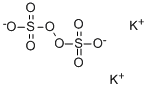
Potassium pyrosulfate
Synonym(s):Potassium disulfate (Potassium pyrosulfate);Potassium pyrosulfate
- CAS NO.:7790-62-7
- Empirical Formula: K2O7S2
- Molecular Weight: 254.32
- MDL number: MFCD00011385
- EINECS: 232-216-8
- SAFETY DATA SHEET (SDS)
- Update Date: 2026-05-28 00:23:08

What is Potassium pyrosulfate?
Chemical properties
Colorless needles or white, crystalline powder or fused pieces. Soluble in water ( converted to potassium bisulfate).
The Uses of Potassium pyrosulfate
Acid flux in analysis, laboratory reagent.
The Uses of Potassium pyrosulfate
Potassium disulfate (K2S2O7) can be used:
- As a salt catalyst for the conversion of hemicellulose into reducing sugars such as xylose and galactose by mechanocatalysis .
- In the preparation of diacylbenzenes via Pd-catalyzed decarboxylative acylation of aromatic ketones with oxocarboxylic acids.
- As an oxidant for the preparation of monosubstituted triazoles from aryl azides and propargyl alcohol using Ag2O as a catalyst.
The Uses of Potassium pyrosulfate
Potassium disulfite supported on silica may be used for the synthesis of ethyl pyruvate.
General Description
Potassium disulfite (Potassium pyrosulfate) has been synthesized from potassium hydrogen sulfate, via melting.
Flammability and Explosibility
Non flammable
Properties of Potassium pyrosulfate
| Melting point: | 325 °C |
| Density | 2.28 g/mL at 25 °C (lit.) |
| storage temp. | no restrictions. |
| solubility | H2O: 0.1 M at 20 °C, clear, colorless |
| form | Solid |
| color | White |
| Specific Gravity | 2.28 |
| PH Range | 1 - 2 at 25.5 g/l at 25 °C |
| PH | 0.8 (50g/l, H2O, 20℃) |
| Odor | Odorless |
| Water Solubility | MAY DECOMPOSE |
| Sensitive | Hygroscopic |
| Merck | 14,7664 |
| Stability: | Stable. Incompatible with strong acids, strong bases. |
| CAS DataBase Reference | 7790-62-7(CAS DataBase Reference) |
| EPA Substance Registry System | Disulfuric acid, dipotassium salt (7790-62-7) |
Safety information for Potassium pyrosulfate
| Signal word | Danger |
| Pictogram(s) |
 Corrosion Corrosives GHS05  Skull and Crossbones Acute Toxicity GHS06 |
| GHS Hazard Statements |
H314:Skin corrosion/irritation H330:Acute toxicity,inhalation |
| Precautionary Statement Codes |
P260:Do not breathe dust/fume/gas/mist/vapours/spray. P271:Use only outdoors or in a well-ventilated area. P280:Wear protective gloves/protective clothing/eye protection/face protection. P303+P361+P353:IF ON SKIN (or hair): Remove/Take off Immediately all contaminated clothing. Rinse SKIN with water/shower. P305+P351+P338:IF IN EYES: Rinse cautiously with water for several minutes. Remove contact lenses, if present and easy to do. Continuerinsing. |
Computed Descriptors for Potassium pyrosulfate
Potassium pyrosulfate manufacturer
Ultra Pure Lab Chem Industries LLP
Mumbai
product: Powder Potassium Pyrosulphate, Grade Standard: Laboratory
ASM Organics
Andhra Pradesh
Phone:91-9866122393
Whatsapp: 91-9866122393
product: Potassium pyrosulfate
New Products
9-Mesityl-10-methylacridinium perchlorate Sulfapyridine Fmoc-OSu (R)-(-)-2-Amino-1-propanol Cyclobutanone 5-bromo-4-fluoro-2-nitrobenzaldehyde 4 pentyn 1 ol N-Vinylformamide Phenethyl cinnamate Pyrrolo[1,2-a]pyrimidine-6-carboxylic acid, 4,6,7,8-tetrahydro-4-oxo-, sodium salt (1:1), (6S) Ethyl 3-phenylpropanoate β-Bromostyrene Methacrylate-PEG-Methacrylate, Mn:35000 2,4-Dihydroxyacetophenone 2-Chloro 5-Fluoro Pyridine Vasicinone 2-Chloroisonicotinic Acid Tween 80 or Polysorbate 80 5-Bromo-1-Pentyne 1-(2-Methyl-5-nitrophenyl)guanidine Nitrate Methyl trans-4-Aminocyclohexanecarboxylate Hydrochloride N-(4-Cyano-3-(trifluoromethyl)phenyl)-2-methyloxirane-2-carboxamide 4-Nitrobenzotrifluoride 2-Pentyn-1-oLRelated products of tetrahydrofuran



You may like
-
 Potassium pyrosulfate 98%View Details
 -
 Potassium hydrogen sulfate 98%View Details
 -
 Potassium Pyrosulphate (Potassium Disulfate) extrapure CAS 7790-62-7View Details
7790-62-7 -
Potassium pyrosulphate, 98% CAS 7790-62-7View Details
7790-62-7 -
Potassium pyrosulphate, GR 99%+ CAS 7790-62-7View Details
7790-62-7 -
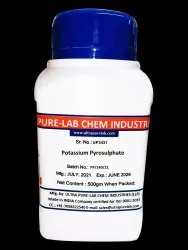 Powder Potassium Pyrosulphate, Grade Standard: LaboratoryView Details
7790-62-7 -
 K2S2O7 Potassium DisulfateView Details
7790-62-7 -
 Potassium DisulfateView Details
7790-62-7
Statement: All products displayed on this website are only used for non medical purposes such as industrial applications or scientific research, and cannot be used for clinical diagnosis or treatment of humans or animals. They are not medicinal or edible.