
Orphenadrine
- CAS NO.:83-98-7
- Empirical Formula: C18H23NO
- Molecular Weight: 269.38
- MDL number: MFCD00053670
- EINECS: 201-509-2
- SAFETY DATA SHEET (SDS)
- Update Date: 2026-07-27 17:00:41
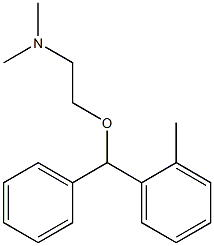
What is Orphenadrine?
Absorption
Orphenadrine is almost completely absorbed in the gastrointestinal tract.
Toxicity
Oral, mouse LD50 = 100 mg/kg; oral, rat LD50 = 255 mg/kg
Originator
Norflex,Riker,US,1959
The Uses of Orphenadrine
Relaxant (skeletal muscle); antihistaminic.
Background
A muscarinic antagonist used to treat drug-induced parkinsonism and to relieve pain from muscle spasm.
Indications
Indicated as an adjunct to rest, physical therapy, and other measures for the relief of discomfort associated with acute painful musculo skeletal conditions.
Definition
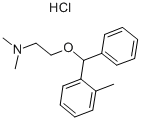
ChEBI: A tertiary amino compound which is the phenyl-o-tolylmethyl ether of 2-(dimethylamino)ethanol.
Manufacturing Process
As described in US Patent 2,567,351, o-methylbenzhydryl bromide is added slowly to β-dimethylaminoethanol at refluxing temperature. After the addition has been completed the mixture is refluxed and stirred for an additional 16 hours. The mixture is cooled and the bottom layer consisting of the crude hydrobromide salt of β-dimethylaminoethanol is drawn off. The excess amino alcohol is distilled from the upper layer in vacuo and the residue is reacted with citric acid.
brand name
Norflex (3M Pharmaceuticals).
Therapeutic Function
Muscle relaxant
Pharmacokinetics
Orphenadrine is indicated as an adjunct to rest, physical therapy, and other measures for the relief of discomfort associated with acute painful musculoskeletal conditions. Orphenadrine is an anticholinergic with a predominantly central effect and only a weak peripheral effect. In addition, it has mild antihistaminic and local anaesthetic properties. Parkinson's syndrome is the consequence of a disturbed balance between cholinergic and dopaminergic neurotransmission in the basal ganglia caused by a decrease in dopamine. Orphenadrine restores the physiological equilibrium and has a favourable effect on the rigidity and tremor of Parkinson's disease and Parkinsonian syndromes. The effect is somewhat less on bradykinesia.
Enzyme inhibitor
This muscle relaxant and antihistaminic agent (FWfree-base = 269.39 g/mol; CAS 83-98-7) is both a muscarinic and histamine H1 receptor antagonist that also inhibits some cytochrome P450 systems. Classified as an anticholinergic drug (with 58% as potent as atropine) and an ethanolamineclass antihistamine, it also inhibits the noradrenergic transporter and NMDA receptor ion channel (Ki ≈ 6 μM). Commercially available as either the hydrochloride or citrate salt, orphenadrines used to relieve pain of muscle injuries, such as strains and sprains. Target(s): aldehyde oxidase; CYP1A2; CYP2A6; CYP3A4; CYP2B; CYP2B6; CYP2C9; CYP2C19; CYP2D6; histamine H1 receptor; N-methyl-D-aspartate (NMDA) receptor; muscarinic receptor; noradrenaline reuptake.
Metabolism
Biotransformation occurs mainly in the liver. Pharmacologically active metabolites are N-demethyl orphenadrine and N,N-didemethyl orphenadrine.
Properties of Orphenadrine
| Melting point: | 25°C |
| Boiling point: | bp12 195° |
| Density | 1.0278 (rough estimate) |
| refractive index | 1.5740 (estimate) |
| pka | pKa 8.4 (Uncertain) |
| form | Solid |
| Water Solubility | 1.801mg/L(22.5 ºC) |
| CAS DataBase Reference | 83-98-7 |
Safety information for Orphenadrine
Computed Descriptors for Orphenadrine
Orphenadrine manufacturer
New Products
2-(2-Chlorophenyl)glycine Propiolic Acid 1-(3-Hydroxy-4-methoxyphenyl)-2-nitroethene (±)-amino(2-fluorophenyl)acetic acid trans-3-Benzyloxy-4-methoxy-beta-nitrostyrene 1-Pentadecanol 2,4-Dihydroxybenzaldehyde Dipropyl disulfide Pyrrolo[1,2-a]pyrimidine-6-carboxylic acid, 4,6,7,8-tetrahydro-4-oxo-, sodium salt (1:1), (6S) Obidoxime hydrochloride API 4 pentyn 1 ol N-Vinylformamide Methacrylate-PEG-Methacrylate, Mn:35000 2,4-Dihydroxyacetophenone 2-Chloro 5-Fluoro Pyridine Vasicinone 2-Chloroisonicotinic Acid Tween 80 or Polysorbate 80 2-Butyn-1-oL N-(4-Cyano-3-(trifluoromethyl)phenyl)-2-methyloxirane-2-carboxamide N-(4-fluoro-2-methoxy-5-nitrophenyl)-4-(1-methyl-1H-indol-3-yl)pyrimidin-2-amine Pirtobrutinib intd. 2-Pentyn-1-oL 4-NitrobenzotrifluorideRelated products of tetrahydrofuran

You may like
-
 83-98-7 Orphedrine free base 98%View Details
83-98-7 -
 OrphenadrineView Details
83-98-7 -
 OrphenadrineView Details
83-98-7 -
 471-25-0 Propiolic Acid 98+View Details
471-25-0 -
84145-28-8 98+View Details
84145-28-8 -
2-(2-Chlorophenyl)glycine 88744-36-9 98+View Details
88744-36-9 -
40216-83-9 trans-4-Hydroxy-L-proline methyl ester hydrochloride 98+View Details
40216-83-9 -
1-(3-Hydroxy-4-methoxyphenyl)-2-nitroethene 98+View Details
39816-35-8