
KURARINONE
- CAS NO.:34981-26-5
- Empirical Formula: C26H30O6
- Molecular Weight: 438.51
- MDL number: MFCD03411889
- EINECS: 233-305-4
- SAFETY DATA SHEET (SDS)
- Update Date: 2026-07-27 17:00:41
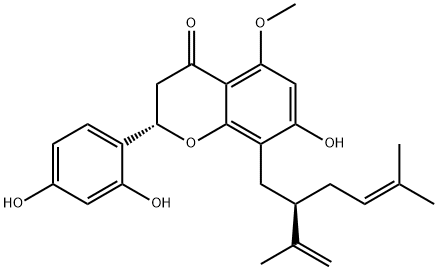
What is KURARINONE?
Definition
ChEBI: (2S)-(-)-kurarinone is a trihydroxyflavanone that is (2S)-flavanone substituted by hydroxy groups at positions 7, 2' and 4', a lavandulyl group at position 8 and a methoxy group at position 5. Isolated from the roots of Sophora flavescens, it exhibits cytotoxicity against human myeloid leukemia HL-60 cells. It has a role as a metabolite and an antineoplastic agent. It is a trihydroxyflavanone, a monomethoxyflavanone and a member of 4'-hydroxyflavanones. It is functionally related to a (2S)-flavanone.
Biological Activity
Kurarinone, a flavonoid isolated from Sophora flavescens, inhibits the pathogenesis of experimental autoimmune encephalomyelitis by inhibiting the differentiation of Th1 and Th17 cells.
Physiological effects
Kurarinon has an anti-endothelial cell proliferative activity, and it has a significant inhibitory effect on endothelial cell proliferation with a median inhibitory concentration (IC50) of 12ug/ml.
Properties of KURARINONE
| Melting point: | 117-119℃ |
| Boiling point: | 651.4±55.0 °C(Predicted) |
| Density | 1?+-.0.06 g/cm3(Predicted) |
| solubility | Soluble in Chloroform,Dichloromethane,Ethyl Acetate,DMSO,Acetone,etc. |
| form | Powder |
| pka | 7.49±0.40(Predicted) |
| color | Light yellow to yellow |
Safety information for KURARINONE
| Signal word | Warning |
| Pictogram(s) |
 Exclamation Mark Irritant GHS07 |
| GHS Hazard Statements |
H315:Skin corrosion/irritation H319:Serious eye damage/eye irritation |
| Precautionary Statement Codes |
P264:Wash hands thoroughly after handling. P264:Wash skin thouroughly after handling. P280:Wear protective gloves/protective clothing/eye protection/face protection. P302+P352:IF ON SKIN: wash with plenty of soap and water. P305+P351+P338:IF IN EYES: Rinse cautiously with water for several minutes. Remove contact lenses, if present and easy to do. Continuerinsing. P332+P313:IF SKIN irritation occurs: Get medical advice/attention. P337+P313:IF eye irritation persists: Get medical advice/attention. |
Computed Descriptors for KURARINONE
New Products
5-bromo-4-fluoro-2-nitrobenzaldehyde (R)-(-)-2-Amino-1-propanol Cyclobutanone Fmoc-OSu 1-(2-Chloroethyl)pyrrolidine Hydrochloride 2-Amino-2-(4-methylphenyl)acetic acid Obidoxime hydrochloride API Decanoic acid, 2-[4-(phenylmethoxy)phenyl]ethyl ester Piperazine, 1-(3-methoxyphenyl)-, hydrochloride (1:1) 4-Bromo-2,6-difluoroaniline 4 pentyn 1 ol N-Vinylformamide Methacrylate-PEG-Methacrylate, Mn:35000 2,4-Dihydroxyacetophenone 2-Chloro 5-Fluoro Pyridine Vasicinone 2-Chloroisonicotinic Acid Tween 80 or Polysorbate 80 N-(4-Cyano-3-(trifluoromethyl)phenyl)-2-methyloxirane-2-carboxamide 2-Pentyn-1-oL 4-Nitrobenzotrifluoride N-(4-fluoro-2-methoxy-5-nitrophenyl)-4-(1-methyl-1H-indol-3-yl)pyrimidin-2-amine Pirtobrutinib intd. 2-Butyn-1-oLRelated products of tetrahydrofuran

You may like
-
 Fmoc-OSu 98+View Details
82911-69-1 -
(R)-(-)-2-Amino-1-propanol 35320-23-1 98+View Details
35320-23-1 -
7250-67-1 1-(2-Chloroethyl)pyrrolidine Hydrochloride 98+View Details
7250-67-1 -
13227-01-5 98+View Details
13227-01-5 -
7250-67-1 1-(2-Chloroethyl)pyrrolidine Hydrochloride 98+View Details
7250-67-1 -
13227-01-5 98+View Details
13227-01-5 -
7250-67-1 1-(2-Chloroethyl)pyrrolidine Hydrochloride 98+View Details
7250-67-1 -
13227-01-5 98+View Details
13227-01-5