
Eflornithine
- CAS NO.:67037-37-0
- Empirical Formula: C6H12F2N2O2
- Molecular Weight: 182.17
- MDL number: MFCD00221766
- SAFETY DATA SHEET (SDS)
- Update Date: 2026-05-20 15:44:27
What is Eflornithine?
Description
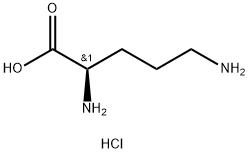
Metcalf et al.reported the synthesis of eflornithine (difluoromethyl ornithine [DFMO]) in 1978. Their interest arose from the desire to prepare ornithine decarboxylase (ODC) inhibitors as tools for studying the role of polyamines as regulators of growth processes. Ornithine decarboxylase catalyzes the conversion of ornithine to putrescine (1,4-diaminobutane), which in turn leads to the formation of the polyamines, spermine, and spermidine. It was not until 1980 that Bacchi et al. demonstrated the potential of DFMO in the treatment of trypanosomiasis.
The Uses of Eflornithine
Labelled Eflornithine. Irreversible inhibitor of ornithine decarboxylase, an enzyme involved in polyamine biosynthesis. Antineoplastic; antipneumocystic; antiprotozoal (Trypanosoma). Used in the treatment of hirsutism.
The Uses of Eflornithine
Eflornithine is an irreversible inhibitor of ornithine decarboxylase that blocks putrescine biosynthesis in T. brucei in vitro and inhibits the growth and multiplication of the parasite in vivo. The drug, administered orally or parenterally, is relatively nontoxic and is effective in eliminating the parasite T. b. rhodesiense and, to a greater extent, T. b. gambiense. Eflornithine was approved for human use by the FDA in late 1990. Side effects associated with oral administration are diarrhea, nausea, and vomiting. There is a significant relapse rate. A mixture of eflornithine (5) and nifurtimox (6, C10H13N3O5S, Lampit, Bayer 2502) shows good activity against T. b. gambiense. The former compound is also reported to potentiate the effect of melarsoprol in infected mice.
Indications
Eflornithine (difluoromethyl ornithine, Ornidyl) is a
unique antiprotozoal agent in that its mode of action involves
inhibition of a specific enzyme, ornithine decarboxylase.
In eukaryotes, decarboxylation of ornithine is
required for biosynthesis of polyamines, which are important
in cell division and differentiation.
Eflornithine is given intravenously, and about 80%
of the drug is excreted in the urine within 24 hours. It
does not bind significantly to plasma proteins and has a
terminal plasma half-life of about 3 hours. It crosses the
blood-brain barrier and is one of the drugs of choice for
treating the hemolymphatic and meningoencephalitic
stage of T. brucei-gambiense. The most significant side
effects are anemia and leukopenia. Oral therapy is associated
with considerable gastrointestinal toxicity.
Diarrhea, thrombocytopenia, and seizures are occasionally
reported.
Definition
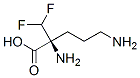
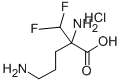
ChEBI: Eflornithine is a fluoroamino acid that is ornithine substituted by a difluoromethyl group at position 2. It has a role as a trypanocidal drug. It is a fluoroamino acid and an alpha-amino acid. It is functionally related to an ornithine.
brand name
Ornidyl (Sanofi Aventis); Vaniqa (Skinmedica).
Mechanism of action
Difluoromethyl ornithine is a suicide inhibitor of ODC, a pyridoxal phosphate–dependent enzyme. Evidence suggests that cysteine-360 in ODC is the site of eflornithine alkylation. Alkylation of ODC blocks the synthesis of putrescine, the rate-determining step in the synthesis of polyamines. Mammalian ODC also may be inhibited, but because the turnover of ODC is so rapid in mammals, eflornithine does not produce serious side effects.
Clinical Use
Eflornithine is used for the treatment of West African sleepingsickness, caused by Trypanosoma brucei gambiense.It is specifically indicated for the meningoencephaliticstage of the disease. Eflornithine is a myelosuppressivedrug that causes high incidences of anemia, leukopenia,and thrombocytopenia. Complete blood cell counts must bemonitored during the course of therapy.The irreversible inactivation of ornithine decarboxylaseby eflornithine is accompanied by decarboxylation andrelease of fluoride ion from the inhibitor, suggesting enzyme-catalyzed activation of the inhibitor. Only the (—) isomer,stereochemically related to L-ornithine, is active.
Eflornithine is supplied as the hydrochloride salt. It may beadministered either intravenously or orally. Approximately80% of the unchanged drug is excreted in the urine.Penetration of eflornithine into the CSF is facilitated by inflammationof the meninges.
Side Effects
Side effects reported for eflornithine consist of anemia, diarrhea, and leukopenia.
Properties of Eflornithine
| Density | 1.1800 (estimate) |
| storage temp. | -15°C |
Safety information for Eflornithine
Computed Descriptors for Eflornithine
Eflornithine manufacturer
New Products
3-AMINO-3-(2-CHLORO-PHENYL)-PROPIONIC ACID 4-Fluorophenylglycine 1-Boc-3-(cyanomethyl)azetidine Dimedone 1-N-Boc-3-(aminoethyl)azetidine N-BOC-piperidine-4-carboxylic acid 4,6-Dichlororesorcinol 5-Amino-2-Bromo-3-Chloropyridine 2-Picolinic acid N-oxide 4-Butyl Resorcinol 2-Bromo-5-Chloropyridine 5-Bromo-2-Hydroxy-3-Nitro Pyridine 2-Amino-4-phenyl-thiazole N-(4-Bromophenyl)-2-chloroacetamide TRIFLOURO ACETICACID-D METHANE SULFONIC ACID-D4 PHOSPORIC ACID-D3 85 W% IN D2O DEUTERIUM OXIDE FOR NMR BENZENE-D6 TOLUENE-D3Related products of tetrahydrofuran


You may like
-
 IODOETHANE-D5 6485-58-1 99%View Details
6485-58-1 -
32008-59-6 PARAFORMALDEHYDE-D2 98%View Details
32008-59-6 -
CHLORO BENZENE-D5 3114-55-4 99%View Details
3114-55-4 -
PHENYL ACETYLENE-D 3240-11-07 99%View Details
3240-11-07 -
918-20-7 TERT-BUTYL CHLORIDE-D9 98%View Details
918-20-7 -
84358-13-4 N-BOC-piperidine-4-carboxylic acid 98+View Details
84358-13-4 -
84358-13-4 N-BOC-piperidine-4-carboxylic acid 98+View Details
84358-13-4 -
84358-13-4 N-BOC-piperidine-4-carboxylic acid 98+View Details
84358-13-4