
Diethyl chlorothiophosphate
Synonym(s):O,O′-Diethylthiophosphoric chloride;Diethyl phosphorochloridothionate
- CAS NO.:2524-04-1
- Empirical Formula: C4H10ClO2PS
- Molecular Weight: 188.61
- MDL number: MFCD00009088
- EINECS: 219-755-4
- SAFETY DATA SHEET (SDS)
- Update Date: 2026-05-28 02:43:48
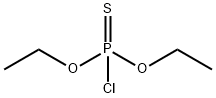
What is Diethyl chlorothiophosphate?
Chemical properties
CLEAR COLORLESS TO LIGHT YELLOW LIQUID
The Uses of Diethyl chlorothiophosphate
Diethyl Chlorothiophosphate is used in the preparation of various organophosporus insecticide including Flupyrazofos (F598620) and Chlorpyrifos (C425300).
General Description
A colorless to light amber liquid with a disagreeable odor. Density 1.196 g / cm3. Boiling point 120°F.Flash point below 100°F. Insoluble in water but soluble in most organic solvents. May be highly toxic and irritating to the eyes and lungs. Used as an intermediate for pesticides, as an oil and gasoline additive, and as a flame retardant.
Air & Water Reactions
Highly flammable. Insoluble in water but soluble in most organic solvents. Contact with moisture in the air produces highly corrosive and toxic fumes containing hydrogen chloride. Decomposes in water producing acidic products.
Reactivity Profile
Diethyl chlorothiophosphate is incompatible with bases (including amines), with strong oxidizing agents, and with alcohols. May react vigorously or explosively if mixed with diisopropyl ether or other ethers in the presence of trace amounts of metal salts [J. Haz. Mat., 1981, 4, 291].
Health Hazard
TOXIC; inhalation, ingestion or contact (skin, eyes) with vapors, dusts or substance may cause severe injury, burns or death. Bromoacetates and chloroacetates are extremely irritating/lachrymators. Reaction with water or moist air will release toxic, corrosive or flammable gases. Reaction with water may generate much heat that will increase the concentration of fumes in the air. Fire will produce irritating, corrosive and/or toxic gases. Runoff from fire control or dilution water may be corrosive and/or toxic and cause pollution.
Fire Hazard
HIGHLY FLAMMABLE: Will be easily ignited by heat, sparks or flames. Vapors form explosive mixtures with air: indoors, outdoors and sewers explosion hazards. Most vapors are heavier than air. They will spread along ground and collect in low or confined areas (sewers, basements, tanks). Vapors may travel to source of ignition and flash back. Substance will react with water (some violently) releasing flammable, toxic or corrosive gases and runoff. Contact with metals may evolve flammable hydrogen gas. Containers may explode when heated or if contaminated with water.
Flammability and Explosibility
Non flammable
Properties of Diethyl chlorothiophosphate
| Melting point: | -75℃ |
| Boiling point: | 96 °C |
| Density | 1.2 g/mL at 25 °C(lit.) |
| vapor pressure | 1.4 mm Hg ( 50 °C) |
| refractive index | n |
| Flash point: | >230 °F |
| solubility | Chloroform (Slightly), Ethyl Acetate (Slightly) |
| form | liquid |
| color | Colorless to Red to Green |
| Water Solubility | hydrolyzes, immiscible |
| CAS DataBase Reference | 2524-04-1(CAS DataBase Reference) |
| NIST Chemistry Reference | Phosphorochloridothioic acid, o,o'-diethyl ester(2524-04-1) |
| EPA Substance Registry System | O,O-Diethyl chlorothiophosphate (2524-04-1) |
Safety information for Diethyl chlorothiophosphate
| Signal word | Danger |
| Pictogram(s) |
 Corrosion Corrosives GHS05  Skull and Crossbones Acute Toxicity GHS06  Environment GHS09 |
| GHS Hazard Statements |
H302:Acute toxicity,oral H314:Skin corrosion/irritation H411:Hazardous to the aquatic environment, long-term hazard |
| Precautionary Statement Codes |
P273:Avoid release to the environment. P280:Wear protective gloves/protective clothing/eye protection/face protection. P301+P312:IF SWALLOWED: call a POISON CENTER or doctor/physician IF you feel unwell. P303+P361+P353:IF ON SKIN (or hair): Remove/Take off Immediately all contaminated clothing. Rinse SKIN with water/shower. P305+P351+P338:IF IN EYES: Rinse cautiously with water for several minutes. Remove contact lenses, if present and easy to do. Continuerinsing. |
Computed Descriptors for Diethyl chlorothiophosphate
Diethyl chlorothiophosphate manufacturer
G C Int'L
New Products
2-(2-Chlorophenyl)glycine Propiolic Acid 1-(3-Hydroxy-4-methoxyphenyl)-2-nitroethene (±)-amino(2-fluorophenyl)acetic acid trans-3-Benzyloxy-4-methoxy-beta-nitrostyrene 1-Pentadecanol 2,4-Dihydroxybenzaldehyde Dipropyl disulfide Pyrrolo[1,2-a]pyrimidine-6-carboxylic acid, 4,6,7,8-tetrahydro-4-oxo-, sodium salt (1:1), (6S) Obidoxime hydrochloride API 4 pentyn 1 ol N-Vinylformamide Methacrylate-PEG-Methacrylate, Mn:35000 2,4-Dihydroxyacetophenone 2-Chloro 5-Fluoro Pyridine Vasicinone 2-Chloroisonicotinic Acid Tween 80 or Polysorbate 80 2-Butyn-1-oL N-(4-Cyano-3-(trifluoromethyl)phenyl)-2-methyloxirane-2-carboxamide N-(4-fluoro-2-methoxy-5-nitrophenyl)-4-(1-methyl-1H-indol-3-yl)pyrimidin-2-amine Pirtobrutinib intd. 2-Pentyn-1-oL 4-NitrobenzotrifluorideRelated products of tetrahydrofuran

You may like
-
 O,O′-Diethyl chlorothiophosphate CAS 2524-04-1View Details
2524-04-1 -
471-25-0 Propiolic Acid 98+View Details
471-25-0 -
84145-28-8 98+View Details
84145-28-8 -
trans-3-Benzyloxy-4-methoxy-beta-nitrostyrene 98+View Details
63909-29-5 -
2-(2-Chlorophenyl)glycine 88744-36-9 98+View Details
88744-36-9 -
40216-83-9 trans-4-Hydroxy-L-proline methyl ester hydrochloride 98+View Details
40216-83-9 -
629-76-5 98+View Details
629-76-5 -
1-(3-Hydroxy-4-methoxyphenyl)-2-nitroethene 98+View Details
39816-35-8