
(6R,S)-5,6,7,8-TETRAHYDRO-L-BIOPTERIN DIHYDROCHLORIDE
- CAS NO.:62989-33-7
- Empirical Formula: C9H15N5O3
- Molecular Weight: 241.25
- MDL number: MFCD00069326
- EINECS: 636-312-4
- SAFETY DATA SHEET (SDS)
- Update Date: 2026-05-28 02:52:54
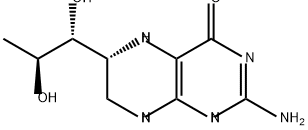
What is (6R,S)-5,6,7,8-TETRAHYDRO-L-BIOPTERIN DIHYDROCHLORIDE?
The Uses of (6R,S)-5,6,7,8-TETRAHYDRO-L-BIOPTERIN DIHYDROCHLORIDE
Treatment of mild-to-moderate phenylketonuria (PKU).
Indications
For the treatment of tetrahydrobiopterin (BH4) deficiency.
Background
Sapropterin (tetrahydrobiopterin or BH4) is a cofactor in the synthesis of nitric oxide. It is also essential in the conversion of phenylalanine to tyrosine by the enzyme phenylalanine-4-hydroxylase; the conversion of tyrosine to L-dopa by the enzyme tyrosine hydroxylase; and conversion of tryptophan to 5-hydroxytryptophan via tryptophan hydroxylase.
Definition
ChEBI: Sapropterin is a tetrahydropterin that is 2-amino-5,6,7,8-tetrahydropteridin-4(3H)-one in which a hydrogen at position 6 is substituted by a 1,2-dihydroxypropyl group (6R,1'R,2'S-enantiomer). It has a role as a coenzyme, a diagnostic agent, a human metabolite and a cofactor.
Pharmacokinetics
Tetrahydrobiopterin (BH4) is used to convert several amino acids, including phenylalanine, to other essential molecules in the body including neurotransmitters. Tetrahydrobiopterin deficiency can be caused by mutations in GTP cyclohydrolase 1 (GCH1), 6-pyruvoyl-tetrahydropterin synthase/dimerization cofactor of hepatocyte nuclear factor 1 alpha (PCBD1), 6-pyruvoyltetrahydropterin synthase (PTS), and quinoid dihydropteridine reductase (QDPR) genes. These genes make the enzymes that are critical for producing and recycling tetrahydrobiopterin. If one of the enzymes fails to function correctly because of a gene mutation, little or no tetrahydrobiopterin is produced. As a result, phenylalanine from the diet builds up in the bloodstream and other tissues and can damage nerve cells in the brain. High levels of phenylalanine can result in signs and symptoms ranging from temporary low muscle tone to mental retardation, movement disorders, difficulty swallowing, seizures, behavioral problems, progressive problems with development, and an inability to control body temperature.
Metabolism
Not Available
Properties of (6R,S)-5,6,7,8-TETRAHYDRO-L-BIOPTERIN DIHYDROCHLORIDE
| Boiling point: | 506.6±60.0 °C(Predicted) |
| Density | 1.89±0.1 g/cm3(Predicted) |
| storage temp. | Keep in dark place,Sealed in dry,2-8°C |
| pka | 5.05(at 25℃) |
Safety information for (6R,S)-5,6,7,8-TETRAHYDRO-L-BIOPTERIN DIHYDROCHLORIDE
| Signal word | Warning |
| Pictogram(s) |
 Exclamation Mark Irritant GHS07 |
| GHS Hazard Statements |
H315:Skin corrosion/irritation H319:Serious eye damage/eye irritation H335:Specific target organ toxicity, single exposure;Respiratory tract irritation |
| Precautionary Statement Codes |
P261:Avoid breathing dust/fume/gas/mist/vapours/spray. P305+P351+P338:IF IN EYES: Rinse cautiously with water for several minutes. Remove contact lenses, if present and easy to do. Continuerinsing. |
Computed Descriptors for (6R,S)-5,6,7,8-TETRAHYDRO-L-BIOPTERIN DIHYDROCHLORIDE
New Products
N-Carbethoxy-4-piperidone 1-Aminocyclopentane carbonitrile Tetrabutylammonium perchlorate N,O-Dimethylhydroxylamine hydrochloride (RS)-beta-Amino-beta-(4-bromophenyl)propionic acid 2-Amino-5-bromo-4-(trifluoromethyl)pyridine N-Vinylformamide 4 pentyn 1 ol Phenethyl cinnamate Dipropyl disulfide Ethyl 3-phenylpropanoate β-Bromostyrene Methacrylate-PEG-Methacrylate, Mn:35000 2,4-Dihydroxyacetophenone 2-Chloro 5-Fluoro Pyridine Vasicinone 2-Chloroisonicotinic Acid Tween 80 or Polysorbate 80 5-Bromo-1-Pentyne 1-(2-Methyl-5-nitrophenyl)guanidine Nitrate Methyl trans-4-Aminocyclohexanecarboxylate Hydrochloride N-(4-Cyano-3-(trifluoromethyl)phenyl)-2-methyloxirane-2-carboxamide 2-Pentyn-1-oL 4-NitrobenzotrifluorideRelated products of tetrahydrofuran




You may like
-
 62989-33-7 Sapropterin 98%View Details
62989-33-7 -
 144-83-2 Sulfapyridine 98+View Details
144-83-2 -
29976-53-2 98+View Details
29976-53-2 -
(RS)-beta-Amino-beta-(4-bromophenyl)propionic acid 39773-47-2 98+View Details
39773-47-2 -
6638-79-5 N,O-Dimethylhydroxylamine hydrochloride 98+View Details
6638-79-5 -
674783-97-2 98+View Details
674783-97-2 -
1-Aminocyclopentane carbonitrile 98+View Details
49830-37-7 -
Tetrabutylammonium perchlorate 1923-70-2 98+View Details
1923-70-2