
4-Acetylbiphenyl
Synonym(s):4-Biphenyl methyl ketone;4-Phenylacetophenone
- CAS NO.:92-91-1
- Empirical Formula: C14H12O
- Molecular Weight: 196.24
- MDL number: MFCD00008749
- EINECS: 202-202-6
- SAFETY DATA SHEET (SDS)
- Update Date: 2026-05-28 05:22:28
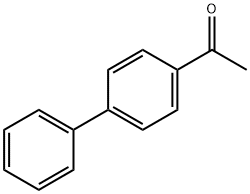
What is 4-Acetylbiphenyl?
Chemical properties
Off-white to beige powder
The Uses of 4-Acetylbiphenyl
4-Acetylbiphenyl is involved in the study of inactivation of 7-ethoxy-4-trifluoromethylcoumarin ortho-deethylase activity by various arylalkynes. Further, it is used in the preparation of Schiffs base.
The Uses of 4-Acetylbiphenyl
Intermediates of Liquid Crystals
The Uses of 4-Acetylbiphenyl
4-Acetylbiphenyl was used to study the inactivation of 7-ethoxy-4-trifluoromethylcoumarin O-deethylase activity by various arylalkynes. It may be used in the synthesis of Schiffs base.
Purification Methods
Crystallise it from EtOH or acetone. It can also be distilled under reduced or atmospheric pressure. The semicarbazone has m 131-132o (aqueous EtOH). [Beilstein 7 H 443, 7 III 2134, 7 IV 1407.]
Properties of 4-Acetylbiphenyl
| Melting point: | 152-155 °C(lit.) |
| Boiling point: | 325-327 °C |
| Density | 1.2510 |
| refractive index | 1.5920 (estimate) |
| Flash point: | 168°C/8mm |
| storage temp. | 2-8°C |
| solubility | chloroform: soluble10mg/200microlitres, clear, colorless to faintly yellow |
| form | neat |
| form | Solid |
| color | White to Green to Brown |
| Water Solubility | insoluble |
| BRN | 1101615 |
| CAS DataBase Reference | 92-91-1(CAS DataBase Reference) |
| NIST Chemistry Reference | Ethanone, 1-[1,1'-biphenyl]-4-yl-(92-91-1) |
| EPA Substance Registry System | Ethanone, 1-[1,1'-biphenyl]-4-yl- (92-91-1) |
Safety information for 4-Acetylbiphenyl
| Signal word | Warning |
| Pictogram(s) |
 Exclamation Mark Irritant GHS07 |
| GHS Hazard Statements |
H315:Skin corrosion/irritation H319:Serious eye damage/eye irritation |
| Precautionary Statement Codes |
P264:Wash hands thoroughly after handling. P264:Wash skin thouroughly after handling. P280:Wear protective gloves/protective clothing/eye protection/face protection. P302+P352:IF ON SKIN: wash with plenty of soap and water. P305+P351+P338:IF IN EYES: Rinse cautiously with water for several minutes. Remove contact lenses, if present and easy to do. Continuerinsing. P332+P313:IF SKIN irritation occurs: Get medical advice/attention. P337+P313:IF eye irritation persists: Get medical advice/attention. |
Computed Descriptors for 4-Acetylbiphenyl
4-Acetylbiphenyl manufacturer
BTC pharm India
5Y
Phone:+91-8790379245
Whatsapp: +91- 6361382515
product: 92-91-1 4-Acetylbiphenyl 98+
New Products
2-(2-Chlorophenyl)glycine Propiolic Acid 1-(3-Hydroxy-4-methoxyphenyl)-2-nitroethene (±)-amino(2-fluorophenyl)acetic acid trans-3-Benzyloxy-4-methoxy-beta-nitrostyrene 1-Pentadecanol 2,4-Dihydroxybenzaldehyde Dipropyl disulfide Pyrrolo[1,2-a]pyrimidine-6-carboxylic acid, 4,6,7,8-tetrahydro-4-oxo-, sodium salt (1:1), (6S) Obidoxime hydrochloride API 4 pentyn 1 ol N-Vinylformamide Methacrylate-PEG-Methacrylate, Mn:35000 2,4-Dihydroxyacetophenone 2-Chloro 5-Fluoro Pyridine Vasicinone 2-Chloroisonicotinic Acid Tween 80 or Polysorbate 80 2-Butyn-1-oL N-(4-Cyano-3-(trifluoromethyl)phenyl)-2-methyloxirane-2-carboxamide N-(4-fluoro-2-methoxy-5-nitrophenyl)-4-(1-methyl-1H-indol-3-yl)pyrimidin-2-amine Pirtobrutinib intd. 2-Pentyn-1-oL 4-NitrobenzotrifluorideRelated products of tetrahydrofuran

You may like
-
 92-91-1 4-Acetylbiphenyl 98+View Details
92-91-1 -
92-91-1 4-Acetylbiphenyl 98+View Details
92-91-1 -
92-91-1 4-Acetylbiphenyl 98+View Details
92-91-1 -
92-91-1 98+View Details
92-91-1 -
92-91-1 98+View Details
92-91-1 -
92-91-1 98+View Details
92-91-1 -
4-Acetylbiphenyl 92-91-1 98+View Details
92-91-1 -
4-Acetylbiphenyl 92-91-1 98+View Details
92-91-1
Statement: All products displayed on this website are only used for non medical purposes such as industrial applications or scientific research, and cannot be used for clinical diagnosis or treatment of humans or animals. They are not medicinal or edible.