
3-Chloro-4-methylphenylisocyanate
- CAS NO.:51488-20-1
- Empirical Formula: C8H6ClNO
- Molecular Weight: 167.59
- MDL number: MFCD11101408
- SAFETY DATA SHEET (SDS)
- Update Date: 2026-05-28 03:05:14
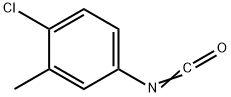
What is 3-Chloro-4-methylphenylisocyanate?
Chemical properties
Chloromethyl phenyl isocyanate is a colorless to yellow liquid or beige, low-melting solid. Acrid odor.
The Uses of 3-Chloro-4-methylphenylisocyanate
It is employed as a intermediates for pharmaceutical.
Potential Exposure
This material is used in organic synthesis.
Shipping
UN22363-Chloro-4-methylphenyl isocyanate, liquid, Hazard Class: 6.1; Labels: 6.1-Poisonous materials.
Incompatibilities
May form explosive mixture with air. Isocyanates are highly flammable and reactive with many compounds, even with themselves. Incompatible with oxidizers (chlorates, nitrates, peroxides, permanganates, perchlorates, chlorine, bromine, fluorine, etc.); contact may cause fires or explosions. Reaction with moist air, water or alcohols may form amines and insoluble polyureas and react exothermically, releasing toxic, corrosive, or flammable gases, including carbon dioxide; and, at the same time, may generate a violent release of heat increasing the concentration of fumes in the air. Incompatible with amines, aldehydes, alkali metals, ammonia, carboxylic acids, caprolactum, alkaline materials, glycols, ketones, mercaptans, hydrides, organotin catalysts, phenols, strong acids, strong bases, strong reducing agents such as hydrides, urethanes, ureas. Elevated temperatures or contact with acids, bases, tertiary amines, and acyl-chlorides may cause explosive polymerization. Attacks some plastics, rubber, and coatings. Contact with metals may evolve flammable hydrogen gas. May accumulate static electrical charges, and may cause ignition of its vapors. Do not store in temperatures above 30C/86F.
Properties of 3-Chloro-4-methylphenylisocyanate
| Boiling point: | 244℃ |
| Density | 1.17 |
| refractive index | 1.5580 |
| Flash point: | 92℃ |
| color | Clear, colourless |
| Water Solubility | Hydrolyzes with water. |
| Sensitive | Moisture Sensitive |
Safety information for 3-Chloro-4-methylphenylisocyanate
| Signal word | Danger |
| Pictogram(s) |
 Skull and Crossbones Acute Toxicity GHS06  Health Hazard GHS08 |
| GHS Hazard Statements |
H315:Skin corrosion/irritation H319:Serious eye damage/eye irritation H330:Acute toxicity,inhalation H334:Sensitisation, respiratory H335:Specific target organ toxicity, single exposure;Respiratory tract irritation |
| Precautionary Statement Codes |
P260:Do not breathe dust/fume/gas/mist/vapours/spray. P309:IF exposed or if you feel unwell: P310:Immediately call a POISON CENTER or doctor/physician. P305+P351+P338:IF IN EYES: Rinse cautiously with water for several minutes. Remove contact lenses, if present and easy to do. Continuerinsing. |
Computed Descriptors for 3-Chloro-4-methylphenylisocyanate
New Products
5-bromo-4-fluoro-2-nitrobenzaldehyde (R)-(-)-2-Amino-1-propanol Cyclobutanone Fmoc-OSu 1-(2-Chloroethyl)pyrrolidine Hydrochloride 2-Amino-2-(4-methylphenyl)acetic acid β-Bromostyrene Ethyl 3-phenylpropanoate Phenethyl cinnamate Dipropyl disulfide 4 pentyn 1 ol N-Vinylformamide Methacrylate-PEG-Methacrylate, Mn:35000 2,4-Dihydroxyacetophenone 2-Chloro 5-Fluoro Pyridine Vasicinone 2-Chloroisonicotinic Acid Tween 80 or Polysorbate 80 2-Butyn-1-oL 2-Pentyn-1-oL 4-Nitrobenzotrifluoride N-(4-fluoro-2-methoxy-5-nitrophenyl)-4-(1-methyl-1H-indol-3-yl)pyrimidin-2-amine Pirtobrutinib intd. N-(4-Cyano-3-(trifluoromethyl)phenyl)-2-methyloxirane-2-carboxamideRelated products of tetrahydrofuran
You may like
-
 Fmoc-OSu 98+View Details
82911-69-1 -
(R)-(-)-2-Amino-1-propanol 35320-23-1 98+View Details
35320-23-1 -
7250-67-1 1-(2-Chloroethyl)pyrrolidine Hydrochloride 98+View Details
7250-67-1 -
13227-01-5 98+View Details
13227-01-5 -
7250-67-1 1-(2-Chloroethyl)pyrrolidine Hydrochloride 98+View Details
7250-67-1 -
13227-01-5 98+View Details
13227-01-5 -
7250-67-1 1-(2-Chloroethyl)pyrrolidine Hydrochloride 98+View Details
7250-67-1 -
13227-01-5 98+View Details
13227-01-5