
2,4,6-TRICHLORONITROBENZENE
- CAS NO.:18708-70-8
- Empirical Formula: C6H2Cl3NO2
- Molecular Weight: 226.44
- MDL number: MFCD00014690
- EINECS: 242-518-1
- SAFETY DATA SHEET (SDS)
- Update Date: 2026-05-28 05:09:00
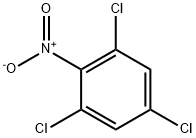
What is 2,4,6-TRICHLORONITROBENZENE?
Chemical properties
yellow solid
The Uses of 2,4,6-TRICHLORONITROBENZENE
1,3,5-Trichloro-2-nitrobenzene is a building block for organic synthesis.
General Description
Needles in alcohol or light beige crystals.
Air & Water Reactions
Insoluble in water.
Reactivity Profile
2,4,6-TRICHLORONITROBENZENE is incompatible with strong bases and strong oxidizing agents.
Health Hazard
SYMPTOMS: Absorption of a similar chemical into the body leads to formation of methemoglobin which in sufficient concentration causes cyanosis.
Fire Hazard
Flash point data for 2,4,6-TRICHLORONITROBENZENE are not available; however, 2,4,6-TRICHLORONITROBENZENE is probably combustible.
Properties of 2,4,6-TRICHLORONITROBENZENE
| Melting point: | 70-72 °C |
| Boiling point: | 303.2±37.0 °C(Predicted) |
| Density | 1.651±0.06 g/cm3(Predicted) |
| storage temp. | 2-8°C |
| solubility | methanol: 0.1 g/mL, clear |
| form | Solid |
| color | White to Pale Yellow |
| BRN | 2213282 |
| Stability: | Stable. Incompatible with strong bases, strong reducing agents, strong oxidizing agents. |
| CAS DataBase Reference | 18708-70-8(CAS DataBase Reference) |
| EPA Substance Registry System | 2,4,6-Trichloronitrobenzene (18708-70-8) |
Safety information for 2,4,6-TRICHLORONITROBENZENE
| Signal word | Danger |
| Pictogram(s) |
 Skull and Crossbones Acute Toxicity GHS06  Health Hazard GHS08 |
| GHS Hazard Statements |
H373:Specific target organ toxicity, repeated exposure H413:Hazardous to the aquatic environment, long-term hazard |
| Precautionary Statement Codes |
P273:Avoid release to the environment. P280:Wear protective gloves/protective clothing/eye protection/face protection. P314:Get medical advice/attention if you feel unwell. |
Computed Descriptors for 2,4,6-TRICHLORONITROBENZENE
New Products
9-Mesityl-10-methylacridinium perchlorate Sulfapyridine Fmoc-OSu (R)-(-)-2-Amino-1-propanol Cyclobutanone 5-bromo-4-fluoro-2-nitrobenzaldehyde 4 pentyn 1 ol N-Vinylformamide Phenethyl cinnamate Pyrrolo[1,2-a]pyrimidine-6-carboxylic acid, 4,6,7,8-tetrahydro-4-oxo-, sodium salt (1:1), (6S) Ethyl 3-phenylpropanoate β-Bromostyrene Methacrylate-PEG-Methacrylate, Mn:35000 2,4-Dihydroxyacetophenone 2-Chloro 5-Fluoro Pyridine Vasicinone 2-Chloroisonicotinic Acid Tween 80 or Polysorbate 80 Methyl trans-4-Aminocyclohexanecarboxylate Hydrochloride N-(4-fluoro-2-methoxy-5-nitrophenyl)-4-(1-methyl-1H-indol-3-yl)pyrimidin-2-amine Pirtobrutinib intd. 4-Nitrobenzotrifluoride 2-Pentyn-1-oL N-(4-Cyano-3-(trifluoromethyl)phenyl)-2-methyloxirane-2-carboxamideRelated products of tetrahydrofuran

You may like
-
 2,4,6-Trichloronitrobenzene CAS 18708-70-8View Details
18708-70-8 -
1191-95-3 Cyclobutanone 98+View Details
1191-95-3 -
Fmoc-OSu 98+View Details
82911-69-1 -
(R)-(-)-2-Amino-1-propanol 35320-23-1 98+View Details
35320-23-1 -
1191-95-3 Cyclobutanone 98+View Details
1191-95-3 -
213382-45-7 98+View Details
213382-45-7 -
Fmoc-OSu 98+View Details
82911-69-1 -
(R)-(-)-2-Amino-1-propanol 35320-23-1 98+View Details
35320-23-1
Statement: All products displayed on this website are only used for non medical purposes such as industrial applications or scientific research, and cannot be used for clinical diagnosis or treatment of humans or animals. They are not medicinal or edible.