
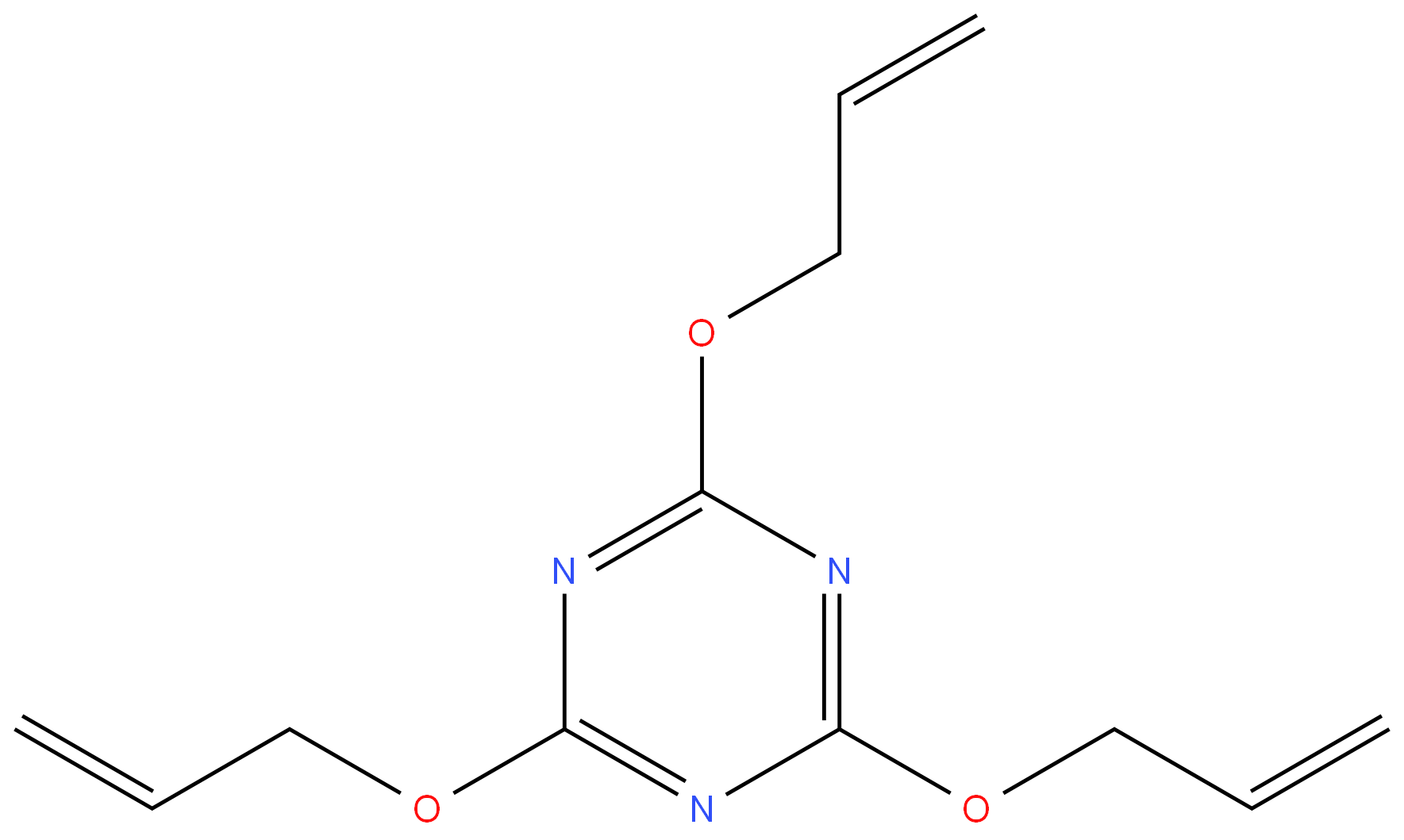
2,4,6-Triallyloxy-1,3,5-triazi
Synonym(s):2,4,6-Tris(allyloxy)-1,3,5-triazine;Cyanuric acid triallyl ester, Triallyl cyanurate;Triallyl cyanurate
- CAS NO.:101-37-1
- Empirical Formula: C12H15N3O3
- Molecular Weight: 249.27
- MDL number: MFCD00006049
- EINECS: 202-936-7
- SAFETY DATA SHEET (SDS)
- Update Date: 2026-06-24 18:39:39
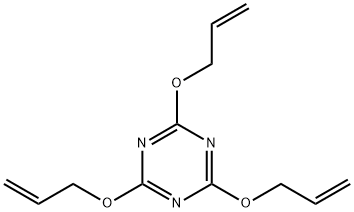
What is 2,4,6-Triallyloxy-1,3,5-triazi?
Chemical properties
Colorless liquid or solid. Miscible with acetone, benzene, chloroform, dioxane, ethyl acetate, ethanol, and xylene. Combustible.
The Uses of 2,4,6-Triallyloxy-1,3,5-triazi
Polymers as monomer and modifier, organic intermediate.
Definition
ChEBI: 2,4,6-triallyloxy-1,3,5-triazine is a member of 1,3,5-triazines and an aromatic ether.
Hazard
Toxic by ingestion and inhalation.
Flammability and Explosibility
Non flammable
Safety Profile
Poison by intravenous route. Flammable when exposed to heat, flame, or oxidizers. To fight fire, use spray, foam, dry chemical. When heated to decomposition or on contact with acid or acid fumes it emits hghly toxic fumes of CNand NOx. See also ESTERS and ALLYL, COMPOUNDS.
Properties of 2,4,6-Triallyloxy-1,3,5-triazi
| Melting point: | 26-28 °C |
| Boiling point: | 156 °C |
| Density | 1.11 g/mL at 30 °C |
| vapor pressure | 1.3 hPa (100 °C) |
| refractive index | 1.5290 (estimate) |
| Flash point: | >230 °F |
| storage temp. | Store at <= 20°C. |
| solubility | 0.3g/l |
| form | Oil |
| pka | 2.04±0.10(Predicted) |
| Specific Gravity | 1.11 |
| color | Colourless |
| Water Solubility | 6g/L(20 ºC) |
| BRN | 235560 |
| Stability: | Stable, but moisture-sensitive. Incompatible with acids, peroxides, strong oxidizing agents, copper, iron and its salts. |
| CAS DataBase Reference | 101-37-1(CAS DataBase Reference) |
| NIST Chemistry Reference | 2,4,6-Triallyloxy-1,3,5-triazine(101-37-1) |
| EPA Substance Registry System | 1,3,5-Triazine, 2,4,6-tris(2-propenyloxy)- (101-37-1) |
Safety information for 2,4,6-Triallyloxy-1,3,5-triazi
| Signal word | Warning |
| Pictogram(s) |
 Exclamation Mark Irritant GHS07  Environment GHS09 |
| GHS Hazard Statements |
H302:Acute toxicity,oral H411:Hazardous to the aquatic environment, long-term hazard |
| Precautionary Statement Codes |
P264:Wash hands thoroughly after handling. P264:Wash skin thouroughly after handling. P270:Do not eat, drink or smoke when using this product. P273:Avoid release to the environment. P391:Collect spillage. Hazardous to the aquatic environment P301+P312:IF SWALLOWED: call a POISON CENTER or doctor/physician IF you feel unwell. P501:Dispose of contents/container to..… |
Computed Descriptors for 2,4,6-Triallyloxy-1,3,5-triazi
New Products
9-Mesityl-10-methylacridinium perchlorate Sulfapyridine Fmoc-OSu (R)-(-)-2-Amino-1-propanol Cyclobutanone 5-bromo-4-fluoro-2-nitrobenzaldehyde 4 pentyn 1 ol N-Vinylformamide Phenethyl cinnamate Pyrrolo[1,2-a]pyrimidine-6-carboxylic acid, 4,6,7,8-tetrahydro-4-oxo-, sodium salt (1:1), (6S) Ethyl 3-phenylpropanoate β-Bromostyrene Methacrylate-PEG-Methacrylate, Mn:35000 2,4-Dihydroxyacetophenone 2-Chloro 5-Fluoro Pyridine Vasicinone 2-Chloroisonicotinic Acid Tween 80 or Polysorbate 80 5-Bromo-1-Pentyne 1-(2-Methyl-5-nitrophenyl)guanidine Nitrate Methyl trans-4-Aminocyclohexanecarboxylate Hydrochloride 2-Pentyn-1-oL 4-Nitrobenzotrifluoride N-(4-Cyano-3-(trifluoromethyl)phenyl)-2-methyloxirane-2-carboxamideRelated products of tetrahydrofuran

You may like
-
 101-37-1 Triallyl cyanurate 98%View Details
101-37-1 -
 Triallyl cyanurate CAS 101-37-1View Details
101-37-1 -
2,4,6-Tris(allyloxy)-1,3,5-triazine, stabilized with 100ppm hydroquinone CAS 101-37-1View Details
101-37-1 -
Triallyl Cyanurate CAS 101-37-1View Details
101-37-1 -
2,4,6-Triallyloxy-1,3,5-triazine CAS 101-37-1View Details
101-37-1 -
2,4,6-Tris(allyloxy)-1,3,5-triazine CAS 101-37-1View Details
101-37-1 -
Fmoc-OSu 98+View Details
82911-69-1 -
(R)-(-)-2-Amino-1-propanol 35320-23-1 98+View Details
35320-23-1
Statement: All products displayed on this website are only used for non medical purposes such as industrial applications or scientific research, and cannot be used for clinical diagnosis or treatment of humans or animals. They are not medicinal or edible.