
1,3,5-Triazine
Synonym(s):1,3,5-Triazine
- CAS NO.:290-87-9
- Empirical Formula: C3H3N3
- Molecular Weight: 81.08
- MDL number: MFCD00006044
- EINECS: 206-028-1
- SAFETY DATA SHEET (SDS)
- Update Date: 2026-11-04 17:01:59
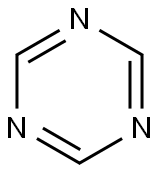
What is 1,3,5-Triazine?
Chemical properties
White crystal
The Uses of 1,3,5-Triazine
1,3,5-Triazine is a reagent in oxidation reactions, in synthesis of heterocycles. Triazine derivatives are used as herbicides, pharmaceuticals, complexation agents, peptidomimetic building blocks, and dyes.
What are the applications of Application
1,3,5-Triazine is a useful replacement for HCN in the Gattermann reaction for the synthesis of aromatic aldehydes. It reacts with nucleophiles, e.g. amines, which is utilized in quinazoline synthesis.
Definition
1,3,5-Triazine, also known as s-triazine, is a six-membered ring organic compound, which is one of the isomers of triazine.
Preparation
Symmetrical 1,3,5-triazines are prepared by trimerization of certain nitriles such as cyanogen chloride or cyanimide. Benzoguanamine (with one phenyl and 2 amino substituents) is synthesised from benzonitrile and dicyandiamide. In the Pinner triazine synthesis (named after Adolf Pinner) the reactants are an alkyl or aryl amidine and phosgene. Insertion of an N-H moiety into a hydrazide by a copper carbenoid, followed by treatment with ammonium chloride also gives the triazine core.
Amine-substituted triazines called Guanamines are prepared by the condensation of cyanoguanidine with the corresponding nitrile:
(H2N)2C=NCN + RCN → (CNH2)2(CR)N3
Properties of 1,3,5-Triazine
| Melting point: | 77-83 °C (dec.)(lit.) |
| Boiling point: | 114°C |
| Density | 1,38 g/cm3 |
| refractive index | 1.5060 (estimate) |
| Flash point: | 114°C |
| storage temp. | Inert atmosphere,Room Temperature |
| solubility | methanol: 0.1 g/mL, clear |
| pka | 2.07±0.10(Predicted) |
| form | powder to crystal |
| color | White to Orange to Green |
| Sensitive | Moisture Sensitive |
| Merck | 14,9602 |
| BRN | 104790 |
| CAS DataBase Reference | 290-87-9(CAS DataBase Reference) |
| NIST Chemistry Reference | 1,3,5-Triazine(290-87-9) |
Safety information for 1,3,5-Triazine
| Signal word | Danger |
| Pictogram(s) |
 Corrosion Corrosives GHS05  Exclamation Mark Irritant GHS07 |
| GHS Hazard Statements |
H302:Acute toxicity,oral H315:Skin corrosion/irritation H318:Serious eye damage/eye irritation H335:Specific target organ toxicity, single exposure;Respiratory tract irritation |
| Precautionary Statement Codes |
P280:Wear protective gloves/protective clothing/eye protection/face protection. P302+P352:IF ON SKIN: wash with plenty of soap and water. |
Computed Descriptors for 1,3,5-Triazine
New Products
2-(2-Chlorophenyl)glycine Propiolic Acid 1-(3-Hydroxy-4-methoxyphenyl)-2-nitroethene (±)-amino(2-fluorophenyl)acetic acid trans-3-Benzyloxy-4-methoxy-beta-nitrostyrene 1-Pentadecanol 4-(4-Αminophenyl)-3-Morpholinone 3-Morpholino-1-(4-(2-oxopiperidin-1-yl) phenyl)-5,6-dihyropyridin-2-(1H)-one 1-(4-Aminophenyl)-3-morpholino-5,6-dihydropyridin-2(1H)-one N-cyanoacetylurethane 1H-IndazoleRelated products of tetrahydrofuran


You may like
-
 1,3,5-Triazine CAS 290-87-9View Details
290-87-9 -
1,3,5-Triazine CAS 290-87-9View Details
290-87-9 -
s-Triazine CAS 290-87-9View Details
290-87-9 -
 1,3,5-Triazine CAS 290-87-9View Details
290-87-9 -
471-25-0 Propiolic Acid 98+View Details
471-25-0 -
2-(2-Chlorophenyl)glycine 88744-36-9 98+View Details
88744-36-9 -
40216-83-9 trans-4-Hydroxy-L-proline methyl ester hydrochloride 98+View Details
40216-83-9 -
1-(3-Hydroxy-4-methoxyphenyl)-2-nitroethene 98+View Details
39816-35-8