
2-Heptyl-4-hydroxyquinoline N-oxide
- CAS NO.:341-88-8
- Empirical Formula: C16H21NO2
- Molecular Weight: 259.34
- MDL number: MFCD00057295
- SAFETY DATA SHEET (SDS)
- Update Date: 2026-09-12 18:53:35
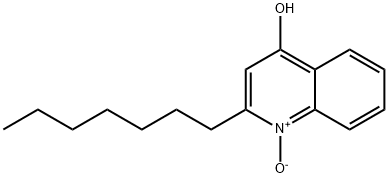
What is 2-Heptyl-4-hydroxyquinoline N-oxide?
Description
HQNO (341-88-8) is a naturally occurring antagonist of dihydrostreptomycin. Potent inhibitor of the respiratory chain binding to the mitochondrial cytochrome b protein. HQNO inhibits NADH oxidase (NADH) and Na+-dependent NADH-quinone reductase (NQR).
The Uses of 2-Heptyl-4-hydroxyquinoline N-oxide
HQNO is a streptomycin antagonist. A naturally occurring antagonist of dihydrostreptomycin.
What are the applications of Application
HQNO is a high affinity respiratory chain inhibitor of quinone oxidation and Zn(II) described to reduce oxygen in and the activity of proton pumps.
Definition
ChEBI: 2-heptyl-4-hydroxyquinoline N-oxide is an inhibitor of the mitochondrial respiratory chain at cytochrome bc1 and of photosynthetic electron flow immediately before cytochrome b559. It is a monohydroxyquinoline and a quinoline N-oxide.
References
References/Citations 1) Nakayama?et al. (1999),?Inhibitor studies of a new antibiotic, korormicin, 2-n-heptyl-4-hydroxyquinoline N-oxide and Ag+?toward the Na+-translocating NADH-quinone reductase from the marine Vibrio alginolyticus; Biol. Pharm. Bull.,?221064
Properties of 2-Heptyl-4-hydroxyquinoline N-oxide
| Melting point: | 156-157° |
| Boiling point: | 445.8±37.0 °C(Predicted) |
| Density | 1.09±0.1 g/cm3(Predicted) |
| storage temp. | Sealed in dry,2-8°C |
| solubility | Soluble in DMSO (up to 8 mg/ml with warming), or in Ethanol (up to 13 mg/ml with warming). |
| form | White to off-white crystalline solid. |
| pka | 1.07±0.40(Predicted) |
| color | White |
| Stability: | Stable for 2 years from date of purchase as supplied. Solutions in DMSO or ethanol may be stored at -20° for up to 1 month. |
Safety information for 2-Heptyl-4-hydroxyquinoline N-oxide
| Signal word | Warning |
| Pictogram(s) |
 Exclamation Mark Irritant GHS07 |
| GHS Hazard Statements |
H302:Acute toxicity,oral H312:Acute toxicity,dermal H315:Skin corrosion/irritation H319:Serious eye damage/eye irritation |
| Precautionary Statement Codes |
P280:Wear protective gloves/protective clothing/eye protection/face protection. P305+P351+P338:IF IN EYES: Rinse cautiously with water for several minutes. Remove contact lenses, if present and easy to do. Continuerinsing. |
Computed Descriptors for 2-Heptyl-4-hydroxyquinoline N-oxide
New Products
9-Mesityl-10-methylacridinium perchlorate Sulfapyridine Fmoc-OSu (R)-(-)-2-Amino-1-propanol Cyclobutanone 5-bromo-4-fluoro-2-nitrobenzaldehyde 4 pentyn 1 ol N-Vinylformamide Phenethyl cinnamate Pyrrolo[1,2-a]pyrimidine-6-carboxylic acid, 4,6,7,8-tetrahydro-4-oxo-, sodium salt (1:1), (6S) Ethyl 3-phenylpropanoate β-Bromostyrene Methacrylate-PEG-Methacrylate, Mn:35000 2,4-Dihydroxyacetophenone 2-Chloro 5-Fluoro Pyridine Vasicinone 2-Chloroisonicotinic Acid Tween 80 or Polysorbate 80 5-Bromo-1-Pentyne 1-(2-Methyl-5-nitrophenyl)guanidine Nitrate Methyl trans-4-Aminocyclohexanecarboxylate Hydrochloride 2-Pentyn-1-oL 4-Nitrobenzotrifluoride N-(4-Cyano-3-(trifluoromethyl)phenyl)-2-methyloxirane-2-carboxamideRelated products of tetrahydrofuran

You may like
-
 1191-95-3 Cyclobutanone 98+View Details
1191-95-3 -
213382-45-7 98+View Details
213382-45-7 -
Fmoc-OSu 98+View Details
82911-69-1 -
(R)-(-)-2-Amino-1-propanol 35320-23-1 98+View Details
35320-23-1 -
1191-95-3 Cyclobutanone 98+View Details
1191-95-3 -
213382-45-7 98+View Details
213382-45-7 -
Fmoc-OSu 98+View Details
82911-69-1 -
(R)-(-)-2-Amino-1-propanol 35320-23-1 98+View Details
35320-23-1