
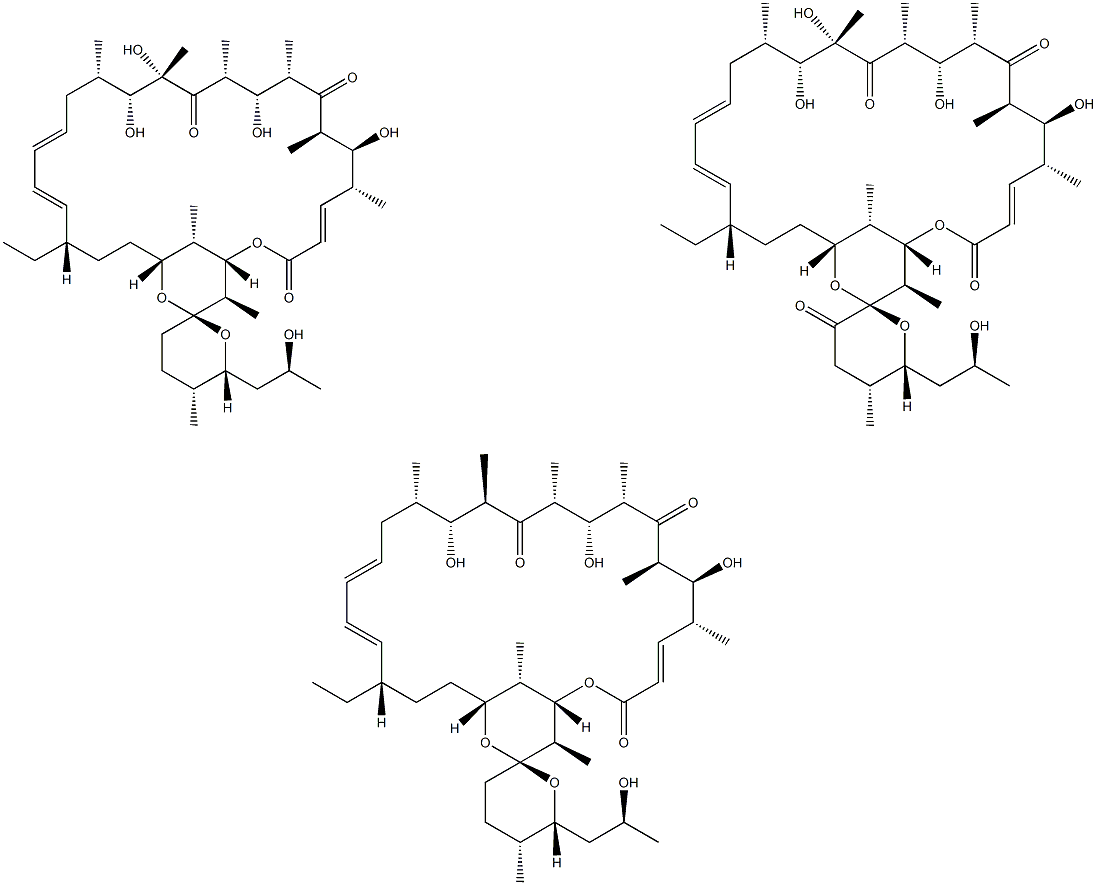
Nigericin sodium salt
Synonym(s):;Azalomycin M;Helexin C;Polyetherin A
- CAS NO.:28643-80-3
- Empirical Formula: C40H69NaO11
- Molecular Weight: 748.97
- MDL number: MFCD30377206
- EINECS: 608-231-4
- SAFETY DATA SHEET (SDS)
- Update Date: 2026-07-16 07:06:08
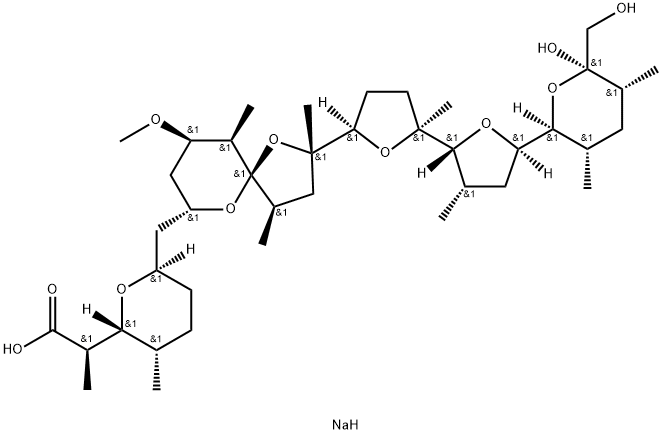
What is Nigericin sodium salt?
Description
Nigericin Na (28643-80-3) is a polyether ionophore which disrupts membrane potential and stimulates ATPase activity in mitochondria. Induces apoptosis resulting from intracellular acidification. Ion selectivity for nigericin Na is K+> Rb+> Cs+>>Na+. Cell permeable.
Chemical properties
NIGERICIN SODIUM SALT is white powder
The Uses of Nigericin sodium salt
Nigericin sodium salt is a polyether ionophore which catalyzes the electroneutral exchange of alkali metal (K+) for H+ (antiport). It disrupts membrane potential and stimulates ATPase activity in mitochondria. It transports monovalent cations across membranes with the following specificity: K+ >Rb+ >Cs+ >>Na. It kills bacteria by facilitating the diffusion of ions across membranes. It is widely used in studies of the consequences of changes in membrane potential in variable systems.
The Uses of Nigericin sodium salt
Nigericin sodium is the atypical salt of nigericin. Since nigericin is an ionophore, its very high affinity for monovalent cations such as Na+ and K+ means that formation of a salt is a facile possess occurring during purification under any but highly acidic conditions. Typically, the salts of polyether ionophores like the free acid, are readily extracted into organic solvents. The sodium ion is stabilised within a polar pocket of the structure, effectively making the salt and free acid different chemical moieties with the potential for differing pharmacology, a fact not readily appreciated in the literature.
The Uses of Nigericin sodium salt
Nigericin sodium is a salt of the atypical polyether antibiotic, nigericin. Since nigericin is an ionophore, its very high affinity for monovalent cations such as Na+ and K+ means that formation of a salt is a facile possess occurring during purification under any but highly acidic conditions. Typically, the salts of polyether ionophores like the free acid, are readily extracted into organic solvents. The sodium ion is stabilised within a polar pocket of the structure, effectively making the salt and free acid different chemical moieties with the potential for differing pharmacology, a fact not readily appreciated in the literature.
What are the applications of Application
Nigericin sodium salt is a polyether antibioitc K+ and Na+ ionophore
General Description
A monocarboxylate that catalyzes the electroneutral exchange of an alkali metal for H+ (antiport). Transports monovalent cations across membranes with the following specificities: K+>Rb+>Cs+>>Na+. An antibiotic that kills bacteria by facilitating the diffusion of ions across membranes. Disrupts the membrane potential and stimulates mitochondrial ATPase activity.
Biochem/physiol Actions
Product does not compete with ATP.
Storage
Store at -20°C
References
1) Akhmedov et al. (2010), Mitochondrial matrix pH controls oxidative phosphorylation and metabolism-secretion coupling in INS-1E clonal beta cells; FASEB J., 24 4613 2) Gong et al. (2010), Chemical probing reveals insights into the signaling mechanism of inflammasome activation; Cell Res., 20 1289
Properties of Nigericin sodium salt
| Melting point: | approximate 255℃ |
| storage temp. | 2-8°C |
| solubility | Soluble in chloroform, methanol or ethanol |
| form | solution |
| color | White |
| Merck | 13,6569 |
| BRN | 3892398 |
| Stability: | Stable for 2 years from date of purchase as supplied. Solutions in DMSO or ethanol may be stored at -20° for up to 2 months. |
Safety information for Nigericin sodium salt
| Signal word | Danger |
| Pictogram(s) |
 Skull and Crossbones Acute Toxicity GHS06 |
| GHS Hazard Statements |
H301:Acute toxicity,oral H319:Serious eye damage/eye irritation |
| Precautionary Statement Codes |
P264:Wash hands thoroughly after handling. P264:Wash skin thouroughly after handling. P270:Do not eat, drink or smoke when using this product. P280:Wear protective gloves/protective clothing/eye protection/face protection. P301+P310:IF SWALLOWED: Immediately call a POISON CENTER or doctor/physician. P305+P351+P338:IF IN EYES: Rinse cautiously with water for several minutes. Remove contact lenses, if present and easy to do. Continuerinsing. P337+P313:IF eye irritation persists: Get medical advice/attention. |
Computed Descriptors for Nigericin sodium salt
| InChIKey | MOYOTUKECQMGHE-NTQCAYBPSA-M |
New Products
2-Bromo-4-hydroxypyridine Dibenzoyl-L-tartaric acid Anhydrous (Resolution Reagent) Dibenzo[b,f][1,4]thiazepin-11(10H)-one 1,2,3,9-Tetrahydro-9-Methyl-4H-Carbazole-4-One Cis-Tosylate 1-(4-methoxyphenyl)-4-(4-Nitrophenyl)Piperazine (IT-1) 2'-Fluoroacetophenone 1-aminocyclobutanecarbonitrile hydrochloride AMINO-O-TOLYL-ACETIC ACID N-Methyl-2-amino-2-methylpropionamide 4-(FMOC-AMINO)-TETRAHYDROPYRAN-4-CARBOXYLIC ACID 1-Aminocyclobutanecarboxylic Acid Hydrochloride METHANOL-D1(OD) TERTIARY BUTANOL-D9 N-ETHYL-D5-AMINE HYDROCHLORIDE BENZOIC ACID-D CHLOROFORM-D TOLUENE-D3 2-(2-Bromophenyl)ethanol Boc-D-Glu(OMe)-OMe 2,5 Dibromopyridine Ethyl 4-hydroxy-3-oxobutanoate Dimethyl (2S)-2-((tert-butoxycarbonyl)amino)-4-(cyanomethyl)pentanedioate 1-(3-Chlorophenyl)piperazine hydrochlorideRelated products of tetrahydrofuran

You may like
-
 Nigericin sodium salt CAS 28643-80-3View Details
28643-80-3 -
106914-07-2 N-Methyl-2-amino-2-methylpropionamide 98+View Details
106914-07-2 -
129592-98-9 98+View Details
129592-98-9 -
4-(FMOC-AMINO)-TETRAHYDROPYRAN-4-CARBOXYLIC ACID 98+View Details
285996-72-7 -
1-aminocyclobutanecarbonitrile hydrochloride 845821-84-3 98+View Details
845821-84-3 -
98071-16-0 1-Aminocyclobutanecarboxylic Acid Hydrochloride 98+View Details
98071-16-0 -
 ADC-151View Details
27176-87-0 -
 Nickel Acetate | Eastmen Chemicals - Manufacturer, Supplier, Exporter metallic saltsView Details