
Biotinyl tyramide
- CAS NO.:41994-02-9
- Empirical Formula: C18H25N3O3S
- Molecular Weight: 363.47
- MDL number: MFCD27953026
- SAFETY DATA SHEET (SDS)
- Update Date: 2026-05-28 04:00:16

What is Biotinyl tyramide?
Description
Biotinyl tyramide is a reagent that has been used for tyramide signal amplification (TSA) via catalyzed reporter deposition (CARD). In CARD, a reporter enzyme, such as horseradish peroxidase (HRP) conjugated to a secondary antibody, is bound to the target of interest and catalyzes the covalent deposition of biotinyl tyramide to the sample. The sample is then probed by a detector, such as streptavidin-HRP, allowing detection via chromogenic or fluorescent methods. Biotinyl tyramide has been used in immunohistochemistry, ELISA, Western blot, and in situ hybridization applications.
The Uses of Biotinyl tyramide
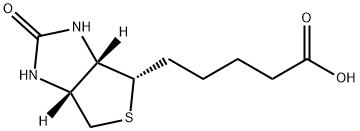
Biotinyl Tyramide is a Biotin (B389040) derivative, a growth factor present in minute amounts in every living cell. Plays an indispensable role in numerous naturally occurring carboxylation reactions. Occurs mainly bound to proteins or polypeptides. The richest sources are liver, kidney, pancreas, yeast, and milk. The biotin content of cancerous tumors is higher than that of normal tissue.
Solubility in water
Biotinyl tyramide is supplied as a solid. A stock solution may be made by dissolving the biotin tyramide in the solvent of choice, which should be purged with an inert gas. It is soluble in organic solvents such as DMS0 and dimethyl formamide. The solubility of biotinyl tyramide in these solvents is approximately 30 mg/ml.
This product is sparingly soluble in aqueous buffers. For maximum solubility in aqueous buffers, biotinyl tyramide should first be dissolved in DMSO and then diluted with the aqueous buffer of choice. Biotinyl tyramide has a solubility of approximately 0.16 mg/ml in a 1:5 solution of DMSO: PBS(pH 7.2) using this method.
Storage
Store at -20°C
References
1) Bobrow?et al.?(1989),?Catalyzed reporter deposition, a novel method of signal amplification. Application to immunoassays; J. Immunol. Methods,?125?279 2) Evans?et al.?(2003),?Optimization of biotinyl-tyramide-based in situ hybridization for sensitive background-free applications in formalin-fixed, paraffin-embedded tissue specimens; BMC. Clin. Pathol.,?3?2 3) Draerova?et al.?(2013),?Quantification of a-tubulin by sandwich ELISA with signal amplification through niotinyl-tyramide or immune-PCR; J. Immunol. Methods,?395?63 4) Einarson and Sen (2017),?Self-biotinylation of DNA G-quadruplexes via intrinsic peroxidase activity; Nucleic Acids Res.,?45?9813 5) Hwang and Espenshade (2016),?Proximity-dependent biotin labelling in yeast using the engineered ascorbate peroxidase APEX2; Biochem. J.,?473?2463
Properties of Biotinyl tyramide
| Boiling point: | 735.8±60.0 °C(Predicted) |
| Density | 1.227±0.06 g/cm3(Predicted) |
| storage temp. | 2-8°C |
| solubility | Soluble in DMSO (up to 35 mg/ml) or in Ethanol (up to 20 mg/ml) |
| form | solid |
| pka | 10.01±0.15(Predicted) |
| color | White |
| Stability: | Stable for 1 year from date of purchase as supplied. Solutions in DMSO or ethanol may be stored at -20°C for up to 1 month. |
Safety information for Biotinyl tyramide
| Signal word | Warning |
| Pictogram(s) |
 Exclamation Mark Irritant GHS07 |
| GHS Hazard Statements |
H302:Acute toxicity,oral H315:Skin corrosion/irritation H319:Serious eye damage/eye irritation H335:Specific target organ toxicity, single exposure;Respiratory tract irritation |
| Precautionary Statement Codes |
P261:Avoid breathing dust/fume/gas/mist/vapours/spray. P305+P351+P338:IF IN EYES: Rinse cautiously with water for several minutes. Remove contact lenses, if present and easy to do. Continuerinsing. |
Computed Descriptors for Biotinyl tyramide
| InChIKey | VZWXNOBHWODXCW-ZOBUZTSGSA-N |
| SMILES | C1(=O)N[C@]2([H])[C@H](CCCCC(NCCC3=CC=C(O)C=C3)=O)SC[C@]2([H])N1 |
New Products
Cyclobutanone (R)-(-)-2-Amino-1-propanol Fmoc-OSu 5-bromo-4-fluoro-2-nitrobenzaldehyde 2-Amino-2-(4-methylphenyl)acetic acid 1-(2-Chloroethyl)pyrrolidine Hydrochloride 2,4-Dihydroxybenzaldehyde Obidoxime hydrochloride API Pyrrolo[1,2-a]pyrimidine-6-carboxylic acid, 4,6,7,8-tetrahydro-4-oxo-, sodium salt (1:1), (6S) Dipropyl disulfide N-Vinylformamide 4 pentyn 1 ol Methacrylate-PEG-Methacrylate, Mn:35000 2,4-Dihydroxyacetophenone 2-Chloro 5-Fluoro Pyridine Vasicinone 2-Chloroisonicotinic Acid Tween 80 or Polysorbate 80 2-Butyn-1-oL N-(4-fluoro-2-methoxy-5-nitrophenyl)-4-(1-methyl-1H-indol-3-yl)pyrimidin-2-amine Pirtobrutinib intd. 2-Pentyn-1-oL 4-Nitrobenzotrifluoride N-(4-Cyano-3-(trifluoromethyl)phenyl)-2-methyloxirane-2-carboxamideRelated products of tetrahydrofuran

![3-[2-N-(BIOTINYL)AMINOETHYLDITHIO]PROPANOIC ACID](https://img.chemicalbook.in/StructureFile/ChemBookStructure7/GIF/CB2425667.gif)
You may like
-
 Biotinyl tyramide CAS 41994-02-9View Details
41994-02-9 -
7250-67-1 1-(2-Chloroethyl)pyrrolidine Hydrochloride 98+View Details
7250-67-1 -
7250-67-1 1-(2-Chloroethyl)pyrrolidine Hydrochloride 98+View Details
7250-67-1 -
13227-01-5 98+View Details
13227-01-5 -
545445-44-1 3-Morpholino-1-(4-(2-oxopiperidin-1-yl) phenyl)-5,6-dihyropyridin-2-(1H)-one 98%View Details
545445-44-1 -
6629-04-5 98%View Details
6629-04-5 -
4-(4-Αminophenyl)-3-Morpholinone 98%View Details
438056-69-0 -
1-(4-Aminophenyl)-3-morpholino-5,6-dihydropyridin-2(1H)-one 1267610-26-3 98%View Details
1267610-26-3