
1,5-Dinitronaphthalene
- CAS NO.:605-71-0
- Empirical Formula: C10H6N2O4
- Molecular Weight: 218.17
- MDL number: MFCD00003916
- EINECS: 210-095-2
- SAFETY DATA SHEET (SDS)
- Update Date: 2026-05-28 05:20:54
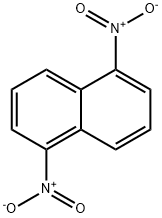
What is 1,5-Dinitronaphthalene?
Chemical properties
Yellow to yellow-green needles or fluffy powder
The Uses of 1,5-Dinitronaphthalene
1,5-Dinitronaphthalene is an intermediate in the production of naphthazarin (5,8- dihydroxy-1,4-naphthoquinone) and 1,5- naphthalenediamine, which is mainly converted to naphthalene 1,5-diisocyanate. As a sensitizing agent for ammonium nitrate explosives the use of mixed isomers is adequate.
Definition
ChEBI: 1,5-dinitronaphthalene is a dinitronaphthalene carrying nitro groups at positions 1 and 5. It has a role as a genotoxin.
Production Methods
Naphthalene is added slowly to mixed acid (22/58/20) at 40 ℃, and the temperature is raised to 80 ℃ over 4 h to give a mixture of 1,5- and 1,8-dinitronaphthalenes. The isomers are separated by fractional crystallization (e.g., from ethylene dichloride) or, preferably, by solvent extraction. The 1,5-isomer can be extracted with toluene, leaving 99 % pure 1,8- dinitronaphthalene. After evaporation of the toluene, the residue is extracted with a strongly polar solvent (e.g., sulfolane) to leave 99 % pure 1,5-isomer.
General Description
Yellowish white needles or light yellow fluffy solid.
Air & Water Reactions
Insoluble in water.
Reactivity Profile
1,5-Dinitronaphthalene is incompatible with strong oxidizers and strong bases. Mixtures with sulfur or sulfuric acid may explode if heated to 248° F .
Fire Hazard
Flash point data for 1,5-Dinitronaphthalene are not available; however, 1,5-Dinitronaphthalene is probably combustible.
Safety Profile
A suspected carcinogen. Mutation data reported. Mxtures with sulfur or sulfuric acid (used in commercial reactions) may explode if heated to 120℃. Initiation temperature depends on the quality of the dinitronaphthalene. When heated to decomposition it emits toxic fumes of NOx. See also NITRO COMPOUNDS of AROMATICHYDROCARBONS
Properties of 1,5-Dinitronaphthalene
| Melting point: | 214 °C |
| Boiling point: | 358.84°C (rough estimate) |
| Density | 1.58 |
| refractive index | 1.7040 (estimate) |
| solubility | Acetonitrile (Very Slightly), Chloroform (Slightly), DMSO (Very Slightly) |
| form | Solid:granular |
| Water Solubility | 60 ppm (12 ºC), 90 ppm (50 ºC) |
| BRN | 527184 |
| CAS DataBase Reference | 605-71-0(CAS DataBase Reference) |
| NIST Chemistry Reference | Naphthalene, 1,5-dinitro-(605-71-0) |
| EPA Substance Registry System | 1,5-Dinitronaphthalene (605-71-0) |
Safety information for 1,5-Dinitronaphthalene
| Signal word | Danger |
| Pictogram(s) |
 Corrosion Corrosives GHS05  Exclamation Mark Irritant GHS07  Health Hazard GHS08 |
| GHS Hazard Statements |
H315:Skin corrosion/irritation H317:Sensitisation, Skin H318:Serious eye damage/eye irritation H319:Serious eye damage/eye irritation H335:Specific target organ toxicity, single exposure;Respiratory tract irritation H341:Germ cell mutagenicity H402:Hazardous to the aquatic environment, acute hazard H412:Hazardous to the aquatic environment, long-term hazard |
| Precautionary Statement Codes |
P201:Obtain special instructions before use. P202:Do not handle until all safety precautions have been read and understood. P261:Avoid breathing dust/fume/gas/mist/vapours/spray. P264:Wash hands thoroughly after handling. P264:Wash skin thouroughly after handling. P273:Avoid release to the environment. P280:Wear protective gloves/protective clothing/eye protection/face protection. P305+P351+P338:IF IN EYES: Rinse cautiously with water for several minutes. Remove contact lenses, if present and easy to do. Continuerinsing. P308+P313:IF exposed or concerned: Get medical advice/attention. P405:Store locked up. P501:Dispose of contents/container to..… |
Computed Descriptors for 1,5-Dinitronaphthalene
New Products
5-bromo-4-fluoro-2-nitrobenzaldehyde (R)-(-)-2-Amino-1-propanol Cyclobutanone Fmoc-OSu 1-(2-Chloroethyl)pyrrolidine Hydrochloride 2-Amino-2-(4-methylphenyl)acetic acid β-Bromostyrene Ethyl 3-phenylpropanoate Phenethyl cinnamate Dipropyl disulfide 4 pentyn 1 ol N-Vinylformamide Methacrylate-PEG-Methacrylate, Mn:35000 2,4-Dihydroxyacetophenone 2-Chloro 5-Fluoro Pyridine Vasicinone 2-Chloroisonicotinic Acid Tween 80 or Polysorbate 80 2-Butyn-1-oL 2-Pentyn-1-oL 4-Nitrobenzotrifluoride N-(4-fluoro-2-methoxy-5-nitrophenyl)-4-(1-methyl-1H-indol-3-yl)pyrimidin-2-amine Pirtobrutinib intd. N-(4-Cyano-3-(trifluoromethyl)phenyl)-2-methyloxirane-2-carboxamideRelated products of tetrahydrofuran


You may like
-
 Fmoc-OSu 98+View Details
82911-69-1 -
(R)-(-)-2-Amino-1-propanol 35320-23-1 98+View Details
35320-23-1 -
7250-67-1 1-(2-Chloroethyl)pyrrolidine Hydrochloride 98+View Details
7250-67-1 -
13227-01-5 98+View Details
13227-01-5 -
7250-67-1 1-(2-Chloroethyl)pyrrolidine Hydrochloride 98+View Details
7250-67-1 -
13227-01-5 98+View Details
13227-01-5 -
7250-67-1 1-(2-Chloroethyl)pyrrolidine Hydrochloride 98+View Details
7250-67-1 -
13227-01-5 98+View Details
13227-01-5