
1,8-Dinitronaphthalene
- CAS NO.:602-38-0
- Empirical Formula: C10H6N2O4
- Molecular Weight: 218.17
- MDL number: MFCD00003918
- EINECS: 210-016-1
- SAFETY DATA SHEET (SDS)
- Update Date: 2026-05-28 02:45:22
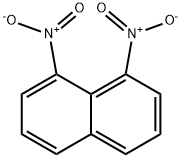
What is 1,8-Dinitronaphthalene?
Chemical properties
Light yellow to Yellow to Orange powder to crystal.
The Uses of 1,8-Dinitronaphthalene
1,8-Dinitronaphthalene (cas# 602-38-0) is a compound useful in organic synthesis.
Definition
ChEBI: 1,8-dinitronaphthalene is a dinitronaphthalene carrying nitro groups at positions 1 and 8.
What are the applications of Application
The reduction of 1,8-dinitronaphthalene to diaminonaphthalene is an important organic synthesis unit reaction and an important way to prepare diaminonaphthalene, and its product diaminonaphthalene is an important pigment intermediate. Diaminonaphthalene mainly includes 1,5-diaminonaphthalene and 1,8-diaminonaphthalene.
Preparation
Separation of dinitronaphthalene: Crude mixtures of dinitronaphthalene (5 g, from Table-3 run 8) was placed together with 50 mL acetone in a 100 mL flask, stirred and heated to reflux. The suspension was refluxing for 2 h and then cooled to 30 oC by stirred and filtered quickly. The precipitate was recrystallized by acetone and 1,5-dinitronaphthalene as light yellow crystals (1.725 g) was got. Then the filter liquor was concentrated to one-thirds of original volume, filtered, the precipitate was recrystallized by toluene and 1,8- dinitronaphthalene as light yellow crystals (1.987 g) was got.
1, 5-Dinitronaphthalene: m.p. 215-216 oC, 1H NMR (400 MHz, CDCl3): δ = 7.84 (t, 2H), 8.33 (d, 2H), 8.81 (d, 2H).
1, 8-Dinitronaphthalene: m.p. 172-173 oC, 1H NMR (400 MHz, CDCl3): δ = 7.98 (t, 2H), 8.51 (dd, 4H).
Zeolite-Assisted Regioselective Synthesis of Dinitronaphthalene
General Description
1,8-dinitronaphthalene appears as yellow crystals. (NTP, 1992)
Air & Water Reactions
Insoluble in water.
Reactivity Profile
1,8-Dinitronaphthalene is sensitive to heat and shock.
Fire Hazard
Flash point data for 1,8-Dinitronaphthalene is not available, however 1,8-Dinitronaphthalene is probably combustible.
Safety Profile
Suspected carcinogen. Mutation data reported. When heated to decomposition it emits toxic vapors of NOx
Purification Methods
Crystallise it from *benzene. [Beilstein 5 H 559, 5 II 455, 5 III 1608.]
Properties of 1,8-Dinitronaphthalene
| Melting point: | 161 °C |
| Boiling point: | 358.84°C (rough estimate) |
| Density | 1.4330 (rough estimate) |
| refractive index | 1.7040 (estimate) |
| solubility | DMSO (Slightly), Methanol (Slightly) |
| form | Solid |
| color | Pale Yellow to Light Yellow |
| Water Solubility | 34mg/L(15 ºC) |
| Stability: | Stability Shock and heat sensitive - may react violently if heated or ground. Combustible. Incompatible with strong oxidizing agents. |
| CAS DataBase Reference | 602-38-0(CAS DataBase Reference) |
| NIST Chemistry Reference | Naphthalene, 1,8-dinitro-(602-38-0) |
| EPA Substance Registry System | 1,8-Dinitronaphthalene (602-38-0) |
Safety information for 1,8-Dinitronaphthalene
| Signal word | Warning |
| Pictogram(s) |
 Flame Flammables GHS02  Exclamation Mark Irritant GHS07 |
| GHS Hazard Statements |
H228:Flammable solids H315:Skin corrosion/irritation H319:Serious eye damage/eye irritation H335:Specific target organ toxicity, single exposure;Respiratory tract irritation |
| Precautionary Statement Codes |
P210:Keep away from heat/sparks/open flames/hot surfaces. — No smoking. P240:Ground/bond container and receiving equipment. P241:Use explosion-proof electrical/ventilating/lighting/…/equipment. P261:Avoid breathing dust/fume/gas/mist/vapours/spray. P302+P352:IF ON SKIN: wash with plenty of soap and water. P305+P351+P338:IF IN EYES: Rinse cautiously with water for several minutes. Remove contact lenses, if present and easy to do. Continuerinsing. |
Computed Descriptors for 1,8-Dinitronaphthalene
| InChIKey | AVCSMMMOCOTIHF-UHFFFAOYSA-N |
New Products
5-bromo-4-fluoro-2-nitrobenzaldehyde (R)-(-)-2-Amino-1-propanol Cyclobutanone Fmoc-OSu 1-(2-Chloroethyl)pyrrolidine Hydrochloride 2-Amino-2-(4-methylphenyl)acetic acid β-Bromostyrene Ethyl 3-phenylpropanoate Phenethyl cinnamate Dipropyl disulfide 4 pentyn 1 ol N-Vinylformamide Methacrylate-PEG-Methacrylate, Mn:35000 2,4-Dihydroxyacetophenone 2-Chloro 5-Fluoro Pyridine Vasicinone 2-Chloroisonicotinic Acid Tween 80 or Polysorbate 80 2-Butyn-1-oL 2-Pentyn-1-oL 4-Nitrobenzotrifluoride N-(4-fluoro-2-methoxy-5-nitrophenyl)-4-(1-methyl-1H-indol-3-yl)pyrimidin-2-amine Pirtobrutinib intd. N-(4-Cyano-3-(trifluoromethyl)phenyl)-2-methyloxirane-2-carboxamideRelated products of tetrahydrofuran


You may like
-
 1,8-Dinitronaphthalene CAS 602-38-0View Details
602-38-0 -
Fmoc-OSu 98+View Details
82911-69-1 -
7250-67-1 1-(2-Chloroethyl)pyrrolidine Hydrochloride 98+View Details
7250-67-1 -
13227-01-5 98+View Details
13227-01-5 -
7250-67-1 1-(2-Chloroethyl)pyrrolidine Hydrochloride 98+View Details
7250-67-1 -
13227-01-5 98+View Details
13227-01-5 -
7250-67-1 1-(2-Chloroethyl)pyrrolidine Hydrochloride 98+View Details
7250-67-1 -
13227-01-5 98+View Details
13227-01-5