
1-Nitronaphthalene
- CAS NO.:86-57-7
- Empirical Formula: C10H7NO2
- Molecular Weight: 173.17
- MDL number: MFCD00003913
- EINECS: 201-684-5
- SAFETY DATA SHEET (SDS)
- Update Date: 2026-05-28 00:33:54
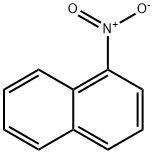
What is 1-Nitronaphthalene?
Chemical properties
yellow crystalline solid
The Uses of 1-Nitronaphthalene
1-Nitronaphthalene as a nitroaromatic compound is studied for mutagenicity, as nitroaromatics are used in everyday products from polmers, dyes to drugs.
The Uses of 1-Nitronaphthalene
Usually used to study excited state dynamics of 1-nitropthalene in nonpolar, aprotic and protic solvents.
Definition
ChEBI: A mononitronaphthalene substituted by a nitro group at position 1.
Production Methods
One method to product 1-Nitronaphthalene: Naphthalene is charged to sulfuric acid alternately with mixed acid at 40 – 50 ℃ over 8 h, with the final temperature being 55 ℃. The acid strength used allows the molten product to be separated as an oil and washed. Continuous operation at 50 – 60 ℃ with mixed acid (33/48/19) gives a comparable product. The crude reaction product is obtained in 90 – 95 % yield and is purified by vacuum distillation.
General Description
1-Nitronaphthalene is a mutagenic nitroaromatic compound present in diesel exhaust and it causes acute liver and lung toxicity in rodents. 1-Nitronaphthalene is a cytochrome P450-bioactivated, nonciliated bronchiolar epithelial (Clara) cell cytotoxicant .
Biochem/physiol Actions
1-Nitronaphthalene binds covalently to protein and forms adducts in the rat airway epithelium in vivo.
Safety Profile
Poison by intraperitoneal route. Mutation data reported. A skin, eye, and mucous membrane irritant. Flammable solid and combustible liquid when exposed to heat or flame. To fight fire, use CO2, dry chemical, or water spray. Explosive reaction with nitric acid + sulfuric acid above 60°C. Forms a sensitive explosive mixture with tetranitromethane. When heated to decomposition it emits toxic fumes of NOx. See also 2-NITRONAPHTHALENE and NITRO COMPOUNDS OF AROMATIC HYDROCARBONS.
Purification Methods
Fractionally distil 1-nitronaphthalene under reduced pressure, then crystallise it from EtOH, aqueous EtOH or heptane. Chromatograph it on alumina with *benzene/pet ether as eluent. It sublimes in vacuo. The 1:1 picrate complex has m 72o (from EtOH). [Beilstein 5 H 553, 5 III 1593, 5 IV 1673.]
Properties of 1-Nitronaphthalene
| Melting point: | 56 °C |
| Boiling point: | 304 °C(lit.) |
| Density | 1.223 g/mL at 25 °C(lit.) |
| refractive index | 1.5200 (estimate) |
| Flash point: | 164 °C |
| storage temp. | 2-8°C |
| solubility | H2O: insoluble |
| form | neat |
| color | Light Yellow To Yellow |
| Specific Gravity | 1.223 |
| Water Solubility | 0.022 g/L |
| Merck | 14,6613 |
| BRN | 1867714 |
| Stability: | Stable. Combustible. Incompatible with oxidizing agents, strong reducing agents. Mixtures with sulfuric or nitric acid are dangerous. |
| CAS DataBase Reference | 86-57-7(CAS DataBase Reference) |
| IARC | 3 (Vol. 46) 1989 |
| NIST Chemistry Reference | Naphthalene, 1-nitro-(86-57-7) |
| EPA Substance Registry System | 1-Nitronaphthalene (86-57-7) |
Safety information for 1-Nitronaphthalene
| Signal word | Warning |
| Pictogram(s) |
 Flame Flammables GHS02  Exclamation Mark Irritant GHS07  Environment GHS09 |
| GHS Hazard Statements |
H228:Flammable solids H302:Acute toxicity,oral H411:Hazardous to the aquatic environment, long-term hazard |
| Precautionary Statement Codes |
P210:Keep away from heat/sparks/open flames/hot surfaces. — No smoking. P240:Ground/bond container and receiving equipment. P241:Use explosion-proof electrical/ventilating/lighting/…/equipment. P264:Wash hands thoroughly after handling. P264:Wash skin thouroughly after handling. P273:Avoid release to the environment. P301+P312:IF SWALLOWED: call a POISON CENTER or doctor/physician IF you feel unwell. |
Computed Descriptors for 1-Nitronaphthalene
| InChIKey | RJKGJBPXVHTNJL-UHFFFAOYSA-N |
New Products
5-bromo-4-fluoro-2-nitrobenzaldehyde (R)-(-)-2-Amino-1-propanol Cyclobutanone Fmoc-OSu 1-(2-Chloroethyl)pyrrolidine Hydrochloride 2-Amino-2-(4-methylphenyl)acetic acid β-Bromostyrene Ethyl 3-phenylpropanoate Phenethyl cinnamate Dipropyl disulfide 4 pentyn 1 ol N-Vinylformamide Methacrylate-PEG-Methacrylate, Mn:35000 2,4-Dihydroxyacetophenone 2-Chloro 5-Fluoro Pyridine Vasicinone 2-Chloroisonicotinic Acid Tween 80 or Polysorbate 80 2-Butyn-1-oL 2-Pentyn-1-oL 4-Nitrobenzotrifluoride N-(4-fluoro-2-methoxy-5-nitrophenyl)-4-(1-methyl-1H-indol-3-yl)pyrimidin-2-amine Pirtobrutinib intd. N-(4-Cyano-3-(trifluoromethyl)phenyl)-2-methyloxirane-2-carboxamideRelated products of tetrahydrofuran


You may like
-
 1-Nitro naphthalene CAS 86-57-7View Details
86-57-7 -
1-Nitronaphthalene CAS 86-57-7View Details
86-57-7 -
7250-67-1 1-(2-Chloroethyl)pyrrolidine Hydrochloride 98+View Details
7250-67-1 -
13227-01-5 98+View Details
13227-01-5 -
7250-67-1 1-(2-Chloroethyl)pyrrolidine Hydrochloride 98+View Details
7250-67-1 -
13227-01-5 98+View Details
13227-01-5 -
7250-67-1 1-(2-Chloroethyl)pyrrolidine Hydrochloride 98+View Details
7250-67-1 -
13227-01-5 98+View Details
13227-01-5