
viridicatumtoxin
- CAS NO.:39277-41-3
- Empirical Formula: C30H31NO10
- Molecular Weight: 565.57
- MDL number: MFCD01675248
- SAFETY DATA SHEET (SDS)
- Update Date: 2026-05-28 04:10:48
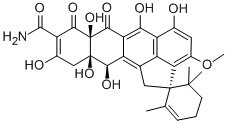
What is viridicatumtoxin?
Description
Viridicatumtoxin in a mycotoxin originally isolated from Penicillium that has diverse biological activities, including antimicrobial, cytotoxic, and toxic properties. It inhibits the growth of B. subtilis, M. luteus, C. perfringens, B. fragilis, and methicillin-resistant S. aureus (MRSA; MICs = 0.39-1.56 μg/ml), as well as C. albicans, S. cerevisiae, M. racemosus, A. niger, and P. chrysogenum (MICs = 6.2-25 μg/ml), but has no activity against M. smegmatis, E. coli, K. pneumoniae, P. aeruginosa, or S. marcescens (MICs = >100 μg/ml). Viridicatumtoxin inhibits the production of polyprenyl alcohols by S. aureus undecaprenyl pyrophosphate (UPP) synthase, E. coli octaprenyl pyrophosphate synthase (OPS), and S. cerevisiae dehydrodolichyl pyrophosphate (DedoIPP) synthase in vitro (IC50s = 3.1, 21, and 71 μM, respectively). It has cytotoxic effects against human Jurkat T (IC50 = 4.92 μM), chronic lymphocytic leukemia (CLL; LC50 = 0.7-3.5 nM), and bone marrow-derived HS-5 stromal cells. Viridicatumtoxin is toxic to rats and mice when administered intraperitoneally (LD50s = 80 and 90 mg/kg, respectively) and to rats when administered via gastric intubation (LD50 = 122.4 mg/kg), but not to rats or mice when administered orally or through subcutaneous injection.
The Uses of viridicatumtoxin
Viridicatumtoxin is a tetracycline-like metabolite produced by several species of Penicillium, first isolated in 1976 as a mycotoxin. Initial testing revealed that viridicatumtoxin caused myocardial deterioration, renal tubule necrosis and spleen atrophy. Analogous to the related tetracyclines, viridicatumtoxin was found to be a potent antibacterial, with activity against S. aureus including MRSA and QRSA strains. Little has been published on the mode of action of viridicatumtoxin.
The Uses of viridicatumtoxin
Viridicatumtoxin is a tetracycline-like metabolite produced by several species of Penicillium.
What are the applications of Application
Viridicatumtoxin is a tetracycline-like metabolite produced by several species of Penicillium
Definition
ChEBI: A tetracycline-like polyketide antibiotic that is produced by several species of Penicillium and Aspergillus.
Properties of viridicatumtoxin
| Melting point: | 235°C (rough estimate) |
| Boiling point: | 630.75°C (rough estimate) |
| Density | 1.3203 (rough estimate) |
| refractive index | 1.6310 (estimate) |
| storage temp. | Store at -20°C |
| solubility | DMF: Soluble; DMSO: Soluble; Ethanol: Soluble; Methanol: Soluble |
| form | A solid |
Safety information for viridicatumtoxin
Computed Descriptors for viridicatumtoxin
New Products
2-(2-Chlorophenyl)glycine Propiolic Acid trans-3-Benzyloxy-4-methoxy-beta-nitrostyrene 1-(3-Hydroxy-4-methoxyphenyl)-2-nitroethene (±)-amino(2-fluorophenyl)acetic acid 1-Pentadecanol N-Vinylformamide 4 pentyn 1 ol Tween 80 or Polysorbate 80 4-(4-Αminophenyl)-3-Morpholinone 3-Morpholino-1-(4-(2-oxopiperidin-1-yl) phenyl)-5,6-dihyropyridin-2-(1H)-one 1-(4-Aminophenyl)-3-morpholino-5,6-dihydropyridin-2(1H)-one N-cyanoacetylurethane 1H-IndazoleRelated products of tetrahydrofuran

You may like
-
 40216-83-9 trans-4-Hydroxy-L-proline methyl ester hydrochloride 98+View Details
40216-83-9 -
471-25-0 Propiolic Acid 98+View Details
471-25-0 -
84145-28-8 98+View Details
84145-28-8 -
trans-3-Benzyloxy-4-methoxy-beta-nitrostyrene 98+View Details
63909-29-5 -
2-(2-Chlorophenyl)glycine 88744-36-9 98+View Details
88744-36-9 -
40216-83-9 trans-4-Hydroxy-L-proline methyl ester hydrochloride 98+View Details
40216-83-9 -
629-76-5 98+View Details
629-76-5 -
1-(3-Hydroxy-4-methoxyphenyl)-2-nitroethene 98+View Details
39816-35-8