
Valerian root oil
- CAS NO.:8008-88-6
- Empirical Formula: C15H26O
- Molecular Weight: 222.36634
- MDL number: MFCD00148758
- EINECS: 616-930-0
- Update Date: 2026-05-28 03:49:23
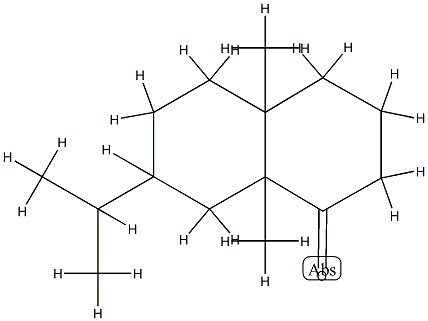
What is Valerian root oil?
Chemical properties
Yellowish or brownish liquid; penetrating odor. Soluble in alcohol, ether, chloroform, acetone, benzene, and carbon disulfide. Combustible.
Chemical properties
Valerian oil is obtained by steam distillation of well-dried ground roots of Valeriana
officinalis L. (Valerianaceae). It is a yellow-green to yellow-brown liquid
with an extremely strong, characteristic, penetrating odor.The oil becomes dark
and viscous on aging or on exposure to air.
d2525 0.942–0.984; n20D 1.4860–1.5025; α20D ?28 ° to ?2 °; acid number: 5–50;
saponification number: 30–107; solubility: 1 vol in 0.5–2.5 vol of 90% ethanol
at 25 ℃, solutions are clear to opalescent when up to 10 vol of ethanol is added.
The main component of the oil is (?)-bornyl acetate, but it also contains other
bornyl esters (e.g., bornyl isovalerate), terpene and sesquiterpene hydrocarbons,
as well as free isovaleric acid, which contributes strongly to the odor of the oil.
Indian valerian oil is produced from the roots of Valeriana wallichii DC. and
has a musky, woody, balsamic, and earthy odor. Indian jatamansi oil is obtained
from the Valerianaceae species Nardostachys grandiflora DC. (syn. Nardostachys
jatamansi Jones, spikenard).
Valerian oil is produced in limited quantities and is used in flavor and fragrance
compositions only in very low dosages to create certain effects.
Chemical properties
Obtained by steam distillation of the partially dried roots in varying yields (0.4 to 0.6%). Very old roots are not recommended for distillation because of the valeric acid content in the distilled product. The presence of valeric acid strongly affects the odor of the oil.
The Uses of Valerian root oil
Tobacco perfume, industrial odorant, flavors.
The Uses of Valerian root oil
The therapeutic activities of valerian oil (Valeriana officinalis) include calming, soothing, and anti-spasmodic. It is also incorporated into cosmetic formulations for perfuming and odor-masking action. Valerian was held in such esteem as a remedy during medieval times that it was called “All Heal.” Its composition is complex, with constituents including alkaloids (catinine and valerine), gamma-aminobutyric acid (gABA), volatile oils (particularly valerenic acid to which valerian’s sedative properties are attributed), formate, flavones such as hesperidin, and terpenes (e.g., l-camphene, l-limonene, and l-pinene). The oil is present in the dried root in quantities of 0.5 to 2 percent depending on the plant variety and place of growth. It is obtained by steam distillation. Reportedly, it can produce headaches when used frequently and in large quantities.
Definition
Extractives and their physically modified derivatives. Valerian officinalis, Valerianaceae.
Safety Profile
Low toxicity by ingestion. Whenheated to decomposition it emits acrid smoke andirritating vapors.
Properties of Valerian root oil
| alpha | -25 º |
| Density | 0.942-0.984 |
| FEMA | 3100 | VALERIAN ROOT OIL (VALERIANA OFFICINALIS L.) |
| refractive index | 1.4860-1.5025 |
| Flash point: | 44°C |
| color | Yellowish to brownish |
| Odor | at 100.00 %. fresh green warm woody balsam rooty animal musk |
| EPA Substance Registry System | Oils, valerian (8008-88-6) |
Safety information for Valerian root oil
Computed Descriptors for Valerian root oil
New Products
2-(2-Chlorophenyl)glycine Propiolic Acid 1-(3-Hydroxy-4-methoxyphenyl)-2-nitroethene (±)-amino(2-fluorophenyl)acetic acid trans-3-Benzyloxy-4-methoxy-beta-nitrostyrene 1-Pentadecanol 2,4-Dihydroxybenzaldehyde Dipropyl disulfide Pyrrolo[1,2-a]pyrimidine-6-carboxylic acid, 4,6,7,8-tetrahydro-4-oxo-, sodium salt (1:1), (6S) Obidoxime hydrochloride API 4 pentyn 1 ol N-Vinylformamide Methacrylate-PEG-Methacrylate, Mn:35000 2,4-Dihydroxyacetophenone 2-Chloro 5-Fluoro Pyridine Vasicinone 2-Chloroisonicotinic Acid Tween 80 or Polysorbate 80 2-Butyn-1-oL N-(4-Cyano-3-(trifluoromethyl)phenyl)-2-methyloxirane-2-carboxamide N-(4-fluoro-2-methoxy-5-nitrophenyl)-4-(1-methyl-1H-indol-3-yl)pyrimidin-2-amine Pirtobrutinib intd. 2-Pentyn-1-oL 4-NitrobenzotrifluorideRelated products of tetrahydrofuran

You may like
-
 40216-83-9 trans-4-Hydroxy-L-proline methyl ester hydrochloride 98+View Details
40216-83-9 -
471-25-0 Propiolic Acid 98+View Details
471-25-0 -
84145-28-8 98+View Details
84145-28-8 -
trans-3-Benzyloxy-4-methoxy-beta-nitrostyrene 98+View Details
63909-29-5 -
2-(2-Chlorophenyl)glycine 88744-36-9 98+View Details
88744-36-9 -
40216-83-9 trans-4-Hydroxy-L-proline methyl ester hydrochloride 98+View Details
40216-83-9 -
629-76-5 98+View Details
629-76-5 -
1-(3-Hydroxy-4-methoxyphenyl)-2-nitroethene 98+View Details
39816-35-8