
Urapidil hydrochloride
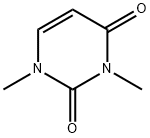
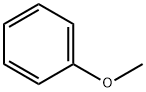
Synonym(s):6-[[3-[4-(o-Methoxyphenyl)-1-piperazinyl]propyl]amino]-1,3-dimethyluracil hydrochloride
- CAS NO.:64887-14-5
- Empirical Formula: C20H30ClN5O3
- Molecular Weight: 423.94
- MDL number: MFCD00078601
- EINECS: 636-348-0
- SAFETY DATA SHEET (SDS)
- Update Date: 2026-07-27 17:00:41
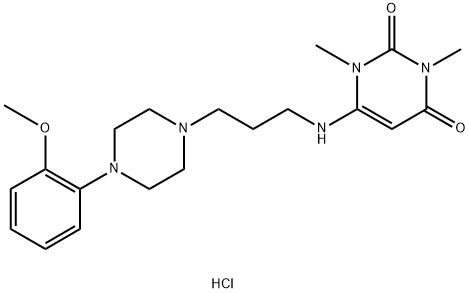
What is Urapidil hydrochloride?
Description
Urapidil is an antagonist of α1-adrenergic receptors (α1-ARs) and a partial agonist of the serotonin (5-HT) receptor subtype 5-HT1A. It selectively binds to α1- over α2-ARs (IC50s = 0.74 and 42 μM, respectively) and to 5-HT1A over 5-HT1B and 5-HT2 receptors (IC50s = 0.4, 20.4, and >10 μM, respectively) in rat cortex. Urapidil inhibits cAMP accumulation induced by forskolin in calf hippocampus as a functional model for 5-HT1A receptors (EC50 = 390 nM). It is also a β1-AR antagonist that inhibits the positive chronotropic response induced by isoproterenol in isolated rat atria (pA2 = 6.05). Urapidil (1 μmol/kg, i.v.) lowers mean arterial pressure (MAP) in anesthetized cats, an effect that is reduced by central administration of the 5-HT1A receptor antagonist spiroxatrine.
Chemical properties
White to Off-White Crystalline Powder
The Uses of Urapidil hydrochloride
a1-Adrenergic antagonist; derivative of Uracil. Antihypertensive
The Uses of Urapidil hydrochloride
α1-Adrenergic antagonist; derivative of Uracil (U801000). Antihypertensive.
The Uses of Urapidil hydrochloride
Antihypertensive;Serotonergic receptor agonist
What are the applications of Application
Urapidil HCl is an adrenergic α1-AR antagonist and a serotonin 5-HT1A (SR-1A) receptor agonist
Biological Activity
α 1 -adrenoceptor antagonist and 5-HT 1A receptor agonist (pIC 50 values are 6.13 and 6.4 respectively). Clinically used hypotensive agent.
Side Effects
Side effects that may occur during treatment with uradil antihypertension include dizziness, fatigue, nausea, and light-headedness effects. The increases in systolic blood pressure heart rate caused by three progressive work loads bicycle exercise were not affected during urapidil, A slight reduction in forced expiratory volume was observed in some patients during treatment with beta-blocker. There was no case orthostatic hypotension during urapidil administration, despite its alpha1-blocking action. Side-effects were rare negligible[1].
References
[1] G LEONETTI. Comparison of the antihypertensive effect of urapidil and metoprolol in hypertension.[J]. European Journal of Clinical Pharmacology, 1986, 30 6: 637-640. DOI:10.1007/BF00608208.
Properties of Urapidil hydrochloride
| Melting point: | 156-1580C |
| storage temp. | Keep in dark place,Inert atmosphere,Room temperature |
| solubility | H2O: soluble |
| form | solid |
| color | white |
| Water Solubility | Soluble to 50 mM in water |
| InChI | InChI=1S/C20H29N5O3.ClH/c1-22-18(15-19(26)23(2)20(22)27)21-9-6-10-24-11-13-25(14-12-24)16-7-4-5-8-17(16)28-3;/h4-5,7-8,15,21H,6,9-14H2,1-3H3;1H |
Safety information for Urapidil hydrochloride
| Signal word | Warning |
| Pictogram(s) |
 Exclamation Mark Irritant GHS07 |
| GHS Hazard Statements |
H302:Acute toxicity,oral |
| Precautionary Statement Codes |
P264:Wash hands thoroughly after handling. P264:Wash skin thouroughly after handling. P270:Do not eat, drink or smoke when using this product. P301+P312:IF SWALLOWED: call a POISON CENTER or doctor/physician IF you feel unwell. P501:Dispose of contents/container to..… |
Computed Descriptors for Urapidil hydrochloride
| InChIKey | KTMLZVUAXJERAT-UHFFFAOYSA-N |
| SMILES | O(C1C=CC=CC=1N1CCN(CCCNC2=CC(=O)N(C)C(=O)N2C)CC1)C.Cl |
New Products
5-bromo-4-fluoro-2-nitrobenzaldehyde Cyclobutanone (R)-(-)-2-Amino-1-propanol Fmoc-OSu 1-(2-Chloroethyl)pyrrolidine Hydrochloride 2-Amino-2-(4-methylphenyl)acetic acid 2,4-Dihydroxybenzaldehyde Obidoxime hydrochloride API Pyrrolo[1,2-a]pyrimidine-6-carboxylic acid, 4,6,7,8-tetrahydro-4-oxo-, sodium salt (1:1), (6S) Dipropyl disulfide 4 pentyn 1 ol N-Vinylformamide Methacrylate-PEG-Methacrylate, Mn:35000 2,4-Dihydroxyacetophenone 2-Chloro 5-Fluoro Pyridine Vasicinone 2-Chloroisonicotinic Acid Tween 80 or Polysorbate 80 2-Butyn-1-oL 2-Pentyn-1-oL 4-Nitrobenzotrifluoride N-(4-Cyano-3-(trifluoromethyl)phenyl)-2-methyloxirane-2-carboxamide N-(4-fluoro-2-methoxy-5-nitrophenyl)-4-(1-methyl-1H-indol-3-yl)pyrimidin-2-amine Pirtobrutinib intd.Related products of tetrahydrofuran
![6-[[3-[4-(2-Methoxyphenyl)-1-piperazinyl]propyl]amino]-1,3-dimethyluracil](https://img.chemicalbook.in/CAS/GIF/34661-75-1.gif)

You may like
-
 64887-14-5 Urapidil hydrochloride 98%View Details
64887-14-5 -
 7250-67-1 1-(2-Chloroethyl)pyrrolidine Hydrochloride 98+View Details
7250-67-1 -
13227-01-5 98+View Details
13227-01-5 -
545445-44-1 3-Morpholino-1-(4-(2-oxopiperidin-1-yl) phenyl)-5,6-dihyropyridin-2-(1H)-one 98%View Details
545445-44-1 -
6629-04-5 98%View Details
6629-04-5 -
4-(4-Αminophenyl)-3-Morpholinone 98%View Details
438056-69-0 -
1-(4-Aminophenyl)-3-morpholino-5,6-dihydropyridin-2(1H)-one 1267610-26-3 98%View Details
1267610-26-3 -
 1H-Indazole | CAS No. 271-44-3 | Pharmaceutical IntermediateView Details
271-44-3