
Toxoflavin
Synonym(s):1,6-Dimethyl-pyrimido[5,4-e]-1,2,4-triazine-5,7(1H,6H)-dione;Toxoflavin;Xanthothricin
- CAS NO.:84-82-2
- Empirical Formula: C7H7N5O2
- Molecular Weight: 193.16
- MDL number: MFCD00459812
- SAFETY DATA SHEET (SDS)
- Update Date: 2026-05-28 02:58:22
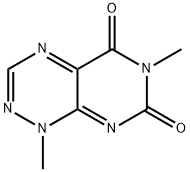
What is Toxoflavin?
The Uses of Toxoflavin
Toxoflavin is a distinctive yellow pigment produced by some species of Pseudomonas and Streptomyces. Toxoflavin is one of two toxins produced when a fermented coconut drink, Tempe bonkrek, is contaminated with P. cocovenenans. Toxoflavin (PKF 118-310) is a potent antagonist of Tcf4/b-catenin signalling, inhibiting the expression of survivin and inducing apoptosis in several tumour cell lines.
The Uses of Toxoflavin
PKF118-310 is an inhibitor of survivin expression and antagonist of Tcf4/b-catenin signaling.
What are the applications of Application
PKF118-310 is an inhibitor of survivin expression and antagonist of Tcf4/b-catenin signaling
Definition
ChEBI: Toxoflavin is a pyrimidotriazine that is 1,6-dimethyl-1,5,6,7-tetrahydropyrimido[5,4-e][1,2,4]triazine with oxo groups at positions 5 and 7. It has a role as an antineoplastic agent, a toxin, a Wnt signalling inhibitor, an apoptosis inducer, a bacterial metabolite, an antibacterial agent and a virulence factor. It is a pyrimidotriazine and a carbonyl compound. It is functionally related to a reumycin.
Biochem/physiol Actions
PKF118-310 is an antagonist of the Tcf4/b-catenin signaling. The compound disrupts the Tcf4/b-catenin complex and inhibits expression of Tcf4 responsive genes. PKF118-310 inhibits expression of survivin and induces apoptosis in HCC, colon tumor and lymphocytic leukemia cell lines.
Properties of Toxoflavin
| Melting point: | 165 °C |
| Boiling point: | 276.7±23.0 °C(Predicted) |
| Density | 1.65±0.1 g/cm3(Predicted) |
| storage temp. | 2-8°C |
| solubility | H2O: soluble10mg/mL, clear |
| form | powder |
| pka | -2.71±0.20(Predicted) |
| color | white to light brown |
Safety information for Toxoflavin
| Signal word | Danger |
| Pictogram(s) |
 Skull and Crossbones Acute Toxicity GHS06 |
| GHS Hazard Statements |
H300:Acute toxicity,oral |
| Precautionary Statement Codes |
P264:Wash hands thoroughly after handling. P264:Wash skin thouroughly after handling. P270:Do not eat, drink or smoke when using this product. P301+P310:IF SWALLOWED: Immediately call a POISON CENTER or doctor/physician. P405:Store locked up. P501:Dispose of contents/container to..… |
Computed Descriptors for Toxoflavin
New Products
2-(2-Chlorophenyl)glycine Propiolic Acid 1-(3-Hydroxy-4-methoxyphenyl)-2-nitroethene (±)-amino(2-fluorophenyl)acetic acid trans-3-Benzyloxy-4-methoxy-beta-nitrostyrene 1-Pentadecanol 2,4-Dihydroxybenzaldehyde Dipropyl disulfide Pyrrolo[1,2-a]pyrimidine-6-carboxylic acid, 4,6,7,8-tetrahydro-4-oxo-, sodium salt (1:1), (6S) Obidoxime hydrochloride API 4 pentyn 1 ol N-Vinylformamide Methacrylate-PEG-Methacrylate, Mn:35000 2,4-Dihydroxyacetophenone 2-Chloro 5-Fluoro Pyridine Vasicinone 2-Chloroisonicotinic Acid Tween 80 or Polysorbate 80 2-Butyn-1-oL N-(4-Cyano-3-(trifluoromethyl)phenyl)-2-methyloxirane-2-carboxamide N-(4-fluoro-2-methoxy-5-nitrophenyl)-4-(1-methyl-1H-indol-3-yl)pyrimidin-2-amine Pirtobrutinib intd. 2-Pentyn-1-oL 4-NitrobenzotrifluorideRelated products of tetrahydrofuran
You may like
-
 PKF118-310 CAS 84-82-2View Details
84-82-2 -
471-25-0 Propiolic Acid 98+View Details
471-25-0 -
84145-28-8 98+View Details
84145-28-8 -
trans-3-Benzyloxy-4-methoxy-beta-nitrostyrene 98+View Details
63909-29-5 -
2-(2-Chlorophenyl)glycine 88744-36-9 98+View Details
88744-36-9 -
40216-83-9 trans-4-Hydroxy-L-proline methyl ester hydrochloride 98+View Details
40216-83-9 -
629-76-5 98+View Details
629-76-5 -
1-(3-Hydroxy-4-methoxyphenyl)-2-nitroethene 98+View Details
39816-35-8