
Titanium oxide
- CAS NO.:12065-65-5
- Empirical Formula: H2OTi
- Molecular Weight: 65.88
- MDL number: MFCD00210650
- EINECS: 601-730-8
- SAFETY DATA SHEET (SDS)
- Update Date: 2026-09-24 21:23:22

What is Titanium oxide?
Chemical properties
Ti3O5: (1) Rel.molar mass (Mr ): 223.0070; (2) wt.% Ti: 64.1; (3) Color: Dark blue; (4) crystal lattice structure: dimorphic (120°C) Low T: Anasovite-type I Monoclinic, C2/m, Z = 4 a = 975.2 pm; b = 380.2 pm; c = 944.2 pm; β = 91.55° High T: Pseudobrookite (orthorhombic); (5) ρcalc. = 4900 kg.m–3, m.p. = 1777°C
Physical properties
Dark blue crystals. Anasovite Type II is similar to that identified in titania slags. Can be stabilized at room temperature with a small amount of iron.
The Uses of Titanium oxide
Nanocrystalline titanium oxide electrodes is useful for photo voltaic applications. It plays an important role as photocatalyst under visible light radiation. Treated titanium oxide nanotubes play a significant part in the development of nano-scale hydroxy apatite. It is too utilized as catalysts.
Preparation
Anosovite can be prepared in
the following ways:
(i) By the hydrogen reduction of solid TiO2
at temperature around 1300°C16 according to
the following reaction scheme:
3TiO2(s) + H2(g) —> T3O5(s) + H2O(g) (1300°C).
(ii) By mixing intimately stoichiometric quantities of titanium metal and titanium dioxide
in an electric-arc furnace under an argon atmosphere according to the following reaction scheme:
5TiO2(s) + Ti(s) —> 2Ti3O5(s) (1150°C)
followed by annealing in a vacuum of the crushed material for 2 weeks at 1150°C in
a sealed silica tube. This oxide is dimorphic with a rapid phase transition from semiconductor to metal occurring at roughly 120°C. α-Ti3O5—> β-Ti3O5
(120°C).
The low-temperature form (α-Ti3O5), also called anosovite type I, crystallizes with a monoclinic unit cell with the Ti-O bond distances ranging from 178 to 221 pm. The structure can
be described in terms of TiO6
8– octahedra joined by sharing the edge and corners to form an
infinite three-dimensional network. Anosovite I is obtained by the hydrogen reduction of
pure rutile at 1300°C. The high-temperature form (β-Ti3O5), also called anosovite type II, is
a slightly deformed pseudobrookite structure (AB2O5) with the Ti-O bond distances ranging
from 191 to 210 pm. The type II is obtained by hydrogen reduction at 1500°C with magnesia
as a catalyst. The anasovite type II is similar to that identified in titanium slags. It can be
stabilized at room temperature with a small amount of iron.
Properties of Titanium oxide
| Melting point: | 1800°C |
| Density | 4.20 |
| solubility | Soluble in hot concentrated sulfuric acid, hydrofluoric acid and alkali. |
| form | Pellet |
| Specific Gravity | 4.2 |
| color | Black |
| Crystal Structure | Dimorphic (120°C): Low temperature: anasovite type monoclinic; High temperature: pseudobrookite orthorhombic |
Safety information for Titanium oxide
| Signal word | Warning |
| Pictogram(s) |
 Exclamation Mark Irritant GHS07  Health Hazard GHS08 |
| GHS Hazard Statements |
H302:Acute toxicity,oral H315:Skin corrosion/irritation H319:Serious eye damage/eye irritation H341:Germ cell mutagenicity |
| Precautionary Statement Codes |
P201:Obtain special instructions before use. P202:Do not handle until all safety precautions have been read and understood. P264:Wash hands thoroughly after handling. P264:Wash skin thouroughly after handling. P270:Do not eat, drink or smoke when using this product. P280:Wear protective gloves/protective clothing/eye protection/face protection. P302+P352:IF ON SKIN: wash with plenty of soap and water. P305+P351+P338:IF IN EYES: Rinse cautiously with water for several minutes. Remove contact lenses, if present and easy to do. Continuerinsing. P308+P313:IF exposed or concerned: Get medical advice/attention. P332+P313:IF SKIN irritation occurs: Get medical advice/attention. P337+P313:IF eye irritation persists: Get medical advice/attention. P405:Store locked up. |
Computed Descriptors for Titanium oxide
Titanium oxide manufacturer
N R Life Care
Dhairya International
New Products
2-(2-Chlorophenyl)glycine Propiolic Acid trans-3-Benzyloxy-4-methoxy-beta-nitrostyrene 1-(3-Hydroxy-4-methoxyphenyl)-2-nitroethene (±)-amino(2-fluorophenyl)acetic acid 1-Pentadecanol N-Vinylformamide 4 pentyn 1 ol 4-(4-Αminophenyl)-3-Morpholinone 3-Morpholino-1-(4-(2-oxopiperidin-1-yl) phenyl)-5,6-dihyropyridin-2-(1H)-one 1-(4-Aminophenyl)-3-morpholino-5,6-dihydropyridin-2(1H)-one N-cyanoacetylurethane 1H-IndazoleRelated products of tetrahydrofuran
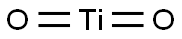
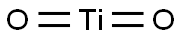



You may like
-
 Titanium oxide CAS 12065-65-5View Details
12065-65-5 -
Titanium oxide CAS 12065-65-5View Details
12065-65-5 -
 White Titanium Dioxide Anatese, For Pigment, 25 kgView Details
12065-65-5 -
 Titanium Dioxide Anatase B101, Chemical Formula: (TiO2), Grade Standard: Technical GradeView Details
12065-65-5 -
 Titanium Dioxide Anatase B101, Chemical Formula: TiO2., Grade Standard: Analytical GradeView Details
1317-70-0 -
471-25-0 Propiolic Acid 98+View Details
471-25-0 -
2-(2-Chlorophenyl)glycine 88744-36-9 98+View Details
88744-36-9 -
40216-83-9 trans-4-Hydroxy-L-proline methyl ester hydrochloride 98+View Details
40216-83-9