
Tiplaxtinin
Synonym(s):(1-Benzyl-5-(4-(trifluoromethoxy)phenyl)-1H-indol-3-yl)oxoacetic acid; a-Oxo-1-(phenylmethyl)-5-[4-(trifluoromethoxy)phenyl]-1H-indole-3-acetic acid;PAI 039;PAI-039;Tiplasinin;WAY-168039
- CAS NO.:393105-53-8
- Empirical Formula: C24H16F3NO4
- Molecular Weight: 439.38
- MDL number: MFCD09475615
- SAFETY DATA SHEET (SDS)
- Update Date: 2026-05-27 23:07:32
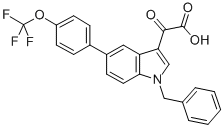
What is Tiplaxtinin?
Description
Tiplaxtinin is an inhibitor of plasminogen activator inhibitor 1 (PAI-1; IC50 = 2.7 μM for the human enzyme). It inhibits differentiation of human adipocytes when used at a concentration of 5 μM. Tiplaxtinin (5 and 20 mg/kg) reduces tumor growth and microvessel density in a T24 bladder cancer mouse xenograft model. It prevents carotid artery occlusion, increases the time to occlusive thrombosis, and decreases the thrombus size in a rat model of ferric chloride-induced arterial thrombosis when administered at a dose of 1 mg/kg.
The Uses of Tiplaxtinin
Tiplaxtinin inhibits smooth muscle cells (SMC) migration and intimal hyperplasia. A novel therapeutic agent to improve diabetic wound.
Definition
ChEBI: Tiplasinin is a member of indole-3-acetic acids. It is a potent and selective PAI-1 inhibitor. Tiplaxtinin demonstrated efficacy in vivo in multiple models of acute arterial thrombosis and has been shown to reduce physiologic PAI-1 activity.
Biochem/physiol Actions
Tiplaxtinin has high oral bioavailability. It is metabolically stable and shows large safety multiples in animal toxicology studies. Tiplaxtinin can be easily synthesized in bulk quantities. This drug also reduces diet-induced obesity in mice.
Storage
Store at +4°C
Properties of Tiplaxtinin
| Melting point: | 164-167℃ |
| Density | 1.34 |
| storage temp. | -20°C |
| solubility | DMSO (Sparingly), Methanol (Slightly) |
| form | powder |
| color | white to beige |
Safety information for Tiplaxtinin
| Signal word | Danger |
| Pictogram(s) |
 Corrosion Corrosives GHS05  Exclamation Mark Irritant GHS07  Environment GHS09 |
| GHS Hazard Statements |
H315:Skin corrosion/irritation H318:Serious eye damage/eye irritation H411:Hazardous to the aquatic environment, long-term hazard |
| Precautionary Statement Codes |
P264:Wash hands thoroughly after handling. P264:Wash skin thouroughly after handling. P270:Do not eat, drink or smoke when using this product. P273:Avoid release to the environment. P280:Wear protective gloves/protective clothing/eye protection/face protection. P391:Collect spillage. Hazardous to the aquatic environment P332+P313:IF SKIN irritation occurs: Get medical advice/attention. P501:Dispose of contents/container to..… |
Computed Descriptors for Tiplaxtinin
New Products
Dibenzoyl-L-tartaric acid Anhydrous (Resolution Reagent) Cis-Tosylate Dibenzo[b,f][1,4]thiazepin-11(10H)-one 1,2,3,9-Tetrahydro-9-Methyl-4H-Carbazole-4-One 1-(4-methoxyphenyl)-4-(4-Nitrophenyl)Piperazine (IT-1) BOC Piperazine 1-Benzhydrylazetane-3-carbonitrile 8-oxa-1,3-diazaspiro[4.5]decane-2,4-dione (±)-amino(2-fluorophenyl)acetic acid 2-(2-Chlorophenyl)glycine AMINO-(3-CHLORO-PHENYL)-ACETIC ACID 2'-Fluoroacetophenone METHANOL-D1(OD) TERTIARY BUTANOL-D9 N-ETHYL-D5-AMINE HYDROCHLORIDE BENZOIC ACID-D CHLOROFORM-D TOLUENE-D3 Trans,trans muconic acid HC Blue-16 4-Amino-2-chloro-6,7-dimethoxyquinazoline Ethyl 4,5-bis(2-methoxyethoxy)-2-nitrobenzoate 2,3-Dimethoxypyridine 1-(3-Chlorophenyl)piperazine hydrochlorideRelated products of tetrahydrofuran
You may like
-
 Tiplaxtinin 95% CAS 393105-53-8View Details
393105-53-8 -
Tiplaxtinin CAS 393105-53-8View Details
393105-53-8 -
 Product IntroductionView Details
 -
 Product InrtroductionView Details
 -
 DGO24View Details
 -
 DGO25View Details
 -
 DGO29View Details
 -
 DGO32View Details