
Ticlopidine
- CAS NO.:55142-85-3
- Empirical Formula: C14H14ClNS
- Molecular Weight: 263.79
- MDL number: MFCD00661081
- EINECS: 259-498-5
- SAFETY DATA SHEET (SDS)
- Update Date: 2026-07-16 07:06:08
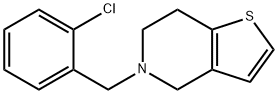
What is Ticlopidine?
Absorption
Absorption is greater than 80%. Food increases absorption by approximately 20%.
Toxicity
Single oral doses of ticlopidine at 1600 mg/kg and 500 mg/kg were lethal to rats and mice, respectively. Symptoms of acute toxicity were GI hemorrhage, convulsions, hypothermia, dyspnea, loss of equilibrium and abnormal gait. The FDA label includes a black-box warning of neutropenia, aplastic anemia, thrombotic thrombocytopenia purpura, and agranulocytosis, so it is necessary to monitor patients' WBC and platelets when they are taking ticlopidine.
Originator
Ticlid,Millot,France,1978
The Uses of Ticlopidine
Ticlopidine suppresses aggregation of thrombocytes and possesses antiaggregant activity. It is believed that its action is connected to its effect on thrombocyte membranes and the reduction in quantity of released adenosine diphosphate and serotonin, which facilitate aggregation of thrombocytes. In wide-ranging clinical trials, ticlopidine presented a number of advantages compared to aspirin.
The Uses of Ticlopidine
Ticlopidine is an antiplatelet drug for the treatment of ischemic heart diseases.
Indications
Used in patients, who have had a stroke or stroke precursors and who cannot take aspirin or aspirin has not worked, to try to prevent another thrombotic stroke.
Background
Ticlopidine is an effective inhibitor of platelet aggregation. It is a prodrug that is metabolised to an active form, which blocks the ADP receptor that is involved in GPIIb/IIIa receptor activation leading to platelet aggregation. Ticlopidine is marketed under the brand name Ticlid and is indicated for patients who cannot take aspirin or in whom aspirin has not worked to prevent a thrombotic stroke. The FDA label includes a black-box warning of neutropenia, aplastic anemia, thrombotic thrombocytopenia purpura, and agranulocytosis, so it is necessary to monitor patients' WBC and platelets when they are taking ticlopidine.
Definition
ChEBI: A thienopyridine that is 4,5,6,7-tetrahydrothieno[3,2-c]pyridine in which the hydrogen attached to the nitrogen is replaced by an o-chlorobenzyl group.
Manufacturing Process
A solution of thieno[3,2-c]pyridine (13.5 g; 0.1 mol) and 2-chlorobenzyl
chloride (17.7 g) in acetonitrile (150 ml) is boiled during 4 hours.
After evaporation of the solvent, the solid residue consists of 5-(2-
chlorobenzyl)-thieno[3,2-c]pyridinium chloride which melts at 166°C
(derivative n° 30). This compound is taken up into a solution comprising
ethanol (300 ml) and water (100 ml). Sodium borohydride (NaBH4)(20 g) is
added portionwise to the solution maintained at room temperature. The
reaction medium is maintained under constant stirring during 12 hours and is
then evaporated. The residue is taken up into water and made acidic with
concentrated hydrochloric acid to destroy the excess reducing agent. The
mixture is then made alkaline with ammonia and extracted with ether. The
ether solution is washed with water, dried and evaporated. The oily residue is
dissolved in isopropanol (50 ml) and hydrochloric acid in ethanol solution is
then added thereto.
After filtration and recrystallization from ethanol, there are obtained 5-(2-
chlorobenzyl)-4,5,6,7-tetrahydrothieno[3,2-c]pyridine hydrochloride crystals
(yield: 60%) having a melting point (Koefler block) of 190°C.
brand name
4-c-32 53-32-c;Aplaquette;Derivatives;Klodin;Opteron;Panaldine;Tcp;Ticlidan;Ticlodix;Ticlodone;Ticlopedine;Ticlosan;Tiklid;Tiklyd;Tilcid.
Therapeutic Function
Platelet aggregation inhibitor
World Health Organization (WHO)
Ticlopidine, an inhibitor of platelet aggregation, was introduced in 1978 for use as an antithrombotic agent. By 1982 its use had been associated with cases of agranulocytosis, severe leucopenia and impaired haemostasis. The drug remains available in most countries in which it was approved with appropriate warnings in the product information.
General Description
Ticlopidine, 5-[(2-chlorophenyl)methyl]-4,5,6,7-tetrahydrothieno [3,2-c]pyridine hydrochloride(Ticlid), is useful in reducing cardiac events in patients withunstable angina and cerebrovascular events in secondaryprevention of stroke. It belongs to the thienopyridine classand facilitated the development of clopidogrel. One of thedrawbacks to this agent is its side effect profile, whichincludes neutropenia, and patients receiving this antithromboticshould have their blood levels monitored. Its mechanismof action is similar to that of clopidogrel, in that itinhibits the purinergic receptors on platelets.
Pharmacokinetics
Ticlopidine is a prodrug that is metabolised to an as yet undetermined metabolite that acts as a platelet aggregation inhibitor. Inhibition of platelet aggregation causes a prolongation of bleeding time. In its prodrug form, ticlopidine has no significant in vitro activity at the concentrations attained in vivo.
Synthesis
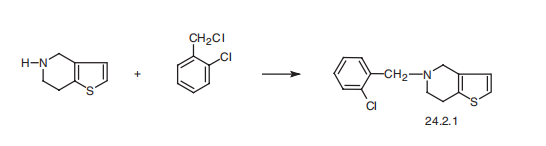
Ticlopidine, 5-(o-chlorobenzyl)-4,5,6,7-tetrahydrothieno[3,2-c]pyridine (24.2.1), is synthesized in many different ways. The first way consists of N-alkylation of 4,5,6,7-tetrahydrothieno[3,2-c]pyridine with 2-chlorobenzylchloride.
Metabolism
Ticlopidine is metabolized extensively by the liver with only trace amounts of intact drug detected. At least 20 metabolites have been identified.
Properties of Ticlopidine
| Melting point: | 210-212 °C |
| Boiling point: | 117-120 °C(Press: 0.5 Torr) |
| Density | 1.273±0.06 g/cm3(Predicted) |
| storage temp. | 2-8°C(protect from light) |
| solubility | Chloroform (Slightly), DMSO (Slightly), Methanol (Slightly) |
| form | Solid |
| pka | 7.10±0.20(Predicted) |
| color | Off-White to Pale Yellow Oil to Low Melting |
| CAS DataBase Reference | 55142-85-3(CAS DataBase Reference) |
| NIST Chemistry Reference | Thieno[3,2-c]pyridine, 5-[(2-chlorophenyl)methyl]-4,5,6,7-tetrahydro-(55142-85-3) |
| EPA Substance Registry System | Thieno[3,2-c]pyridine, 5-[(2-chlorophenyl)methyl]-4,5,6,7-tetrahydro- (55142-85-3) |
Safety information for Ticlopidine
| Signal word | Warning |
| Pictogram(s) |
 Exclamation Mark Irritant GHS07 |
| GHS Hazard Statements |
H315:Skin corrosion/irritation H319:Serious eye damage/eye irritation |
| Precautionary Statement Codes |
P280:Wear protective gloves/protective clothing/eye protection/face protection. P302+P352:IF ON SKIN: wash with plenty of soap and water. P305+P351+P338:IF IN EYES: Rinse cautiously with water for several minutes. Remove contact lenses, if present and easy to do. Continuerinsing. P332+P313:IF SKIN irritation occurs: Get medical advice/attention. P337+P313:IF eye irritation persists: Get medical advice/attention. |
Computed Descriptors for Ticlopidine
Ticlopidine manufacturer
New Products
9-Mesityl-10-methylacridinium perchlorate Sulfapyridine Fmoc-OSu (R)-(-)-2-Amino-1-propanol Cyclobutanone 5-bromo-4-fluoro-2-nitrobenzaldehyde 4 pentyn 1 ol N-Vinylformamide Phenethyl cinnamate Pyrrolo[1,2-a]pyrimidine-6-carboxylic acid, 4,6,7,8-tetrahydro-4-oxo-, sodium salt (1:1), (6S) Ethyl 3-phenylpropanoate β-Bromostyrene Methacrylate-PEG-Methacrylate, Mn:35000 2,4-Dihydroxyacetophenone 2-Chloro 5-Fluoro Pyridine Vasicinone 2-Chloroisonicotinic Acid Tween 80 or Polysorbate 80 5-Bromo-1-Pentyne 1-(2-Methyl-5-nitrophenyl)guanidine Nitrate Methyl trans-4-Aminocyclohexanecarboxylate Hydrochloride 2-Pentyn-1-oL 4-Nitrobenzotrifluoride N-(4-Cyano-3-(trifluoromethyl)phenyl)-2-methyloxirane-2-carboxamideRelated products of tetrahydrofuran

You may like
-
 55142-85-3 Ticlopidine 99%View Details
55142-85-3 -
 Ticlopidine 95% CAS 55142-85-3View Details
55142-85-3 -
Fmoc-OSu 98+View Details
82911-69-1 -
(R)-(-)-2-Amino-1-propanol 35320-23-1 98+View Details
35320-23-1 -
1191-95-3 Cyclobutanone 98+View Details
1191-95-3 -
213382-45-7 98+View Details
213382-45-7 -
Fmoc-OSu 98+View Details
82911-69-1 -
(R)-(-)-2-Amino-1-propanol 35320-23-1 98+View Details
35320-23-1