
thenalidine
- CAS NO.:86-12-4
- Empirical Formula: C17H22N2S
- Molecular Weight: 286.43
- MDL number: MFCD00865681
- EINECS: 201-651-5
- SAFETY DATA SHEET (SDS)
- Update Date: 2024-03-19 15:37:51
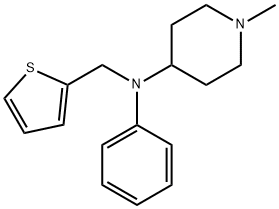
What is thenalidine?
The Uses of thenalidine
Thenalidine is an antihistamine that has anticholinergic properties which is used as an antipruritic drugs.
Background
Withdrawn from the Canadian, US, and UK markets in 1963 due to concerns involving neutropenia.
Definition
ChEBI: Thenalidine is a dialkylarylamine and a tertiary amino compound.
brand name
Sanbosten.
World Health Organization (WHO)
Thenalidine, a piperidine antihistamine, was introduced in 1953 for the management of dermatologic and allergic conditions. By 1958 its use had been associated with cases of severe neutropenia, two of them fatal, which led to its withdrawal in the United States of America and subsequently in the United Kingdom. Over the next fifteen years, continued reports of its association with cases of neutropenia resulted in further withdrawals in many countries. It is apparently still available, however, in some combination products.
Synthesis
Thenalidine is synthesized by alkylation of 1-methyl-4-phenylaminopiperidine with 2-chloromethyl thiophene .
Metabolism
Not Available
Properties of thenalidine
| Melting point: | 95-97° |
| Boiling point: | bp0.02 158-160° |
| Density | 1.140±0.06 g/cm3(Predicted) |
| pka | pKa 3.36±0.06(H2O
t undefined
I = 0.30
(NaCl)) (Uncertain);8.39±0.07(H2O
t undefined
I = 0.30
(NaCl)) (Uncertain) |
Safety information for thenalidine
Computed Descriptors for thenalidine
New Products
Indole Methyl Resin tert-butyl 9-methoxy-3-azaspiro[5.5]undecane-3-carboxylate Boc-His(Boc)-OH 2-CTC Resin 4-Chloro-7-tosy1-7Hpyrrolo[2,3-d]pyrimidine 5,7-Dibromo-1H-indole 2,5-dichloro-N-hydroxy-4,6-dimethylpyridine-3-carboximidamide 2,2-Dimethoxy-7-azaspiro[3.5]nonane hydrochloride 4-chloromethyl-5-methyl-1,3-dioxol-2-one (DMDO-Cl) R-2-BENZYLOXY PROPIONIC ACID 1,1’-CARBONYLDIIMIDAZOLE 1,1’-CARBONYLDI (1,2-4 TRIAZOLE) N-METHYL INDAZOLE-3-CARBOXYLIC ACID 4-((2-hydroxyethyl)thio)benzoic acid 1-(TERT-BUTOXYCARBONYL)-2-PYRROLIDINONE Methyl 6-methylnicotinate 3-Pyridineacrylic acid tert-Butyl carbazate TETRAHYDRO-2H-PYRAN-3-OL 2-((4-morpholinophenylamino) (methylthio) methylene) malononitrile 3-(4-morpholinophenylamino)-5-amino-1H-pyrazole-4-carbonitrile 2,4-dihydroxybenzaldehyde 1,3-Diethyl-1,3-Diphenylurea Methyl 2-methylquinoline-6-carboxylateRelated products of tetrahydrofuran


![N-[2-METHYL-1H-INDOL-5-YL]-N-[1-(2-PHENYLETHYL)PIPERIDIN-4-YL]THIOPHENE-2-CARBOXAMIDE](https://img.chemicalbook.in/StructureFile/ChemBookStructure5/GIF/CB7123030.gif)


You may like
-
 Pyridine 99.5% HPLC /UV SpectroscopyView Details
110-86-1 -
 Guanine , 99%View Details
73-40-5 -
 Piperazine Spot supply, best priceView Details
110-85-0 -
 Potassium Hydroxide 90%View Details
1310-58-3 -
 Dibutyl PhthalateView Details
84-74-2 -
 Imidazole Spot supply, competitive priceView Details
288-32-4 -
 Octadecyl 3-(3,5-di-tert-butyl-4-hydroxyphenyl)propionate 98% (GC)View Details
2082-79-3 -
 Thiourea 99% ARView Details
62-56-6