
Tetrakis(hydroxymethyl)phosphonium chloride
Synonym(s):THPC solution
- CAS NO.:124-64-1
- Empirical Formula: C4H12ClO4P
- Molecular Weight: 190.56
- MDL number: MFCD00031687
- EINECS: 204-707-7
- SAFETY DATA SHEET (SDS)
- Update Date: 2026-05-27 23:58:29
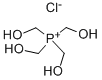
What is Tetrakis(hydroxymethyl)phosphonium chloride ?
Chemical properties
Clear light pink or yellow-green solution
The Uses of Tetrakis(hydroxymethyl)phosphonium chloride
Tetrakis(hydroxymethyl)phosphonium chloride solution (80% in H2O) has been used as a reducing agent and stabilizing ligand for the synthesis of gold nanoparticles (AuNPs) from gold(III) chloride trihydrate (HAuCl4.3H2O). It is a tetra-functional, amine-reactive, aqueous crosslinker that can be used for tuning the properties of protein-based hydrogels for 3D cell encapsulation applications.
The Uses of Tetrakis(hydroxymethyl)phosphonium chloride
Flame-retarding agent for cotton fabrics. May be used in combination with triethylolamine and urea (Roxel process) or with triethanolamine and tris(1-aziridinyl) phosphine oxide.
Definition
A crystalline compound made by the reaction of phosphine, formaldehyde, and hydrochloric acid.
General Description
Clear slightly viscous,colorless to yellow liquid (20% H2O solution).
Air & Water Reactions
Hygroscopic. Water soluble.
Reactivity Profile
Tetrakis(hydroxymethyl)phosphonium chloride reacts vigorously with oxidizers and alkalis. Reacts with cellulose.
Health Hazard
ACUTE/CHRONIC HAZARDS: Tetrakis(hydroxymethyl)phosphonium chloride may be corrosive. When heated to decomposition, it may emit very toxic fumes of POx, hydrogen chloride and bis(chloromethyl)ether. Decomposition of Tetrakis(hydroxymethyl)phosphonium chloride in an aqueous environment may produce phosphine, formaldehyde and hydrogen chloride.
Fire Hazard
Tetrakis(hydroxymethyl)phosphonium chloride is probably combustible.
Flammability and Explosibility
Non flammable
Purification Methods
Crystallise it from AcOH and dry it at 100o in a vacuum. An 80% w/v aqueous solution has d4 1.33 [Reeves J Am Chem Soc 77 3923 1955]. [Beilstein 1 IV 3062.]
Properties of Tetrakis(hydroxymethyl)phosphonium chloride
| Melting point: | 154°C |
| Boiling point: | 115°C/760mmHg |
| Density | 1.341 g/mL at 25 °C |
| vapor pressure | 0Pa at 25℃ |
| refractive index | n |
| form | Solution |
| pka | 6.05[at 20 ℃] |
| color | Clear light pink or yellow-green |
| Water Solubility | >=10 g/100 mL at 20 ºC |
| BRN | 3631669 |
| InChI | InChI=1S/C4H12O4P.ClH/c5-1-9(2-6,3-7)4-8;/h5-8H,1-4H2;1H/q+1;/p-1 |
| CAS DataBase Reference | 124-64-1(CAS DataBase Reference) |
| EPA Substance Registry System | Tetrakis(hydroxymethyl)phosphonium chloride (124-64-1) |
Safety information for Tetrakis(hydroxymethyl)phosphonium chloride
| Signal word | Danger |
| Pictogram(s) |
 Corrosion Corrosives GHS05  Skull and Crossbones Acute Toxicity GHS06  Health Hazard GHS08  Environment GHS09 |
| GHS Hazard Statements |
H290:Corrosive to Metals H314:Skin corrosion/irritation H317:Sensitisation, Skin H410:Hazardous to the aquatic environment, long-term hazard |
| Precautionary Statement Codes |
P201:Obtain special instructions before use. P273:Avoid release to the environment. P280:Wear protective gloves/protective clothing/eye protection/face protection. P303+P361+P353:IF ON SKIN (or hair): Remove/Take off Immediately all contaminated clothing. Rinse SKIN with water/shower. P305+P351+P338:IF IN EYES: Rinse cautiously with water for several minutes. Remove contact lenses, if present and easy to do. Continuerinsing. |
Computed Descriptors for Tetrakis(hydroxymethyl)phosphonium chloride
| InChIKey | AKXUUJCMWZFYMV-UHFFFAOYSA-M |
| SMILES | [P+](CO)(CO)(CO)CO.[Cl-] |
New Products
9-Mesityl-10-methylacridinium perchlorate Sulfapyridine Fmoc-OSu (R)-(-)-2-Amino-1-propanol Cyclobutanone 5-bromo-4-fluoro-2-nitrobenzaldehyde 4 pentyn 1 ol N-Vinylformamide Phenethyl cinnamate Pyrrolo[1,2-a]pyrimidine-6-carboxylic acid, 4,6,7,8-tetrahydro-4-oxo-, sodium salt (1:1), (6S) Ethyl 3-phenylpropanoate β-Bromostyrene Methacrylate-PEG-Methacrylate, Mn:35000 2,4-Dihydroxyacetophenone 2-Chloro 5-Fluoro Pyridine Vasicinone 2-Chloroisonicotinic Acid Tween 80 or Polysorbate 80 Methyl trans-4-Aminocyclohexanecarboxylate Hydrochloride N-(4-fluoro-2-methoxy-5-nitrophenyl)-4-(1-methyl-1H-indol-3-yl)pyrimidin-2-amine Pirtobrutinib intd. 4-Nitrobenzotrifluoride 2-Pentyn-1-oL N-(4-Cyano-3-(trifluoromethyl)phenyl)-2-methyloxirane-2-carboxamideRelated products of tetrahydrofuran


You may like
-
 Tetrakis(hydroxymethyl)phosphonium chloride solution, 80% CAS 124-64-1View Details
124-64-1 -
Tetrakis(hydroxymethyl)phosphonium chloride (ca. 80% in Water) CAS 124-64-1View Details
124-64-1 -
Tetrakis(hydroxymethyl)phosphonium chloride solution CAS 124-64-1View Details
124-64-1 -
Fmoc-OSu 98+View Details
82911-69-1 -
1191-95-3 Cyclobutanone 98+View Details
1191-95-3 -
213382-45-7 98+View Details
213382-45-7 -
Fmoc-OSu 98+View Details
82911-69-1 -
(R)-(-)-2-Amino-1-propanol 35320-23-1 98+View Details
35320-23-1