
Tebufenpyrad
Synonym(s):4-Chloro-N-(4-tert-butylbenzyl)-3-ethyl-1-methyl-1H-pyrazole-5-carboxamide
- CAS NO.:119168-77-3
- Empirical Formula: C18H24ClN3O
- Molecular Weight: 333.86
- MDL number: MFCD01632408
- EINECS: 242-070-7
- SAFETY DATA SHEET (SDS)
- Update Date: 2026-07-31 15:25:13
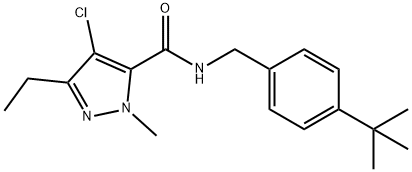
What is Tebufenpyrad?
Chemical properties
Tan Solid
The Uses of Tebufenpyrad
Tebufenpyrad is a pyrazole acaricide and insecticide commonly used in commercial greenhouses.
The Uses of Tebufenpyrad
Acaricide.
Definition
ChEBI: Tebufenpyrad is a pyrazole acaricide and a pyrazole insecticide. It has a role as a mitochondrial NADH:ubiquinone reductase inhibitor.
Metabolic pathway
By incubation of tebufenpyrad with rat liver
homogenate, tebufenpyrad undergoes
biotransformation to yield the major metabolites N-(4-
tert-butylbenzyl)-4-chloro-3-(1-hydroxyethyl)-1-
methylpyrazole-5-carboxamide via hydroxylation of the
w-1-carbon of the ethyl group and N-[4-(1-carboxy-1-
methylethyl)benzyl]-4-chloro-3-ethyl-1-methylpyrazole-
5-carboxamide via oxidation of the methyl group in the
tert-butyl moiety to the carboxylic acid derivatives.
When the rat is orally dosed tebufenpyrad, the major
metabolism pathway is via both hydroxylation and
oxidation reactions to yield N-[4-(1-carboxy-1-
methylethyl)benzyl]-4-chloro-3-(1-hydroxyethyl)-1-
methylpyrazole-5-carboxamide which is mainly
excreted in the urine.
Properties of Tebufenpyrad
| Melting point: | 61-62° |
| Boiling point: | 468.4±45.0 °C(Predicted) |
| Density | 1.1639 (rough estimate) |
| refractive index | 1.5790 (estimate) |
| storage temp. | 0-6°C |
| solubility | Benzene (Slightly), DMSO (Slightly), Methanol (Slightly) |
| pka | 13.19±0.46(Predicted) |
| form | neat |
| BRN | 8636471 |
| CAS DataBase Reference | 119168-77-3(CAS DataBase Reference) |
| EPA Substance Registry System | Tebufenpyrad (119168-77-3) |
Safety information for Tebufenpyrad
| Signal word | Danger |
| Pictogram(s) |
 Skull and Crossbones Acute Toxicity GHS06  Health Hazard GHS08  Environment GHS09 |
| GHS Hazard Statements |
H301:Acute toxicity,oral H317:Sensitisation, Skin H332:Acute toxicity,inhalation H373:Specific target organ toxicity, repeated exposure H410:Hazardous to the aquatic environment, long-term hazard |
| Precautionary Statement Codes |
P273:Avoid release to the environment. P280:Wear protective gloves/protective clothing/eye protection/face protection. P314:Get medical advice/attention if you feel unwell. P301+P310:IF SWALLOWED: Immediately call a POISON CENTER or doctor/physician. P302+P352:IF ON SKIN: wash with plenty of soap and water. |
Computed Descriptors for Tebufenpyrad
New Products
5-bromo-4-fluoro-2-nitrobenzaldehyde (R)-(-)-2-Amino-1-propanol Cyclobutanone Fmoc-OSu 1-(2-Chloroethyl)pyrrolidine Hydrochloride 2-Amino-2-(4-methylphenyl)acetic acid β-Bromostyrene Ethyl 3-phenylpropanoate Phenethyl cinnamate Dipropyl disulfide 4 pentyn 1 ol N-Vinylformamide Methacrylate-PEG-Methacrylate, Mn:35000 2,4-Dihydroxyacetophenone 2-Chloro 5-Fluoro Pyridine Vasicinone 2-Chloroisonicotinic Acid Tween 80 or Polysorbate 80 2-Butyn-1-oL 2-Pentyn-1-oL 4-Nitrobenzotrifluoride N-(4-fluoro-2-methoxy-5-nitrophenyl)-4-(1-methyl-1H-indol-3-yl)pyrimidin-2-amine Pirtobrutinib intd. N-(4-Cyano-3-(trifluoromethyl)phenyl)-2-methyloxirane-2-carboxamideRelated products of tetrahydrofuran
You may like
-
 Tebufenpyrad CAS 119168-77-3View Details
119168-77-3 -
Fmoc-OSu 98+View Details
82911-69-1 -
7250-67-1 1-(2-Chloroethyl)pyrrolidine Hydrochloride 98+View Details
7250-67-1 -
13227-01-5 98+View Details
13227-01-5 -
7250-67-1 1-(2-Chloroethyl)pyrrolidine Hydrochloride 98+View Details
7250-67-1 -
13227-01-5 98+View Details
13227-01-5 -
7250-67-1 1-(2-Chloroethyl)pyrrolidine Hydrochloride 98+View Details
7250-67-1 -
13227-01-5 98+View Details
13227-01-5