
Azocyclotin
- CAS NO.:41083-11-8
- Empirical Formula: C20H35N3Sn
- Molecular Weight: 436.22
- MDL number: MFCD00055290
- EINECS: 255-209-1
- SAFETY DATA SHEET (SDS)
- Update Date: 2026-07-31 15:25:14
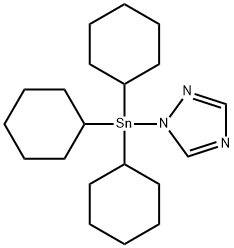
What is Azocyclotin?
The Uses of Azocyclotin
Azocyclotin is an organotin aracacide used in the control of mites. Azocyclotin showed weak antifeedant activity against other insects such as Spodoptera littoralis.
The Uses of Azocyclotin
Azocyclotin is used to control all motile stages of spider mites on fruit, vines, hops, cotton, vegetables and ornamentals.
What are the applications of Application
Azocyclotin is an organotin contact acaricide effective against phytophagous mites
Definition
ChEBI: A member of the class of triazoles that is 1,2,4-triazole substituted at position 1 by a tricyclohexylstannyl group.
Metabolic pathway
The sedimentation of particles coated with the pesticide is relatively fast. Shortly after application of 14C-azocyclotin, distribution, solubilizing, and metabolism in fresh water microcosms begin, and azocyclotin is quickly hydrolyzed to cyhexatin (tricyclohexyltin hydroxide) by splitting of the triazole residue, and, according to the solubility of cyhexatin, cyhexatin is mainly absorbed to sediment and the layer of biota in direct contact with the sediment and further undergoes successive metabolism to result in dicyclohexyltin oxide and cyclohexyltin acid.
Degradation
Azocyclotin undergoes hydrolysis with DT50 values (22 °C) of 96 hours at pH 4,81 hours at pH 7 and 8 hours at pH 9 (I'M).
Properties of Azocyclotin
| Melting point: | 210℃ |
| Boiling point: | 487.4±28.0 °C(Predicted) |
| vapor pressure | 2×10-11 Pa (20 °C, est.) |
| storage temp. | 0-6°C |
| solubility | Chloroform (Slightly), DMSO (Slightly), Methanol (Slightly) |
| pka | 5.36 (weak base) |
| form | neat |
| Water Solubility | 0.12 mg l-1 (20 °C) |
| BRN | 621636 |
| CAS DataBase Reference | 41083-11-8(CAS DataBase Reference) |
| NIST Chemistry Reference | 1H-1,2,4-triazole, 1-(tricyclohexylstannyl)-(41083-11-8) |
| EPA Substance Registry System | Azocyclotin (41083-11-8) |
Safety information for Azocyclotin
| Signal word | Danger |
| Pictogram(s) |
 Corrosion Corrosives GHS05  Skull and Crossbones Acute Toxicity GHS06  Environment GHS09 |
| GHS Hazard Statements |
H301:Acute toxicity,oral H315:Skin corrosion/irritation H318:Serious eye damage/eye irritation H330:Acute toxicity,inhalation H335:Specific target organ toxicity, single exposure;Respiratory tract irritation H410:Hazardous to the aquatic environment, long-term hazard |
| Precautionary Statement Codes |
P260:Do not breathe dust/fume/gas/mist/vapours/spray. P273:Avoid release to the environment. P280:Wear protective gloves/protective clothing/eye protection/face protection. P302+P352:IF ON SKIN: wash with plenty of soap and water. P305+P351+P338:IF IN EYES: Rinse cautiously with water for several minutes. Remove contact lenses, if present and easy to do. Continuerinsing. |
Computed Descriptors for Azocyclotin
New Products
2-(2-Chlorophenyl)glycine Propiolic Acid 1-(3-Hydroxy-4-methoxyphenyl)-2-nitroethene (±)-amino(2-fluorophenyl)acetic acid trans-3-Benzyloxy-4-methoxy-beta-nitrostyrene 1-Pentadecanol 4-(4-Αminophenyl)-3-Morpholinone 3-Morpholino-1-(4-(2-oxopiperidin-1-yl) phenyl)-5,6-dihyropyridin-2-(1H)-one 1-(4-Aminophenyl)-3-morpholino-5,6-dihydropyridin-2(1H)-one N-cyanoacetylurethane 1H-IndazoleRelated products of tetrahydrofuran


You may like
-
 40216-83-9 trans-4-Hydroxy-L-proline methyl ester hydrochloride 98+View Details
40216-83-9 -
471-25-0 Propiolic Acid 98+View Details
471-25-0 -
84145-28-8 98+View Details
84145-28-8 -
trans-3-Benzyloxy-4-methoxy-beta-nitrostyrene 98+View Details
63909-29-5 -
2-(2-Chlorophenyl)glycine 88744-36-9 98+View Details
88744-36-9 -
40216-83-9 trans-4-Hydroxy-L-proline methyl ester hydrochloride 98+View Details
40216-83-9 -
629-76-5 98+View Details
629-76-5 -
1-(3-Hydroxy-4-methoxyphenyl)-2-nitroethene 98+View Details
39816-35-8