
TAXIFOLIN 3-O-RHAMNOSIDE
Synonym(s):Astilbin;Dihydroquercetin 3-rhamnoside;Taxifolin 3-rhamnoside
- CAS NO.:29838-67-3
- Empirical Formula: C21H22O11
- Molecular Weight: 450.4
- MDL number: MFCD20274680
- EINECS: 694-695-3
- SAFETY DATA SHEET (SDS)
- Update Date: 2026-07-27 17:00:41
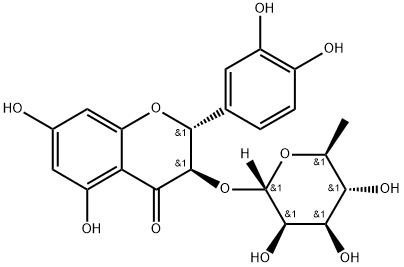
What is TAXIFOLIN 3-O-RHAMNOSIDE?
Description
Astilbin is a flavonoid that has been found in S. glabra and has diverse biological activities. It inhibits cisplatin-induced increases in apoptosis and accumulation of reactive oxygen species (ROS) in HEK293 cells when used at a concentration of 200 μM. Astilbin (50 mg/kg) increases renal glutathione (GSH) levels and superoxide dismutase (SOD) and catalase activity and reduces serum creatinine and blood urea nitrogen (BUN) levels, renal IL-1β, IL-6, and TNF-α levels, apoptosis in kidney tissue, and kidney injury in a mouse model of cisplatin-induced nephrotoxicity. It reduces loss of dopaminergic neurons in the substantia nigra and increases striatal GSH levels and SOD activity in a mouse model of MPTP-induced Parkinson''s disease when administered at a dose of 50 mg/kg per day. Astilbin also reduces descent time in a pole test and increases traction test score in a mouse model of Parkinson''s disease, indicating reduced motor deficits. It reduces cell viability of MDA-MB-231 and MCF-7 cells (IC50s = 167.9 and 191.6 μM, respectively), as well as inhibits migration and increases apoptosis when used at concentrations of 50 and 200 μM. Astilbin (20 mg/kg every other day for 14 days) reduces tumor growth in an MCF-7 mouse xenograft model.
The Uses of TAXIFOLIN 3-O-RHAMNOSIDE
Astilbin displays anti-depressant activity involving monoaminergic neurotransmitters an the BDNF signal pathway. Anti-oxidant.
Definition
ChEBI: A flavanone glycoside that is (+)-taxifolin substituted by a alpha-L-rhamnosyl moiety at position 3 via a glycosidic linkage.
Properties of TAXIFOLIN 3-O-RHAMNOSIDE
| Melting point: | 180 °C (decomp) |
| Boiling point: | 801.1±65.0 °C(Predicted) |
| Density | 1.74 |
| storage temp. | Sealed in dry,2-8°C |
| solubility | H2O: soluble1mg/mL, clear, colorless |
| pka | 7.34±0.60(Predicted) |
| form | A crystalline solid |
| color | White to off-white |
Safety information for TAXIFOLIN 3-O-RHAMNOSIDE
| Signal word | Warning |
| Pictogram(s) |
 Environment GHS09 |
| GHS Hazard Statements |
H400:Hazardous to the aquatic environment, acute hazard |
| Precautionary Statement Codes |
P273:Avoid release to the environment. |
Computed Descriptors for TAXIFOLIN 3-O-RHAMNOSIDE
New Products
9-Mesityl-10-methylacridinium perchlorate Sulfapyridine Fmoc-OSu (R)-(-)-2-Amino-1-propanol Cyclobutanone 5-bromo-4-fluoro-2-nitrobenzaldehyde 4 pentyn 1 ol N-Vinylformamide Phenethyl cinnamate Pyrrolo[1,2-a]pyrimidine-6-carboxylic acid, 4,6,7,8-tetrahydro-4-oxo-, sodium salt (1:1), (6S) Ethyl 3-phenylpropanoate β-Bromostyrene Methacrylate-PEG-Methacrylate, Mn:35000 2,4-Dihydroxyacetophenone 2-Chloro 5-Fluoro Pyridine Vasicinone 2-Chloroisonicotinic Acid Tween 80 or Polysorbate 80 Methyl trans-4-Aminocyclohexanecarboxylate Hydrochloride N-(4-fluoro-2-methoxy-5-nitrophenyl)-4-(1-methyl-1H-indol-3-yl)pyrimidin-2-amine Pirtobrutinib intd. 4-Nitrobenzotrifluoride 2-Pentyn-1-oL N-(4-Cyano-3-(trifluoromethyl)phenyl)-2-methyloxirane-2-carboxamideRelated products of tetrahydrofuran
You may like
-
 Astilbin from Engelhardtia roxburghiana 98% (HPLC) CAS 29838-67-3View Details
29838-67-3 -
1191-95-3 Cyclobutanone 98+View Details
1191-95-3 -
Fmoc-OSu 98+View Details
82911-69-1 -
(R)-(-)-2-Amino-1-propanol 35320-23-1 98+View Details
35320-23-1 -
1191-95-3 Cyclobutanone 98+View Details
1191-95-3 -
213382-45-7 98+View Details
213382-45-7 -
Fmoc-OSu 98+View Details
82911-69-1 -
(R)-(-)-2-Amino-1-propanol 35320-23-1 98+View Details
35320-23-1