
SULFOTEP
Synonym(s):O,O,O′,O′-Tetraethyl dithiopyrophosphate
- CAS NO.:3689-24-5
- Empirical Formula: C8H20O5P2S2
- Molecular Weight: 322.31
- MDL number: MFCD00026764
- EINECS: 222-995-2
- SAFETY DATA SHEET (SDS)
- Update Date: 2026-07-31 15:25:14
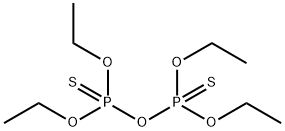
What is SULFOTEP?
Chemical properties
Yellowliquid. Slightly soluble in water; soluble in most organic solvents.
Chemical properties
Sulfotep is a yellow mobile liquid. Garliclike odor.
The Uses of SULFOTEP
Sulfotep is used to control aphids, thrips, mites and whiteflies in glasshouses by fumigation. It also used to control sciarid and phorid flies in mushrooms.
The Uses of SULFOTEP
An organophosphate pesticide that is an inhibitor of acetylcholinesterase (AChE).
The Uses of SULFOTEP
Insecticide; miticide.
Definition
ChEBI: Sulfotep is an organic thiophosphate and an organothiophosphate insecticide. It has a role as an EC 3.1.1.7 (acetylcholinesterase) inhibitor, an EC 3.1.1.8 (cholinesterase) inhibitor, an acaricide and an agrochemical. It is functionally related to a dithiodiphosphoric acid.
General Description
Tetraethyl dithiopyrophosphate and compressed gas mixture is a liquid charged with a gas. Tetraethyl dithiopyrophosphate is a yellow liquid. Its vapor is heavier than air. SULFOTEP is lethal by skin absorption and inhalation. Prolonged exposure of the containers to fire or heat may result in their violent rupturing and rocketing.
Reactivity Profile
Organothiophosphates, such as TETRAETHYL DITHIOPYROPHOSPHATE, are susceptible to formation of highly toxic and flammable phosphine gas in the presence of strong reducing agents such as hydrides. Partial oxidation by oxidizing agents may result in the release of toxic phosphorus oxides. SULFOTEP is incompatible with the following: Strong oxidizers, iron [Note: Corrosive to iron.] .
Hazard
Toxic by ingestion, inhalation, and skin absorption; cholinesterase inhibitor; use may be restricted. Questionable carcinogen.
Safety Profile
Poison by ingestion, skin contact, inhalation, intramuscular, intraperitoneal, subcutaneous, and intravenous routes. A cholinesterase inhbitor type of insecticide. When heated to decomposition it emits toxic fumes of POx and SOx. See also PARATHION.
Potential Exposure
Sulfotep is used in greenhouse fumigant formulations for control of aphids, spider mites; thrips, whiteflies, etc.
Environmental Fate
Soil. Cleavage of the molecule yields diethyl phosphate, monoethyl phosphate and
phosphoric acid (Hartley and Kidd, 1987).
Chemical/Physical. Emits toxic oxides of sulfur and phosphorus oxides when heated
to decomposition (Lewis, 1990).
Metabolic pathway
Sulfotep and related compounds may be formed photochemically from a number of phosphorodithioate and phosphorothioate insecticides including azinphos-methyl, chlorpyrifos, malathion, methidathion and phosalone (Abdelbagi and Gaston, 1998). Since sulfotep has a rather high mammalian toxicity, this may be of some toxicological sigruficance. Sulfotep is transformed in the environment via oxidative desulfuration to the highly active anti-cholinesterase compounds monosulfotep and tetraethyl pyrophosphate. It is deactivated by hydrolysis to O,O-diethyl phosphorothioate and diethyl phosphate.
Shipping
UN1704 (Sulfotep) Tetraethyl dithiopyrophosphate, Hazard Class: 6.1; Labels: 6.1-Poisonous materials.
Degradation
Sulfotep is relatively slowly hydrolysed with DT50 values of 10.7,8.2 and 9.1 days at pH values 4,7 and 9 respectively (PM).
Toxicity evaluation
Sulfotep is formulated as fumigant. The acute oral LD50 for rats is about 10 mg/kg. Inhalation LC50 (4 h) for rats is about 0.05 mg/L air. NOEL (2 yr) for rats is 10mg/kg diet (0.5mg/kg/d). ADI is 1 μg/kg b.w. Sulfotep is activated by oxidative desulfuration to tetraethyl monothiopyrophosphate and pyrophosphate in the environment. Sulfotep administered to rats is quickly eliminated. The major elimination product is diethyl hydrogen phosphorothioate.
Incompatibilities
Incompatible with oxidizers (chlorates, nitrates, peroxides, permanganates, perchlorates, chlorine,bromine, fluorine, etc.); contact may cause fires or explosions. Keep away from alkaline materials, strong bases, strong acids, oxoacids, epoxides. Hydrolyzes very slowly in aqueous solution. Attacks some forms of plastic, rubber and coating. Corrosive to iron.
Waste Disposal
Consult with environmental regulatory agencies for guidance on acceptable disposal practices. Generators of waste containing this contaminant (≥100 kg/mo) must conform with EPA regulations governing storage, transportation, treatment, and waste disposal. In accordance with 40CFR165, follow recommendations for the disposal of pesticides and pesticide containers. Must be disposed properly by following package label directions or by contacting your local or federal environmental control agency, or by contacting your regional EPA office. Incineration with added flammable solvent in furnace equipped with afterburner and alkaline scrubber.
Properties of SULFOTEP
| Melting point: | <25℃ |
| Boiling point: | bp2 136-139° |
| Density | 1.2175 g/cm3 (20℃) |
| vapor pressure | 1.7 x 10⁻⁴ at 20 °C (Windholz et al., 1983) |
| refractive index | 1.5000 (589.3 nm 20℃) |
| Flash point: | -18 °C |
| storage temp. | APPROX 4°C
|
| solubility | Miscible with methyl chloride and most organic solvents (Worthing and Hance, 1991) |
| form | Liquid |
| color | Clear colorless |
| Water Solubility | 30 mg/L at 20 °C (Worthing and Hance, 1991) |
| Merck | 13,9056 |
| BRN | 1714019 |
| Henry's Law Constant | 2.88 at 20 °C (approximate - calculated from water solubility and vapor pressure) |
| Exposure limits | NIOSH REL: TWA 0.2 mg/m3, IDLH 10 mg/m3; ACGIH TLV: TWA
0.2 mg/m3. |
| EPA Substance Registry System | Sulfotep (3689-24-5) |
Safety information for SULFOTEP
| Signal word | Danger |
| Pictogram(s) |
 Skull and Crossbones Acute Toxicity GHS06  Environment GHS09 |
| GHS Hazard Statements |
H410:Hazardous to the aquatic environment, long-term hazard |
| Precautionary Statement Codes |
P260:Do not breathe dust/fume/gas/mist/vapours/spray. P262:Do not get in eyes, on skin, or on clothing. P273:Avoid release to the environment. P280:Wear protective gloves/protective clothing/eye protection/face protection. |
Computed Descriptors for SULFOTEP
New Products
2-Bromo-4-hydroxypyridine Dibenzoyl-L-tartaric acid Anhydrous (Resolution Reagent) Dibenzo[b,f][1,4]thiazepin-11(10H)-one 1,2,3,9-Tetrahydro-9-Methyl-4H-Carbazole-4-One Cis-Tosylate 1-(4-methoxyphenyl)-4-(4-Nitrophenyl)Piperazine (IT-1) 2'-Fluoroacetophenone 1-aminocyclobutanecarbonitrile hydrochloride AMINO-O-TOLYL-ACETIC ACID N-Methyl-2-amino-2-methylpropionamide 4-(FMOC-AMINO)-TETRAHYDROPYRAN-4-CARBOXYLIC ACID 1-Aminocyclobutanecarboxylic Acid Hydrochloride METHANOL-D1(OD) TERTIARY BUTANOL-D9 N-ETHYL-D5-AMINE HYDROCHLORIDE BENZOIC ACID-D CHLOROFORM-D TOLUENE-D3 2-(2-Bromophenyl)ethanol Boc-D-Glu(OMe)-OMe 2,5 Dibromopyridine Ethyl 4-hydroxy-3-oxobutanoate Dimethyl (2S)-2-((tert-butoxycarbonyl)amino)-4-(cyanomethyl)pentanedioate 1-(3-Chlorophenyl)piperazine hydrochlorideRelated products of tetrahydrofuran

You may like
-
 Sulfotep CAS 3689-24-5View Details
3689-24-5 -
Sulfotep CAS 3689-24-5View Details
3689-24-5 -
106914-07-2 N-Methyl-2-amino-2-methylpropionamide 98+View Details
106914-07-2 -
129592-98-9 98+View Details
129592-98-9 -
4-(FMOC-AMINO)-TETRAHYDROPYRAN-4-CARBOXYLIC ACID 98+View Details
285996-72-7 -
1-aminocyclobutanecarbonitrile hydrochloride 845821-84-3 98+View Details
845821-84-3 -
98071-16-0 1-Aminocyclobutanecarboxylic Acid Hydrochloride 98+View Details
98071-16-0 -
 ADC-151View Details
27176-87-0