
Sorbic acid
- CAS NO.:22500-92-1
- Empirical Formula: C6H8O2
- Molecular Weight: 0
- MDL number: MFCD00002703
- SAFETY DATA SHEET (SDS)
- Update Date: 2026-05-28 05:22:38

What is Sorbic acid?
Chemical properties
White or almost white, crystalline powder.
Chemical properties
Sorbic acid is a tasteless, white to yellow-white crystalline powder with a faint characteristic odor.
The Uses of Sorbic acid
Pharmaceutic aid (antimicrobial agent).
Definition
ChEBI: A hexadienoic acid with double bonds at C-2 and C-4; it has four geometrical isomers, of which the trans,trans-form is naturally occurring.
Production Methods
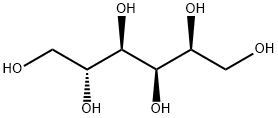
Naturally occurring sorbic acid may be extracted as the lactone (parasorbic acid) from the berries of the mountain ash Sorbus aucuparia L. (Fam. Rosaceae). Synthetically, sorbic acid may be prepared by the condensation of crotonaldehyde and ketene in the presence of boron trifluoride; by the condensation of crotonaldehyde and malonic acid in pyridine solution; or from 1,1,3,5- tetraalkoxyhexane. Fermentation of sorbaldehyde or sorbitol with bacteria in a culture medium has also been used.
Pharmaceutical Applications
Sorbic acid is an antimicrobial preservative with antibacterial and
antifungal properties used in pharmaceuticals, foods, enteral
preparations, and cosmetics. Generally, it is used at concentrations
of 0.05–0.2% in oral and topical pharmaceutical formulations,
especially those containing nonionic surfactants. Sorbic acid is also
used with proteins, enzymes, gelatin, and vegetable gums. It has
been shown to be an effective preservative for promethazine
hydrochloride solutions in a concentration of 1 g/L.
Sorbic acid has limited stability and activity against bacteria and
is thus frequently used in combination with other antimicrobial
preservatives or glycols, when synergistic effects appear to occur.
Safety
Sorbic acid is used as an antimicrobial preservative in oral and
topical pharmaceutical formulations and is generally regarded as a
nontoxic material. However, adverse reactions to sorbic acid and
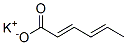
potassium sorbate, including irritant skin reactions and
allergic hypersensitivity skin reactions (which are less frequent),
have been reported.
Other adverse reactions that have been reported include
exfoliative dermatitis due to ointments that contain sorbic
acid, and allergic conjunctivitis caused by contact lens solutions
preserved with sorbic acid.
No adverse reactions have been described after systemic
administration of sorbic acid, and it has been reported that it can
be ingested safely by patients who are allergic to sorbic acid.
However, perioral contact urticaria has been reported.
The WHO has set an estimated total acceptable daily intake for
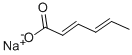
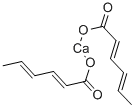
sorbic acid, calcium sorbate, potassium sorbate, and sodium
sorbate, expressed as sorbic acid, at up to 25 mg/kg bodyweight.
Animal toxicological studies have shown no mammalian
carcinogenicity or teratogenicity for sorbic acid consumed at up
to 10% of the diet.
LD50 (mouse, IP): 2.82 g/kg
LD50 (mouse, oral): 3.20 g/kg
LD50 (mouse, SC): 2.82 g/kg
LD50 (rat, oral): 7.36 g/kg
Storage
Sorbic acid is sensitive to oxidation, particularly in the presence of
light; oxidation occurs more readily in aqueous solution than in the
solid form. Sorbic acid may be stabilized by phenolic antioxidants
such as 0.02% propyl gallate.
Sorbic acid is combustible when exposed to heat or flame. When
heated to decomposition, it emits acrid smoke and irritating fumes.
The bulk material should be stored in a well-closed container,
protected from light, at a temperature not exceeding 40℃.
Incompatibilities
Sorbic acid is incompatible with bases, oxidizing agents, and
reducing agents. Some loss of antimicrobial activity occurs in the
presence of nonionic surfactants and plastics. Oxidation is
catalyzed by heavy-metal salts. Sorbic acid will also react with
sulfur-containing amino acids, although this can be prevented by
the addition of ascorbic acid, propyl gallate, or butylhydroxytoluene.
When stored in glass containers, the solution becomes very pH
sensitive; therefore, preparations using sorbic acid as a preservative
should be tested for their microbial purity after prolonged periods
of storage.
Aqueous solutions of sorbic acid without the addition of
antioxidants are rapidly decomposed when stored in polypropylene,
polyvinylchloride, and polyethylene containers.
Regulatory Status
GRAS listed. Accepted as a food additive in Europe. Included in the FDA Inactive Ingredients Database (ophthalmic solutions; oral capsules, solutions, syrups, tablets; topical and vaginal preparations). Included in nonparenteral medicines licensed in the UK. Included in the Canadian List of Acceptable Non-medicinal Ingredients.
Properties of Sorbic acid
| solubility | Slightly soluble in water, freely soluble in ethanol (96 per cent). |
| Odor | characteristic |
| InChI | InChI=1S/C6H8O2/c1-2-3-4-5-6(7)8/h2-5H,1H3,(H,7,8)/b3-2+,5-4+ |
Safety information for Sorbic acid
Computed Descriptors for Sorbic acid
| InChIKey | WSWCOQWTEOXDQX-MQQKCMAXSA-N |
| SMILES | C(O)(=O)/C=C/C=C/C |
New Products
2-(2-Chlorophenyl)glycine Propiolic Acid 1-(3-Hydroxy-4-methoxyphenyl)-2-nitroethene (±)-amino(2-fluorophenyl)acetic acid trans-3-Benzyloxy-4-methoxy-beta-nitrostyrene 1-Pentadecanol 2,4-Dihydroxybenzaldehyde Dipropyl disulfide Pyrrolo[1,2-a]pyrimidine-6-carboxylic acid, 4,6,7,8-tetrahydro-4-oxo-, sodium salt (1:1), (6S) Obidoxime hydrochloride API 4 pentyn 1 ol N-Vinylformamide Methacrylate-PEG-Methacrylate, Mn:35000 2,4-Dihydroxyacetophenone 2-Chloro 5-Fluoro Pyridine Vasicinone 2-Chloroisonicotinic Acid Tween 80 or Polysorbate 80 2-Butyn-1-oL N-(4-Cyano-3-(trifluoromethyl)phenyl)-2-methyloxirane-2-carboxamide N-(4-fluoro-2-methoxy-5-nitrophenyl)-4-(1-methyl-1H-indol-3-yl)pyrimidin-2-amine Pirtobrutinib intd. 2-Pentyn-1-oL 4-NitrobenzotrifluorideRelated products of tetrahydrofuran
You may like
-
 40216-83-9 trans-4-Hydroxy-L-proline methyl ester hydrochloride 98+View Details
40216-83-9 -
471-25-0 Propiolic Acid 98+View Details
471-25-0 -
84145-28-8 98+View Details
84145-28-8 -
trans-3-Benzyloxy-4-methoxy-beta-nitrostyrene 98+View Details
63909-29-5 -
2-(2-Chlorophenyl)glycine 88744-36-9 98+View Details
88744-36-9 -
40216-83-9 trans-4-Hydroxy-L-proline methyl ester hydrochloride 98+View Details
40216-83-9 -
629-76-5 98+View Details
629-76-5 -
1-(3-Hydroxy-4-methoxyphenyl)-2-nitroethene 98+View Details
39816-35-8