
SODIUM MERCURY AMALGAM
- CAS NO.:11110-52-4
- Empirical Formula: HgNa
- Molecular Weight: 223.58
- MDL number: MFCD00210362
- SAFETY DATA SHEET (SDS)
- Update Date: 2026-05-28 04:12:51
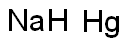
What is SODIUM MERCURY AMALGAM?
Chemical properties
grey solid, often supplied in the form of beads
The Uses of SODIUM MERCURY AMALGAM
Preparation of hydrogen, reduction of metal halogen compounds and organic compounds, reagent in analytical chemistry.
The Uses of SODIUM MERCURY AMALGAM
Magnetic characteristics were studied of organometallic oxo-vanadium cluster compounds, such as [C5Me5V]4(μ-O)6, which is formed by reduction with sodium mercury amalgam.
Used for:
- Ionic liquid based sodium ion conducting gel polymer electrolytes
- Dehalogenation agent for the room-temperature synthesis of carbonaceous films
- Plant-scaled method for preparation of deuterium-depleted water
- Investigations of solvent effects on desulfonylation of polyethylene glycol-substituted aryl alkyl sulfones
Catalyst for synthesis of selectively benzylated Me α-D-glucopyranosides
Reagent for reduction of RDX for functionalization for forensic analysis
Hazard
Flammable, dangerous fire risk.
Properties of SODIUM MERCURY AMALGAM
| Melting point: | 61 °C |
| storage temp. | water-free area |
| form | beads |
| color | Gray |
| Merck | 13,8646 |
| Stability: | Stable, but extremely reactive. Highly flammable. Reacts violently with water, generating hydrogen. Incompatible with oxidizing agents, water, halogens, acids. |
Safety information for SODIUM MERCURY AMALGAM
| Signal word | Danger |
| Pictogram(s) |
 Flame Flammables GHS02  Corrosion Corrosives GHS05  Skull and Crossbones Acute Toxicity GHS06  Health Hazard GHS08  Environment GHS09 |
| GHS Hazard Statements |
H260:Substances And Mixtures Which, In Contact With Water,Emit Flammable Gases H314:Skin corrosion/irritation H331:Acute toxicity,inhalation H372:Specific target organ toxicity, repeated exposure H410:Hazardous to the aquatic environment, long-term hazard |
| Precautionary Statement Codes |
P201:Obtain special instructions before use. P280:Wear protective gloves/protective clothing/eye protection/face protection. P231+P232:Handle under inert gas. Protect from moisture. P308+P313:IF exposed or concerned: Get medical advice/attention. P370+P378:In case of fire: Use … for extinction. P402+P404:Store in a dry place. Store in a closed container. |
Computed Descriptors for SODIUM MERCURY AMALGAM
New Products
2-(2-Chlorophenyl)glycine Propiolic Acid trans-3-Benzyloxy-4-methoxy-beta-nitrostyrene 1-(3-Hydroxy-4-methoxyphenyl)-2-nitroethene (±)-amino(2-fluorophenyl)acetic acid 1-Pentadecanol N-Vinylformamide 4 pentyn 1 ol 4-(4-Αminophenyl)-3-Morpholinone 3-Morpholino-1-(4-(2-oxopiperidin-1-yl) phenyl)-5,6-dihyropyridin-2-(1H)-one 1-(4-Aminophenyl)-3-morpholino-5,6-dihydropyridin-2(1H)-one N-cyanoacetylurethane 1H-IndazoleRelated products of tetrahydrofuran

You may like
-
 40216-83-9 trans-4-Hydroxy-L-proline methyl ester hydrochloride 98+View Details
40216-83-9 -
471-25-0 Propiolic Acid 98+View Details
471-25-0 -
84145-28-8 98+View Details
84145-28-8 -
trans-3-Benzyloxy-4-methoxy-beta-nitrostyrene 98+View Details
63909-29-5 -
2-(2-Chlorophenyl)glycine 88744-36-9 98+View Details
88744-36-9 -
40216-83-9 trans-4-Hydroxy-L-proline methyl ester hydrochloride 98+View Details
40216-83-9 -
629-76-5 98+View Details
629-76-5 -
1-(3-Hydroxy-4-methoxyphenyl)-2-nitroethene 98+View Details
39816-35-8
Statement: All products displayed on this website are only used for non medical purposes such as industrial applications or scientific research, and cannot be used for clinical diagnosis or treatment of humans or animals. They are not medicinal or edible.