
SAFFRON
Synonym(s):Gram Stain, C.I. 75100;Saffron
- CAS NO.:8022-19-3
- Empirical Formula: C20H24O4
- Molecular Weight: 328.4
- MDL number: MFCD00064590
- EINECS: 255-881-6
- SAFETY DATA SHEET (SDS)
- Update Date: 2026-06-24 18:39:39
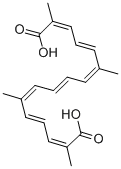
What is SAFFRON?
Chemical properties
Red and yellow fibers
Chemical properties
True saffron is native to Asia Minor and southern Europe. Several varieties of C. sativus L. are known and cultivated in various countries (e.g., France, Spain, Turkey, Greece and Italy). The varieties C. sativus thomasii Ten and C. orsini Parl. are commonly cultivated in Italy. This herbaceous plant is approximately 30 cm (12 in.) tall, has bulbous roots usually branched by smaller fibrous roots, an erect, white, thin scape terminated by purple inflorescences and three red-orange stigmas. The mature stigmas are collected during a short blooming season to produce the spice saffron. Saffron has a sweet, spicy, floral odor with a fatty, herbaceous undertone and a slightly bitter taste. For coloring purposes, the less expensive dried flowers of the American or Mexican saffron (Carthamus tinctorius L., family Compositae) are used in lieu of saffron. However, these varieties have a scarcely perceptible flavor.
Occurrence
Saffron is found in Europe and Asia.
The Uses of SAFFRON
Saffron is a spice obtained from the dried stigmas of the fall-flower- ing crocus sativus l. the flower stigma is of intense yellow color. it has a powerful, somewhat bitter aroma. it is used in breads, fish, chicken, sauces, and rice dishes.
Definition
Extractives and their physically modified derivatives. Crocus sativus, Iridaceae.
Composition
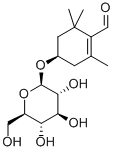
The dried stigmas contain picrocrocin, crocin, vitamins B and B2 and a small amount of essential oil (ca 0.30%) that is either solvent-extracted or sometimes steam-distilled for specific uses only. Crocin is a mixture of glycosides. The presence of 2,2,6-trimethyl-4,6 cyclohexidienal causes the characteristic spicy, warm odor of the dried product and tinctures; crocin yields the characteristic, bright orange-yellow color.
Properties of SAFFRON
| Odor | at 100.00 %. herbal saffron |
| EPA Substance Registry System | Oils, saffron (8022-19-3) |
Safety information for SAFFRON
Computed Descriptors for SAFFRON
New Products
2-(2-Chlorophenyl)glycine Propiolic Acid 1-(3-Hydroxy-4-methoxyphenyl)-2-nitroethene (±)-amino(2-fluorophenyl)acetic acid trans-3-Benzyloxy-4-methoxy-beta-nitrostyrene 1-Pentadecanol 2,4-Dihydroxybenzaldehyde Dipropyl disulfide Pyrrolo[1,2-a]pyrimidine-6-carboxylic acid, 4,6,7,8-tetrahydro-4-oxo-, sodium salt (1:1), (6S) Obidoxime hydrochloride API 4 pentyn 1 ol N-Vinylformamide Methacrylate-PEG-Methacrylate, Mn:35000 2,4-Dihydroxyacetophenone 2-Chloro 5-Fluoro Pyridine Vasicinone 2-Chloroisonicotinic Acid Tween 80 or Polysorbate 80 2-Butyn-1-oL N-(4-Cyano-3-(trifluoromethyl)phenyl)-2-methyloxirane-2-carboxamide N-(4-fluoro-2-methoxy-5-nitrophenyl)-4-(1-methyl-1H-indol-3-yl)pyrimidin-2-amine Pirtobrutinib intd. 2-Pentyn-1-oL 4-NitrobenzotrifluorideRelated products of tetrahydrofuran

You may like
-
 Saffron CASView Details
 -
471-25-0 Propiolic Acid 98+View Details
471-25-0 -
84145-28-8 98+View Details
84145-28-8 -
trans-3-Benzyloxy-4-methoxy-beta-nitrostyrene 98+View Details
63909-29-5 -
2-(2-Chlorophenyl)glycine 88744-36-9 98+View Details
88744-36-9 -
40216-83-9 trans-4-Hydroxy-L-proline methyl ester hydrochloride 98+View Details
40216-83-9 -
629-76-5 98+View Details
629-76-5 -
1-(3-Hydroxy-4-methoxyphenyl)-2-nitroethene 98+View Details
39816-35-8