
Retaspimycin
- CAS NO.:857402-23-4
- Empirical Formula: C31H45N3O8
- Molecular Weight: 587.7
- MDL number: MFCD30344690
- SAFETY DATA SHEET (SDS)
- Update Date: 2026-05-11 19:39:08
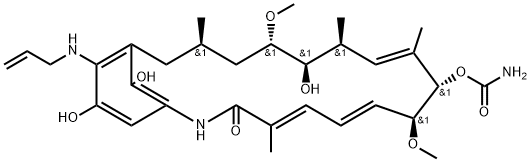
What is Retaspimycin?
Description
Retaspimycin is a small-molecule inhibitor of heat shock protein 90 (HSP90) with antiproliferative and antineoplastic activities. Retaspimycin binds to and inhibits the cytosolic chaperone functions of HSP90, which maintains the stability and functional shape of many oncogenic signaling proteins and may be overexpressed or overactive in tumor cells. Retaspimycin-mediated inhibition of HSP90 promotes the proteasomal degradation of oncogenic signaling proteins in susceptible tumor cell populations, which may result in the induction of apoptosis.
The Uses of Retaspimycin
Retaspimycin (IPI-504) was previously under development by manufacturer Infinity Pharmaceuticals in conjunction with MedImmune, a part of AstraZeneca. Retaspimycin is a small-molecule inhibitor of heat shock protein 90 (HSP90) with antiproliferative and antineoplastic activities. Retaspimycin binds to and inhibits the cytosolic chaperone functions of HSP90, which maintains the stability and functional shape of many oncogenic signaling proteins and may be overexpressed or overactive in tumor cells. Retaspimycin-mediated inhibition of HSP90 promotes the proteasomal degradation of oncogenic signaling proteins in susceptible tumor cell populations, which may result in the induction of apoptosis. Orphan drug designation was assigned to the compound by the FDA for the treatment of gastrointestinal stromal cancer (GIST). Infinity Pharmaceuticals has discontinued the development of retaspimycin (IPI-504) an inhibitor of the HSP-90) complex, for the treatment of cancer due to lack of efficacy in 1913.
Definition
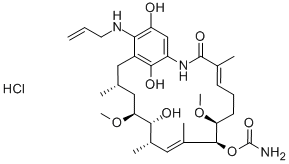
ChEBI: An ansamycin that is tanespimycin in which the benzoquinone moiety has been reduced to the corresponding hydroquinone. A semi-synthetic analogue of geldanamycin, it is used (generally as the hydrochloride salt) in cancer treatment.
Biological Activity
IPI-504 potently inhibits proliferation in several tumor cell lines with 50% inhibition concentration IC50 values ranging from 10-40 nM and has been used for the treatment of gastrointestinal stromal tumors, soft-tissue sarcomas and non-small cell lung cancer.
Mode of action
Cancer cells depend on the Hsp90 chaperone to maintain many proteins critical for cancer growth, proliferation and survival in a functional state. Retaspimycin binds to and inhibits the cytosolic chaperone functions of HSP90, which maintains the stability and functional shape of many oncogenic signaling proteins and may be overexpressed or overactive in tumor cells. Retaspimycin-mediated inhibition of HSP90 promotes the proteasomal degradation of oncogenic signaling proteins in susceptible tumor cell populations, which results in the induction of apoptosis.
References
[1]. hanson b e, vesole d h. retaspimycin hydrochloride (ipi-504): a novel heat shock protein inhibitor as an anticancer agent. 2009.
[2]. floris g, debiec-rychter m, wozniak a, et al. the heat shock protein 90 inhibitor ipi-504 induces kit degradation, tumor shrinkage, and cell proliferation arrest in xenograft models of gastrointestinal stromal tumors. molecular cancer therapeutics, 2011, 10(10): 1897-1908.
Properties of Retaspimycin
| Boiling point: | 800.9±65.0 °C(Predicted) |
| Density | 1.23 |
| storage temp. | Store at -20°C |
| solubility | Soluble in DMSO |
| form | Powder |
| pka | 10.15±0.70(Predicted) |
Safety information for Retaspimycin
Computed Descriptors for Retaspimycin
New Products
2-(2-Chlorophenyl)glycine Propiolic Acid 1-(3-Hydroxy-4-methoxyphenyl)-2-nitroethene (±)-amino(2-fluorophenyl)acetic acid trans-3-Benzyloxy-4-methoxy-beta-nitrostyrene 1-Pentadecanol 2,4-Dihydroxybenzaldehyde Dipropyl disulfide Pyrrolo[1,2-a]pyrimidine-6-carboxylic acid, 4,6,7,8-tetrahydro-4-oxo-, sodium salt (1:1), (6S) Obidoxime hydrochloride API 4 pentyn 1 ol N-Vinylformamide Methacrylate-PEG-Methacrylate, Mn:35000 2,4-Dihydroxyacetophenone 2-Chloro 5-Fluoro Pyridine Vasicinone 2-Chloroisonicotinic Acid Tween 80 or Polysorbate 80 2-Butyn-1-oL N-(4-Cyano-3-(trifluoromethyl)phenyl)-2-methyloxirane-2-carboxamide N-(4-fluoro-2-methoxy-5-nitrophenyl)-4-(1-methyl-1H-indol-3-yl)pyrimidin-2-amine Pirtobrutinib intd. 2-Pentyn-1-oL 4-NitrobenzotrifluorideRelated products of tetrahydrofuran
You may like
-
 40216-83-9 trans-4-Hydroxy-L-proline methyl ester hydrochloride 98+View Details
40216-83-9 -
471-25-0 Propiolic Acid 98+View Details
471-25-0 -
84145-28-8 98+View Details
84145-28-8 -
trans-3-Benzyloxy-4-methoxy-beta-nitrostyrene 98+View Details
63909-29-5 -
2-(2-Chlorophenyl)glycine 88744-36-9 98+View Details
88744-36-9 -
40216-83-9 trans-4-Hydroxy-L-proline methyl ester hydrochloride 98+View Details
40216-83-9 -
629-76-5 98+View Details
629-76-5 -
1-(3-Hydroxy-4-methoxyphenyl)-2-nitroethene 98+View Details
39816-35-8