
Quinupristin
- CAS NO.:120138-50-3
- Empirical Formula: C53H67N9O10S
- Molecular Weight: 1022.22
- MDL number: MFCD00865105
- SAFETY DATA SHEET (SDS)
- Update Date: 2026-08-01 20:02:01
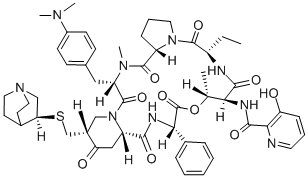
What is Quinupristin?
Description
Quinupristin is a streptogramin antibiotic that blocks peptide bond formation and peptide extension in bacteria. Quinupristin is usually combined with another streptogramin antibiotic, dalfopristin , to produce quinupristin-dalfopristin complex , known commercially as Synercid. While both quinupristin and dalfopristin have bacteriostatic effects, they act synergistically to kill Gram-positive bacteria, as well as some Gram-negative and anaerobic bacteria.
The Uses of Quinupristin
Quinupristin is a semi-synthetic analogue of virginiamycin B (ostreogyrcin B, pristinamycin IA, streptogramin B) formed by a Mannich condensation and elimination to generate an exocyclic methylene alpha to the ketone of the 4-piperidinone. Addition of quinucidinylthiol to the methylene group affords quinupristin. The structural changes provide a more hydrophobic compound with a readily ionisable group for generating a salt. Quinupristin is used commercially in synergistic combination with dalfopristin (30:70). There is little published data on the synthesis, biological or antibiotic activity of quinupristin alone, however the combination product is highly effective, including activity against antibiotic resistant strains.
The Uses of Quinupristin
Semisynthetic depsipeptide type I streptogramin. An antibacterial agent.
The Uses of Quinupristin
Quinupristin is a semi-synthetic analogue of virginiamycin B (ostreogrycin B, pristinamycin IA, streptogramin B) formed by a Mannich condensation and elimination to generate an exocyclic methylene alpha to the ketone of the 4-piperidinone. Addition of quinucidinylthiol to the methylene group affords quinupristin. The structural changes provide a more hydrophobic compound with a readily ionisable group for generating a salt. Quinupristin is used commercially in synergistic combination with dalfopristin (30:70). There is little published data on the synthesis, biological or antibiotic activity of quinupristin alone, however the combination product is highly effective, including activity against antibiotic resistant strains.
Indications
For the treatment of bacterial infections (usually in combination with dalfopristin).
Background
Quinupristin/dalfopristin is a combination of two antibiotics used to treat infections by staphylococci and by vancomycin-resistant Enterococcus faecium. Dalfopristin inhibits the early phase of protein synthesis in the bacterial ribosome and quinupristin inhibits the late phase of protein synthesis. The combination of the two components acts synergistically and is more effective in vitro than each component alone.
What are the applications of Application
Quinupristin is used commercially in synergistic combination with dalfopristin
Pharmacokinetics
Quinupristin is a streptogramin antibiotic, derived from pristinamycin I. By inhibiting the bacterial ribosomal subunits, protein synthesis is inhibited thus leading to eventual bacterial cell death or stasis.
Metabolism
Quinupristin is converted to two conjugated active major metabolites, one with glutathione and one with cysteine.
Properties of Quinupristin
| Melting point: | ~200° |
| form | Solid |
| color | White to off-white |
Safety information for Quinupristin
Computed Descriptors for Quinupristin
New Products
2-Bromo-4-hydroxypyridine 2-Benzyl-1,1,3,3-tetramethylisoindoline AMINO-O-TOLYL-ACETIC ACID AMINO(2-BROMOPHENYL)ACETIC ACID 6-BROMOTETRAZOLO[1,5-A]PYRIDINE 3-Oxocyclobutanecarboxylic acid 1,3-Diazaspiro[4.5]decane-2,4-dione, 8,8-difluoro- AMINO-(3-FLUORO-PHENYL)-ACETIC ACID Pyrrolo[1,2-a]pyrimidine-6-carboxylic acid, 4,6,7,8-tetrahydro-4-oxo-, sodium salt (1:1), (6S) Obidoxime hydrochloride API Piperazine, 1-(3-methoxyphenyl)-, hydrochloride (1:1) Decanoic acid, 2-[4-(phenylmethoxy)phenyl]ethyl ester 2,4-Dihydroxybenzaldehyde 3-Cyano-4-(2-methylpropoxy)benzenecarbothioamide 1-(2, 4-dichlorophenyl)-N-(2, 4-difluorophenyl)-N isopropyl-5-oxo-1H-1, 2, 4-trizole-4(5H)-carboxamide 2,4-Dihydroxyacetophenone 2-Chloro 5-Fluoro Pyridine Vasicinone 2-Chloroisonicotinic Acid Tween 80 or Polysorbate 80 2-Butyn-1-oL N-(4-fluoro-2-methoxy-5-nitrophenyl)-4-(1-methyl-1H-indol-3-yl)pyrimidin-2-amine Pirtobrutinib intd. N-(4-Cyano-3-(trifluoromethyl)phenyl)-2-methyloxirane-2-carboxamideRelated products of tetrahydrofuran

![ETHYL[(1-METHYLPIPERIDIN-2-YL)METHYL]AMINE](https://img.chemicalbook.in/CAS/GIF/66300-62-7.gif)
![Methyl[(1-methylpiperidin-2-yl)methyl]amine](https://img.chemicalbook.in/CAS/GIF/184637-50-1.gif)
You may like
-
 Methyl-2-chloro pyridine-5-carboxylate 98%View Details
58481-11-1 -
14432-16-7 98%View Details
14432-16-7 -
695-34-1 2-Amino 4-Methyl Pyridine 98%View Details
695-34-1 -
2398-81-4 Nicotinic acid N-oxide 98%View Details
2398-81-4 -
9005-64-6 Tween 80 or Polysorbate 80 98%View Details
9005-64-6 -
Tetrahydropiperin 23434-88-0 >98%View Details
23434-88-0 -
N,N,N',N'-Tetramethylmethylenediamine Or Bis(dimethylamino)methane 51-80-9 98%View Details
51-80-9 -
2-Bromo 4-Nitro Pyridine N-Oxide 98%View Details
52092-43-0