
propoxycaine
- CAS NO.:86-43-1
- Empirical Formula: C16H26N2O3
- Molecular Weight: 294.39
- MDL number: MFCD00864426
- EINECS: 201-670-9
- SAFETY DATA SHEET (SDS)
- Update Date: 2026-05-28 03:59:37
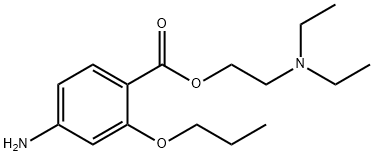
What is propoxycaine ?
Toxicity
The toxicity of this medication (7-8 times higher than that of procaine), has prevented this medication from being used on its own .
Ester-type local anesthetics are much more likely to cause an allergic reaction compared to the amide-group local anesthetics because of the formation of PABA (Para-aminobenzoic acid) during the metabolic process. PABA may cause allergic reactions that range from urticaria to anaphylaxis. PABA is also formed during the metabolism of methylparaben (a common preservative) that is normally found in multi-dose vials including lidocaine (MDV) (amide-type local anesthetic) .
The Uses of propoxycaine
Anesthetic (local) Blockain.
Indications
Propoxycaine is a local anesthetic medication. It was used beginning in the 1950s during dental procedures . It has been combined with procaine to accelerate its onset of action and provide longer-lasting anesthetic effect .
It was produced for use when amide local anesthetics were contraindicated due to allergy or when several amide anesthetics were unsuccessful .
Background
Propoxycaine is a local anesthetic of the ester type that has a rapid onset of action and a longer duration of action than procaine hydrochloride . This drug was removed from the US market in 1996. Although no longer available in the United States, this medication was used in combination with procaine to aid in anesthesia during dental procedures . Used in combination with procaine, it was the only dental local anesthetic available in cartridge form .
Definition
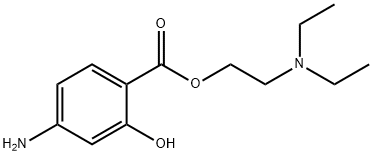
ChEBI: Propoxycaine is a benzoate ester.
brand name
Hydrochloride (Sterling Winthrop); Ravocaine Hydrochloride (Cook-Waite).
Pharmacokinetics
Propoxycaine is a local anesthetic which acts to decrease nerve impulses and therefore pain sensation during dental procedures .
Metabolism
This drug his hydrolyzed in both the plasma and the liver by plasma esterases .
Properties of propoxycaine
| pka | pKa 8.6 (Uncertain) |
Safety information for propoxycaine
| Signal word | Danger |
| Pictogram(s) |
 Skull and Crossbones Acute Toxicity GHS06 |
| GHS Hazard Statements |
H301:Acute toxicity,oral |
| Precautionary Statement Codes |
P264:Wash hands thoroughly after handling. P264:Wash skin thouroughly after handling. P270:Do not eat, drink or smoke when using this product. P301+P310:IF SWALLOWED: Immediately call a POISON CENTER or doctor/physician. P405:Store locked up. P501:Dispose of contents/container to..… |
Computed Descriptors for propoxycaine
New Products
2-(2-Chlorophenyl)glycine Propiolic Acid 1-(3-Hydroxy-4-methoxyphenyl)-2-nitroethene (±)-amino(2-fluorophenyl)acetic acid trans-3-Benzyloxy-4-methoxy-beta-nitrostyrene 1-Pentadecanol 2,4-Dihydroxybenzaldehyde Dipropyl disulfide Pyrrolo[1,2-a]pyrimidine-6-carboxylic acid, 4,6,7,8-tetrahydro-4-oxo-, sodium salt (1:1), (6S) Obidoxime hydrochloride API 4 pentyn 1 ol N-Vinylformamide Methacrylate-PEG-Methacrylate, Mn:35000 2,4-Dihydroxyacetophenone 2-Chloro 5-Fluoro Pyridine Vasicinone 2-Chloroisonicotinic Acid Tween 80 or Polysorbate 80 2-Butyn-1-oL N-(4-Cyano-3-(trifluoromethyl)phenyl)-2-methyloxirane-2-carboxamide N-(4-fluoro-2-methoxy-5-nitrophenyl)-4-(1-methyl-1H-indol-3-yl)pyrimidin-2-amine Pirtobrutinib intd. 2-Pentyn-1-oL 4-NitrobenzotrifluorideRelated products of tetrahydrofuran


You may like
-
 40216-83-9 trans-4-Hydroxy-L-proline methyl ester hydrochloride 98+View Details
40216-83-9 -
471-25-0 Propiolic Acid 98+View Details
471-25-0 -
84145-28-8 98+View Details
84145-28-8 -
trans-3-Benzyloxy-4-methoxy-beta-nitrostyrene 98+View Details
63909-29-5 -
2-(2-Chlorophenyl)glycine 88744-36-9 98+View Details
88744-36-9 -
40216-83-9 trans-4-Hydroxy-L-proline methyl ester hydrochloride 98+View Details
40216-83-9 -
629-76-5 98+View Details
629-76-5 -
1-(3-Hydroxy-4-methoxyphenyl)-2-nitroethene 98+View Details
39816-35-8