
PROPAPHOS
- CAS NO.:7292-16-2
- Empirical Formula: C13H21O4PS
- Molecular Weight: 304.34
- MDL number: MFCD00128923
- SAFETY DATA SHEET (SDS)
- Update Date: 2026-04-10 10:27:14
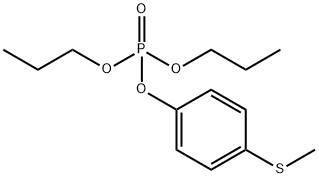
What is PROPAPHOS?
The Uses of PROPAPHOS
Propaphos is used to control rice hoppers and stem borers in rice.
The Uses of PROPAPHOS
Propaphos acts as a pesticide
Definition
ChEBI: Propaphos is an organophosphate insecticide and a dialkyl aryl phosphate. It has a role as an EC 3.1.1.7 (acetylcholinesterase) inhibitor and an agrochemical. It is functionally related to a 4-(methylsulfanyl)phenol.
Metabolic pathway
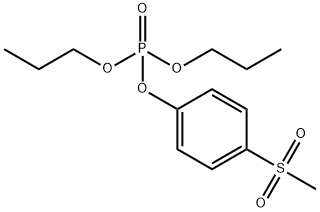
As with other organophosphorus insecticides containing a methylthiosubstituted phenyl group (fenamiphos, fenthion and sulprofos), the principal route of metabolism of is via thiooxidation to the sulfoxide and sulfone. The two pathways for the metabolism of propaphos are degradation by hydrolysis followed by oxidation to give the thiooxidation products of 4-thiomethyphenol and activation yielding propaphos sulfoxide and sulfone. Similar pathways exist in both animals and plants. Phase II metabolism involves the conjugation of the oxidised 4thiomethyl phenols.
Degradation
Propaphos is stable in neutral and acidic solutions but it is slowly hydrolysed
under alkaline conditions (PM).
The photolysis of propaphos has been studied under UV and sunlight
irradiation in aqueous solution (Fujii et al., 1979) and by xenon lamp
irradiation in methanol and aqueous solution (Koshioka et al., 1986).
Under UV irradiation at 254 or 365 nm propaphos was rapidly
decomposed to CO2. Under sunlight irradiation, the photolysis products
were both oxidative and hydrolytic forming propaphos sulfoxide (2),
propaphos sulfone (3), 4-(methy1thio)phenol (4), 4-(methylsulfinyl)-
phenol (5) and 4-(methylsulfonyl)phenol (6) together with unidentified
polar products (Fujii et al., 1979). Using xenon lamp irradiation
of propaphos and its two thiooxidation products, Koshioka et al. (1986)
showed that the photodecomposition of propaphos (1), propaphos
sulfoxide (2) and sulfone (3) was rapid in the near UV (>280 nm) in
aqueous solution, with the main photoproducts being due to oxidation
and hydrolysis. Using GC-MS analysis the following eight metabolites
were identified from the aqueous photolysis of propaphos: the
thiooxidation products propaphos sulfoxide (2) and propaphos sulfone
(3) and the hydrolytic products 4-(methylthio)phenol (4), 4(methylsulfinyl)
phenol (5) and 4-(methylsulfonyl)phenol (6). Additionally, the
methylthio group was lost, probably via the sulfone to give dipropyl
phenyl phosphate (7). Two minor metabolites were identified as 1,4-
benzenediol (8) and 4-hydroxythiophenol (9). Possible pathways for
the photodegradation of propaphos in aqueous solution are shown in
Scheme 1.
Toxicity evaluation
The acute oral LD50 for rats is 70mg/kg. Inhalation LC50 (4 h) for rats is 39.2 mg/m3. NOEL (2yr) for rats is 0.08mg/kg/d. Propaphos orally administered to rats is rapidly excreted, mainly in the urine. The principal metabolic routes of propaphos are oxidation of the sulfide group to the sulfoxide and sulfone, and hydrolysis of phenyl phosphate ester bond in both animals and plants.
Properties of PROPAPHOS
| Melting point: | 25°C |
| Boiling point: | 176°C (rough estimate) |
| Density | approximate 1.14g/mL |
| vapor pressure | 1.2×10⁻⁴ Pa (25 °C) |
| storage temp. | 0-6°C |
| solubility | Chloroform (Slightly), Methanol (Slightly) |
| Water Solubility | 125 mg l-1(25 °C) |
| form | liquid |
| color | Colourless |
| Specific Gravity | approximate 1.14 |
| Stability: | Hygroscopic |
Safety information for PROPAPHOS
Computed Descriptors for PROPAPHOS
New Products
2-Ethoxyphenol Methyl 2-methoxy-5-sulfamoylbenzoate Ethyl 2-chloro-2-(2-(4-methoxyphenyl)hydrazono)acetate 3,6-Dichloropyridazine 3,6-Dichloro-4-Isopropylpyridazine 2-[(2-Ethoxyphenoxy)methyl]oxirane m-Tolualdehyde p-Anisaldehyde 2-Bromobenzaldehyde 4-Fluorobenzaldehyde 1-Propyl-4-piperidone 3-Amino-3-(3-fluorophenyl)propanoic acid 6-Methyl-2-pyridinemethanol 2-Pyridinecarboxaldehdye tert-Butyl ((1R,2S,5S)-2-amino-5-(dimethylcarbamoyl)cyclohexyl)carbamate 1-Indanone 2-Chloromethyl-6-methyl-pyridine 4-Morpholinoaniline Abiraterone Ethyl Ether 1-nitro-3,5-dimethyl adamantine (NMEM) Vardenafil Bis-sulphonamide(Dimer) 3-(2-aminoethyl) benzene sulfonamide Nabumetone Impurity 5 2,2-dibromo-1-cyclopropyl-2-(2-fluorophenyl)ethan-1-oneRelated products of tetrahydrofuran
You may like
-
![3-(4-Bromo-3-methyl-2-oxo-2,3-dihydro-1h-benzo[d]imidazol-1-yl)piperidine-2,6-dione 2304754-51-4 99%+](https://img.chemicalbook.in//Content/image/CP5.jpg) 3-(4-Bromo-3-methyl-2-oxo-2,3-dihydro-1h-benzo[d]imidazol-1-yl)piperidine-2,6-dione 2304754-51-4 99%+View Details
3-(4-Bromo-3-methyl-2-oxo-2,3-dihydro-1h-benzo[d]imidazol-1-yl)piperidine-2,6-dione 2304754-51-4 99%+View Details
2304754-51-4 -
1126-74-5 99%+View Details
1126-74-5 -
2-Fluoro-6-iodobenzoic acid 99%+View Details
111771-08-5 -
120013-39-0 2,3-Dihydro-5,6-dimethoxy-2-(4-piperidinylmethyl)-1H-inden-1-one hydrochloride 99%+View Details
120013-39-0 -
2-pyridineacetonitrile 2739-97-1 99%+View Details
2739-97-1 -
4-FORMYL-N-CBZ-PIPERIDINE 99%+View Details
138163-08-3 -
ethyl 2-oxo-2,3,9,10-tetrahydro-1H-pyrido[3',4':4,5]pyrrolo[1,2,3-de]quinoxaline-8(7H)-carboxylate 313544-31-9 99%+View Details
313544-31-9 -
1-Boc-4-cyanopiperidine 91419-52-2 99%+View Details
91419-52-2