
PRODIGIOSIN
Synonym(s):Casein Kinase I Inhibitor IV, 2-Methyl-3-pentyl-6-methoxyprodigiosene, NSC 47147;Prodigiosin Serratia marcescens - CAS 82-89-3 - Calbiochem
- CAS NO.:82-89-3
- Empirical Formula: C20H25N3O
- Molecular Weight: 323.43
- MDL number: MFCD01740630
- SAFETY DATA SHEET (SDS)
- Update Date: 2026-08-30 11:39:11
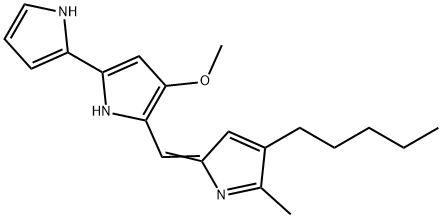
What is PRODIGIOSIN?
The Uses of PRODIGIOSIN
Prodigiosin is an intensely red, pyrrole pigment produced by several bacteria, most notably Serratia marcescens. Prodigiosin has a broad biological profile with activity against fungi, tumour cell lines and malaria. It was shown to be an immunosuppressant in 2007. Prodigiosin acts via caspase inhibition to induce of apoptosis in human primary cancer cells. Prodigiosin also acts as an inducer of p21WAF1/CIP1 expression via transforming growth factor-β receptor pathway, and activates NAG-1 via glycogen synthase kinase-3β.
The Uses of PRODIGIOSIN
Prodigiosin is an intensely red pyrrole pigment produced by several bacteria, most notably Serratia marcescens. Prodigiosin has a broad biological profile with activity against fungi, tumor cell lines and malaria. It was shown to be an immunosuppressant in 2007. Prodigiosin acts via caspase inhibition to induce of apoptosis in human primary cancer cells. Prodigiosin also acts as an inducer of p21WAF1/CIP1 expression via transforming growth factor-β receptor pathway, and activates NAG-1 via glycogen synthase kinase-3β.
The Uses of PRODIGIOSIN
Prodigiosin is a naturally occurring pigment which occurs as a product of Serratia marcescens. Pink colored pigment.
What are the applications of Application
Prodigiosin is a potent proapoptotic compound that also acts as an antibiotic
Definition
ChEBI: A member of the class of tripyrroles that is a red-coloured pigment with antibiotic properties produced by Serratia marcescens.
General Description
A cell-permeable tripyrrole alkaloid compound that displays immunosuppressive and anti-tumor properties irrespective of p53 status and multidrug resistance. Shown to selectively upregulate p21WAF/CIP1 and NAG-1 (nonsteroidal anti-inflammatory drug-activated gene 1) and downregulate survivin expression levels, induce mitochondria-mediated apoptosis and cell cycle arrest in tumor cells. Prevents FADD phosphorylation (IC50 = 2.0 μM in A549-FKR cells) through inhibition of FADD-kinase CK1α (IC50 ~ 6.0 μM in SW620-BGCR cells) and augments cisplatin (Cat. No. 232120)-induced apoptosis. Blocks NF-κB activation by decreasing pIκBα (by 63% at 3 μM) and IκBα levels in A549 cells, and shrinks tumor growth in A549-FKR tumor xenograft mouse model (3 mg/kg, i.p., o.d.).
Enzyme inhibitor
This red bacterial pigment (FWfree-base = 323.44 g/mol; melting point = 151- 152°C) is an antibiotic produced by Serratia marcescens (formerly Chromobacterium prodigiosum). Prodigiosin is the parent member of a class of pyrrole-containing natural products that exhibit immunosuppressive, cytotoxic, and apoptotic activity and can facilitate copper-promoted oxidative double-strand DNA cleavage through reductive activation of Cu2+. They also uncouple lysosomal vacuolar-type ATPases by promoting H+/Cl– symport activity. The solid pigment is dark red and displays a green reflex. Acidic aqueous solutions are also red, but neutral or alkaline solutions are orange-yellow. Target(s): DNA topoisomerase I; DNA topoisomerase II; FoF1 ATPase, or H+-transporting two-sector ATPase, as an uncoupler; H+/K+-ATPase, as an uncoupler; proton translocation, as an uncoupler; and Serratia marcescens nuclease.
Storage
+4°C
Properties of PRODIGIOSIN
| Melting point: | 151-152° |
| Boiling point: | 554.3±50.0 °C(Predicted) |
| Density | 1.12±0.1 g/cm3(Predicted) |
| storage temp. | -20C |
| solubility | Acetonitrile: Soluble; Ethanol: Soluble; Methanol: Soluble |
| form | Dark red solid |
| pka | 17.09±0.50(Predicted) |
| color | Dark red |
Safety information for PRODIGIOSIN
Computed Descriptors for PRODIGIOSIN
New Products
Cyclobutanone (R)-(-)-2-Amino-1-propanol Fmoc-OSu 5-bromo-4-fluoro-2-nitrobenzaldehyde 2-Amino-2-(4-methylphenyl)acetic acid 1-(2-Chloroethyl)pyrrolidine Hydrochloride 2,4-Dihydroxybenzaldehyde Obidoxime hydrochloride API Pyrrolo[1,2-a]pyrimidine-6-carboxylic acid, 4,6,7,8-tetrahydro-4-oxo-, sodium salt (1:1), (6S) Dipropyl disulfide N-Vinylformamide 4 pentyn 1 ol Methacrylate-PEG-Methacrylate, Mn:35000 2,4-Dihydroxyacetophenone 2-Chloro 5-Fluoro Pyridine Vasicinone 2-Chloroisonicotinic Acid Tween 80 or Polysorbate 80 2-Butyn-1-oL N-(4-fluoro-2-methoxy-5-nitrophenyl)-4-(1-methyl-1H-indol-3-yl)pyrimidin-2-amine Pirtobrutinib intd. 2-Pentyn-1-oL 4-Nitrobenzotrifluoride N-(4-Cyano-3-(trifluoromethyl)phenyl)-2-methyloxirane-2-carboxamideRelated products of tetrahydrofuran
![1,3-benzoxazol-2-yl 3-benzyl-3H-[1,2,3]triazolo[4,5-d]pyrimidin-7-yl sulfide](https://img.chemicalbook.in/CAS/20180711/GIF/722456-31-7.gif)


You may like
-
 Prodigiosin Serratia marcescens CAS 82-89-3View Details
82-89-3 -
7250-67-1 1-(2-Chloroethyl)pyrrolidine Hydrochloride 98+View Details
7250-67-1 -
7250-67-1 1-(2-Chloroethyl)pyrrolidine Hydrochloride 98+View Details
7250-67-1 -
13227-01-5 98+View Details
13227-01-5 -
545445-44-1 3-Morpholino-1-(4-(2-oxopiperidin-1-yl) phenyl)-5,6-dihyropyridin-2-(1H)-one 98%View Details
545445-44-1 -
6629-04-5 98%View Details
6629-04-5 -
4-(4-Αminophenyl)-3-Morpholinone 98%View Details
438056-69-0 -
1-(4-Aminophenyl)-3-morpholino-5,6-dihydropyridin-2(1H)-one 1267610-26-3 98%View Details
1267610-26-3