
Poly(4-methyl-1-pentene)
- CAS NO.:25068-26-2
- Empirical Formula: C6H12
- Molecular Weight: 84.15948
- MDL number: MFCD00084382
- SAFETY DATA SHEET (SDS)
- Update Date: 2026-09-12 18:50:31
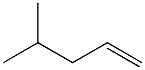
What is Poly(4-methyl-1-pentene)?
Chemical properties
off-white beads
Chemical properties
Poly(4-methyl-1-pentene) was first introduced in 1965 by Imperial Chemical
Industries Ltd (UK) but since 1975 the polymer has been manufactured solely
by Mitsui Petrochemical Industries Ltd. Polymerization is carried out using
a Ziegler-Natta catalyst such as titanium trichloride/diethylaluminium chloride in a hydrocarbon diluent at atmospheric pressure and 30-60°C: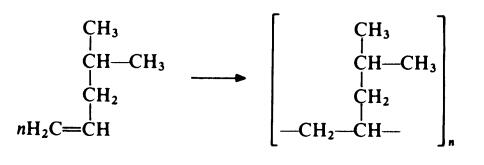
The commercial material contains a comonomer, possibly 1-hexene, which
enhances clarity. The polymer configuration is predominantly isotactic.
Generally, this material has the basic physical properties to be expected
from a crystalline polyolefin but in some respects it offers significant improvements over other polyolefins. One outstanding property of poly(4-methyl-l-pentene) is the very low specific gravity, which at 0.83 is the lowest of current
polymers. The crystalline melting point is 240°C and the Vicat softening
temperature is 179°C; these high values mean that a useful form stability is
maintained up to about 200°C. The transparency of the polymer is of a high
order, being comparable to poly(methyl methacrylate) and polystyrene.
Poly(4-methyl-l-pentene) exhibits resistance to oxidizing and other chemical
environments broadly similar to that shown by polypropylene; however,
poly(4-methyl-l-pentene) does undergo environmental stress cracking
comparable to low density polyethylene. The permeability of poly(4-methyl-I-pentene) to gases and water vapour is considerably higher than that for
other polyolefins. Poly(4-methyl-l-pentene) may be extruded and injection
moulded using standard equipment. The material has been used in several
applications where transparency and heat resistance are required, e.g. medical and laboratory ware.
The Uses of Poly(4-methyl-1-pentene)
Coating for paper food containers for microwave and conventional ovens. Release coatings for food and synthetic leather. Molded into medical labware. Film for decorative laminates and printed circuit boards.
Properties of Poly(4-methyl-1-pentene)
| Melting point: | 240 °C |
| Boiling point: | 0.83 °C |
| Density | 0.835 g/mL at 25 °C |
| refractive index | n |
| form | Beads |
| color | Clear |
| CAS DataBase Reference | 25068-26-2 |
| EPA Substance Registry System | 1-Pentene, 4-methyl-, homopolymer (25068-26-2) |
Safety information for Poly(4-methyl-1-pentene)
Computed Descriptors for Poly(4-methyl-1-pentene)
New Products
9-Mesityl-10-methylacridinium perchlorate Sulfapyridine Fmoc-OSu (R)-(-)-2-Amino-1-propanol Cyclobutanone 5-bromo-4-fluoro-2-nitrobenzaldehyde 4 pentyn 1 ol N-Vinylformamide Phenethyl cinnamate Pyrrolo[1,2-a]pyrimidine-6-carboxylic acid, 4,6,7,8-tetrahydro-4-oxo-, sodium salt (1:1), (6S) Ethyl 3-phenylpropanoate β-Bromostyrene Methacrylate-PEG-Methacrylate, Mn:35000 2,4-Dihydroxyacetophenone 2-Chloro 5-Fluoro Pyridine Vasicinone 2-Chloroisonicotinic Acid Tween 80 or Polysorbate 80 5-Bromo-1-Pentyne 1-(2-Methyl-5-nitrophenyl)guanidine Nitrate Methyl trans-4-Aminocyclohexanecarboxylate Hydrochloride N-(4-Cyano-3-(trifluoromethyl)phenyl)-2-methyloxirane-2-carboxamide 4-Nitrobenzotrifluoride 2-Pentyn-1-oLRelated products of tetrahydrofuran




You may like
-
 Poly(4-methyl-1-pentene) CAS 25068-26-2View Details
25068-26-2 -
1191-95-3 Cyclobutanone 98+View Details
1191-95-3 -
Fmoc-OSu 98+View Details
82911-69-1 -
(R)-(-)-2-Amino-1-propanol 35320-23-1 98+View Details
35320-23-1 -
1191-95-3 Cyclobutanone 98+View Details
1191-95-3 -
213382-45-7 98+View Details
213382-45-7 -
Fmoc-OSu 98+View Details
82911-69-1 -
(R)-(-)-2-Amino-1-propanol 35320-23-1 98+View Details
35320-23-1