
POLY-p-PHENYLENE TEREPHTHALAMIDE
- CAS NO.:24938-64-5
- Empirical Formula: (C14H10N2O2)n
- Molecular Weight: 0
- Update Date: 2025-12-17 09:49:30

What is POLY-p-PHENYLENE TEREPHTHALAMIDE?
Chemical properties
Poly(p-phenylene terephthalamide) is an extraordinarily strong material. The specific tensile strength (tensile strength/density) of the fibre is higher than that of any other continuous fibre commercially available. The polymer does not melt but begins to carbonize at about 425°C. The material retains its mechanical properties over a wide temperature range for prolonged periods. There is little change up to about 180°C and even at 250°C approximately half of the initial tensile strength is retained after 100 hours. The material is attacked by mineral acids and alkalis and is also sensitive to ultraviolet light.
The Uses of POLY-p-PHENYLENE TEREPHTHALAMIDE
Poly(p-phenylene terephthalamide) fibres currently have three major applications, namely as reinforcement in radial tyres and mechanical rubber goods, in ballistic protective fabrics and ropes, and as reinforcement in polymer (particularly epoxy) composites for aircraft and aerospace components.
Preparation
Poly(p-phenylene terephthalamide) is produced by reaction of terephthaloyl
chloride and p-phenylenediamine:
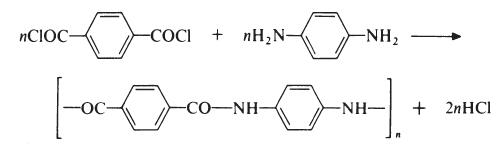
Full details of the manufacture of the polymer have not been disclosed. The reaction is reported to be carried out in a solvent mixture of hexamethylphosphoramide and N -methylpyrrolidone. The polymer is supplied in fibre form. Poly(p-phenylene terephthalamide) is an extraordinarily strong material.
Properties of POLY-p-PHENYLENE TEREPHTHALAMIDE
| Melting point: | 550.7 °C |
| Density | 1.45 g/cm3 |
| IARC | 3 (Vol. 68) 1997 |
| EPA Substance Registry System | Poly(imino-1,4-phenyleneiminocarbonyl-1,4-phenylenecarbonyl) (24938-64-5) |
Safety information for POLY-p-PHENYLENE TEREPHTHALAMIDE
Computed Descriptors for POLY-p-PHENYLENE TEREPHTHALAMIDE
New Products
9-Mesityl-10-methylacridinium perchlorate Sulfapyridine Fmoc-OSu (R)-(-)-2-Amino-1-propanol Cyclobutanone 5-bromo-4-fluoro-2-nitrobenzaldehyde 4 pentyn 1 ol N-Vinylformamide Phenethyl cinnamate Pyrrolo[1,2-a]pyrimidine-6-carboxylic acid, 4,6,7,8-tetrahydro-4-oxo-, sodium salt (1:1), (6S) Ethyl 3-phenylpropanoate β-Bromostyrene Methacrylate-PEG-Methacrylate, Mn:35000 2,4-Dihydroxyacetophenone 2-Chloro 5-Fluoro Pyridine Vasicinone 2-Chloroisonicotinic Acid Tween 80 or Polysorbate 80 5-Bromo-1-Pentyne 1-(2-Methyl-5-nitrophenyl)guanidine Nitrate Methyl trans-4-Aminocyclohexanecarboxylate Hydrochloride N-(4-Cyano-3-(trifluoromethyl)phenyl)-2-methyloxirane-2-carboxamide 4-Nitrobenzotrifluoride 2-Pentyn-1-oLRelated products of tetrahydrofuran

You may like
-
 1191-95-3 Cyclobutanone 98+View Details
1191-95-3 -
213382-45-7 98+View Details
213382-45-7 -
Fmoc-OSu 98+View Details
82911-69-1 -
(R)-(-)-2-Amino-1-propanol 35320-23-1 98+View Details
35320-23-1 -
1191-95-3 Cyclobutanone 98+View Details
1191-95-3 -
213382-45-7 98+View Details
213382-45-7 -
Fmoc-OSu 98+View Details
82911-69-1 -
(R)-(-)-2-Amino-1-propanol 35320-23-1 98+View Details
35320-23-1