
PINOCARVEOL
- CAS NO.:5947-36-4
- Empirical Formula: C10H16O
- Molecular Weight: 152.23
- MDL number: MFCD00800007
- EINECS: 227-705-8
- SAFETY DATA SHEET (SDS)
- Update Date: 2026-05-24 22:25:33
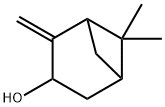
What is PINOCARVEOL?
Chemical properties
2(10)-Pinen-3-ol has a warm, woody, balsamic, slightly piney, fennel-like odor.
Occurrence
Reported found in grapefruit peel oil, bilberries, black currant (buds), other types of ginger, Scotch spearmint oil, pepper, Thymus vulgaris L., hop oil, cognac, myrtle leaf and Roman chamomile.
The Uses of PINOCARVEOL
This cyclic terpene alcohol, pinocarveol, has been used in perfume compositions. The material has also been commercially available as an intermediate.
Definition
ChEBI: A pinane monoterpenoid that is a bicyclo[3.1.1]heptane substituted by two methyl groups at position 6, a methylidene group at position 2 and a hydroxy group at position 3.
Production Methods
Pinocarveol is produced from Pinyl aminoacetate or -nitrate with Nitrous acid, by isolation from Eucalyptus oil tail fractions, by Meerwein-Ponndorf-Verley reduction of Pinocarvone, or by Autoxidation of beta-Pinene with Cobalt siccative or by oxidation with Selenium oxide.
Taste threshold values
Taste characteristics at 25 ppm: camphoraceous, woody, pine-like with fresh, cooling minty undernotes
Flammability and Explosibility
Non flammable
Properties of PINOCARVEOL
| Melting point: | 7 °C |
| Boiling point: | 101.5-102.5 °C(Press: 20 Torr) |
| Density | 0.9730 g/cm3 |
| vapor pressure | 13.9Pa at 24℃ |
| FEMA | 3587 | 2(10)-PINEN-3-OL |
| solubility | Insoluble in water, soluble in alcohol and oils. |
| form | Viscous, slightly yellowish or pale straw-coloured oil. |
| pka | 14.91±0.40(Predicted) |
| Odor | at 100.00 %. herbal camphor woody pine balsam |
| Water Solubility | 1.22g/L at 24℃ |
| JECFA Number | 1403 |
| EPA Substance Registry System | Bicyclo[3.1.1]heptan-3-ol, 6,6-dimethyl-2-methylene- (5947-36-4) |
Safety information for PINOCARVEOL
Computed Descriptors for PINOCARVEOL
New Products
2-(2-Chlorophenyl)glycine Propiolic Acid 1-(3-Hydroxy-4-methoxyphenyl)-2-nitroethene (±)-amino(2-fluorophenyl)acetic acid trans-3-Benzyloxy-4-methoxy-beta-nitrostyrene 1-Pentadecanol 4-(4-Αminophenyl)-3-Morpholinone 3-Morpholino-1-(4-(2-oxopiperidin-1-yl) phenyl)-5,6-dihyropyridin-2-(1H)-one 1-(4-Aminophenyl)-3-morpholino-5,6-dihydropyridin-2(1H)-one N-cyanoacetylurethane 1H-IndazoleRelated products of tetrahydrofuran

You may like
-
 40216-83-9 trans-4-Hydroxy-L-proline methyl ester hydrochloride 98+View Details
40216-83-9 -
471-25-0 Propiolic Acid 98+View Details
471-25-0 -
84145-28-8 98+View Details
84145-28-8 -
trans-3-Benzyloxy-4-methoxy-beta-nitrostyrene 98+View Details
63909-29-5 -
2-(2-Chlorophenyl)glycine 88744-36-9 98+View Details
88744-36-9 -
40216-83-9 trans-4-Hydroxy-L-proline methyl ester hydrochloride 98+View Details
40216-83-9 -
629-76-5 98+View Details
629-76-5 -
1-(3-Hydroxy-4-methoxyphenyl)-2-nitroethene 98+View Details
39816-35-8