
3-Heptanol
Synonym(s):Butyl ethyl carbinol
- CAS NO.:589-82-2
- Empirical Formula: C7H16O
- Molecular Weight: 116.2
- MDL number: MFCD00004586
- EINECS: 209-661-1
- SAFETY DATA SHEET (SDS)
- Update Date: 2026-10-13 16:36:52
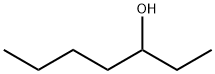
What is 3-Heptanol?
Description
3-Heptanol has a powerful, herbaceous odor and a pungent, slightly bitter taste. May be prepared through catalytic hydrogenation of ethyl-n-butyl ketone.
Chemical properties
Colorless, oily liquid
Chemical properties
3-Heptanol has a powerful, herbaceous odor and a pungent, slightly bitter taste.
Occurrence
Reported found in banana, papaya, French fried potato, peppermint oil, butter, fried or grilled beef, cognac, coffee, peated malt and rooibus tea (Aspalathius linearis)
The Uses of 3-Heptanol
3-Heptanol can be used:
- As a solvent to form microenvironments around single-walled carbon nanotubes.
- To prepare substituted pyrimidine derivatives as C1 domain-targeted isophthalate analogs to study their binding affinities towards PKCα?isoform.
- As a building block to synthesize 4-(3-adamantan-1-yl-ureido)-butyric acid and cyclohexanecarboxylic acid derivatives as sEH inhibitors.
The Uses of 3-Heptanol
Flotation frother, solvent and diluent in organic coatings, intermediates.
Preparation
By catalytic hydrogenation of ethyl-n-butyl ketone.
Definition
ChEBI: Heptan-3-ol is a secondary alcohol.
Aroma threshold values
240 to 410 ppb.
Synthesis Reference(s)
The Journal of Organic Chemistry, 30, p. 3760, 1965 DOI: 10.1021/jo01022a038
Synthetic Communications, 26, p. 1065, 1996 DOI: 10.1080/00397919608003713
General Description
3-Heptanol is the main biotransformation product of n-heptane.
Hazard
Toxic by ingestion. Moderate fire risk.
Biochem/physiol Actions
Odor at 1.0%
Metabolism
In the rabbit, heptan-l-ol is metabolized partly by direct conjugation with glucuronic acid to form an ether glucuronide and mainly by oxidation to the carboxylic acid, which either undergoes further oxidation to CO2 or forms an ester glucuronide
Properties of 3-Heptanol
| Melting point: | -70°C |
| Boiling point: | 66 °C/20 mmHg (lit.) |
| Density | 0.821 g/mL at 20 °C
0.818 g/mL at 25 °C (lit.) |
| refractive index | n |
| FEMA | 3547 | 3-HEPTANOL |
| Flash point: | 130 °F |
| storage temp. | 2-8°C |
| solubility | Chloroform, Methanol (Sparingly) |
| pka | 15.31±0.20(Predicted) |
| form | neat |
| color | Colorless to Almost colorless |
| Odor | at 1.00 % in dipropylene glycol. powerful herbal |
| Water Solubility | 3.984g/L(25 ºC) |
| JECFA Number | 286 |
| BRN | 1719067 |
| Dielectric constant | 6.8600000000000003 |
| CAS DataBase Reference | 589-82-2(CAS DataBase Reference) |
| EPA Substance Registry System | 3-Heptanol (589-82-2) |
Safety information for 3-Heptanol
| Signal word | Warning |
| Pictogram(s) |
 Flame Flammables GHS02  Exclamation Mark Irritant GHS07 |
| GHS Hazard Statements |
H226:Flammable liquids H302:Acute toxicity,oral |
| Precautionary Statement Codes |
P210:Keep away from heat/sparks/open flames/hot surfaces. — No smoking. |
Computed Descriptors for 3-Heptanol
New Products
2-(2-Chlorophenyl)glycine Propiolic Acid 1-(3-Hydroxy-4-methoxyphenyl)-2-nitroethene (±)-amino(2-fluorophenyl)acetic acid trans-3-Benzyloxy-4-methoxy-beta-nitrostyrene 1-Pentadecanol 4-(4-Αminophenyl)-3-Morpholinone 3-Morpholino-1-(4-(2-oxopiperidin-1-yl) phenyl)-5,6-dihyropyridin-2-(1H)-one 1-(4-Aminophenyl)-3-morpholino-5,6-dihydropyridin-2(1H)-one N-cyanoacetylurethane 1H-IndazoleRelated products of tetrahydrofuran



You may like
-
 3-Heptanol CAS 589-82-2View Details
589-82-2 -
3-Heptanol CAS 589-82-2View Details
589-82-2 -
471-25-0 Propiolic Acid 98+View Details
471-25-0 -
84145-28-8 98+View Details
84145-28-8 -
trans-3-Benzyloxy-4-methoxy-beta-nitrostyrene 98+View Details
63909-29-5 -
2-(2-Chlorophenyl)glycine 88744-36-9 98+View Details
88744-36-9 -
40216-83-9 trans-4-Hydroxy-L-proline methyl ester hydrochloride 98+View Details
40216-83-9 -
1-(3-Hydroxy-4-methoxyphenyl)-2-nitroethene 98+View Details
39816-35-8