
Pinacidil
- CAS NO.:85371-64-8
- Empirical Formula: C13H21N5O
- Molecular Weight: 263.35
- MDL number: MFCD00242745
- EINECS: 622-053-4
- SAFETY DATA SHEET (SDS)
- Update Date: 2026-07-16 07:06:08
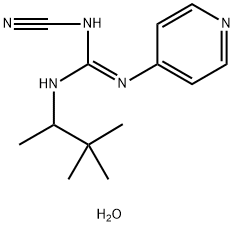
What is Pinacidil?
Description
Pinacidil is a peripheral vasodilator useful in the management of arterial hypertension of all degrees of seventy, usually in combination with a diuretic or beta-blocker. Preclinical evidence suggests that its hypotensive effect may be attributed to potassium channel activation.
Originator
Leo (Denmark)
The Uses of Pinacidil
Pinacidil Monohydrate is a K+ channel opener, used to induce relaxation of serotonin-produced contractions in porcine and human arterial rings. Vasodilator. Antihypertensive agent.
The Uses of Pinacidil
cardiac stimulant
The Uses of Pinacidil
Pinacidil monohydrate has been used:
- in repolarization studies by infusing into left anterior descending artery (LAD)
- to induce ATP-sensitive K+ (KATP) current in ventricular myocytes for electrophysiological studies
- as a KATP opener to treat myocardial cells
What are the applications of Application
Pinacidil monohydrate is a K+ channel activator
Definition
ChEBI: Pinacidil is an organic molecular entity.
brand name
Pindac (Leo).
Biochem/physiol Actions
Pinacidil is a KATP channel agonist. It protects cardiomyocytes by preventing loss of mitochondrial membrane potential. It prevents the caspase 3 activation in hypoxia/reoxygenation injury.
References
1) Hermsmeyer et al. (1988), Pinacidil actions on ion channels in vascular muscle; J. Cardiovasc. Pharmacol., 12(Suppl. 2) S17 2) Gollasch et al. (1995), Pinacidil relaxes porcine and human coronary arteries by activating ATP-dependent potassium channels in smooth muscle cells; J. Pharmacol. Exp. Therap., 275 681 3) Cohen & Kurz (1988), Pinacidil-induced vascular relaxation: comparison to other vasodilators and to classical mechanisms of vasodilation; J. Cardiovasc. Pharmacol., 12(Suppl. 2) S5 4) Teshima et al. (2003), Mitochondrial ATP-sensitive potassium channel activation protects cerebellar granule neurons from apoptosis induced by oxidative stress; Stroke, 34 1796 5) Xie et al. (2010), K(ATP) channel openers protect mesencephalic neurons against MPP+-induced cytotoxicity via inhibition of ROS protection; J. Neurosci. Res., 88 428 6) Zhang et al. (2008), Effects of ATP sensitive potassium channel opener on the mRNA and protein expressions of caspase-12 after cerebral ischemia-reperfusion in rats; Neurosci. Bull., 24 7
Properties of Pinacidil
| Melting point: | 164-165° |
| storage temp. | RT |
| solubility | ethanol: 14 mg/mL |
| pka | pKa 空 (Uncertain) |
| form | solid |
| color | white |
| Stability: | Stable for 1 year from date of purchase as supplied. Solutions in DMSO or ethanol may be stored at -20°C for up to 2 months. |
| CAS DataBase Reference | 85371-64-8(CAS DataBase Reference) |
Safety information for Pinacidil
| Signal word | Warning |
| Pictogram(s) |
 Exclamation Mark Irritant GHS07 |
| GHS Hazard Statements |
H302:Acute toxicity,oral H315:Skin corrosion/irritation H319:Serious eye damage/eye irritation H335:Specific target organ toxicity, single exposure;Respiratory tract irritation |
| Precautionary Statement Codes |
P261:Avoid breathing dust/fume/gas/mist/vapours/spray. P264:Wash hands thoroughly after handling. P264:Wash skin thouroughly after handling. P270:Do not eat, drink or smoke when using this product. P301+P312:IF SWALLOWED: call a POISON CENTER or doctor/physician IF you feel unwell. P302+P352:IF ON SKIN: wash with plenty of soap and water. P305+P351+P338:IF IN EYES: Rinse cautiously with water for several minutes. Remove contact lenses, if present and easy to do. Continuerinsing. |
Computed Descriptors for Pinacidil
New Products
9-Mesityl-10-methylacridinium perchlorate Sulfapyridine Fmoc-OSu (R)-(-)-2-Amino-1-propanol Cyclobutanone 5-bromo-4-fluoro-2-nitrobenzaldehyde 4 pentyn 1 ol N-Vinylformamide Phenethyl cinnamate Pyrrolo[1,2-a]pyrimidine-6-carboxylic acid, 4,6,7,8-tetrahydro-4-oxo-, sodium salt (1:1), (6S) Ethyl 3-phenylpropanoate β-Bromostyrene Methacrylate-PEG-Methacrylate, Mn:35000 2,4-Dihydroxyacetophenone 2-Chloro 5-Fluoro Pyridine Vasicinone 2-Chloroisonicotinic Acid Tween 80 or Polysorbate 80 Methyl trans-4-Aminocyclohexanecarboxylate Hydrochloride N-(4-fluoro-2-methoxy-5-nitrophenyl)-4-(1-methyl-1H-indol-3-yl)pyrimidin-2-amine Pirtobrutinib intd. 4-Nitrobenzotrifluoride 2-Pentyn-1-oL N-(4-Cyano-3-(trifluoromethyl)phenyl)-2-methyloxirane-2-carboxamideRelated products of tetrahydrofuran
![2-[4-(1,3-Benzodioxol-5-ylmethyl)piperazin-1-yl]pyrimidine](https://img.chemicalbook.in/CAS/GIF/3605-01-4.gif)

You may like
-
 Pinacidil monohydrate >95% CAS 85371-64-8View Details
85371-64-8 -
Pinacidil monohydrate CAS 85371-64-8View Details
85371-64-8 -
Fmoc-OSu 98+View Details
82911-69-1 -
(R)-(-)-2-Amino-1-propanol 35320-23-1 98+View Details
35320-23-1 -
1191-95-3 Cyclobutanone 98+View Details
1191-95-3 -
213382-45-7 98+View Details
213382-45-7 -
Fmoc-OSu 98+View Details
82911-69-1 -
(R)-(-)-2-Amino-1-propanol 35320-23-1 98+View Details
35320-23-1